I paid homage to the Great Noble Council of Akanitta Brahma Realm
Connected Discourses, Mahavagga (The Great Book), Bojjangasamyutta, Bojjangavagga, Aggi Sutta (Fire)
On an occasion bhikkhus, when the mind becomes excited (Uddata cittaṃ) it is untimely to develop the enlightenment factor of discrimination of states (dhammavichaya), the enlightenment factor of effort (viriya), and the enlightenment factor of rapture (priti). For what reason? Because the mind is excited, bhikkhus, it is difficult to calm it with those things.
Suppose, bhikkhus, a man wants to extinguish a great bonfire. If he throws dry grass, dry cowdung, and dry timber into it, blows on it, and does not scatter soil over it, would he be able to extinguish that great bonfire?”
“No venerable sir.”
“So too, bhikkhus, on an occasion when the mind becomes excited, it is untimely to develop the enlightenment factor of discrimination of states (dhammavichaya), the enlightenment factor of effort (viriya), and the enlightenment factor of rapture (priti). For what reason? Because the mind is excited, bhikkhus, and it is difficult to calm it down with those things.
“On an occasion, bhikkhus, when the mind becomes excited, it is timely to develop the enlightenment factor of tranquillity, the enlightenment factor of concentration, and the enlightenment factor of equanimity. For what reason? Because the mind is excited, bhikkhus, and it is easy to calm it down with those things.
“Suppose, bhikkhus, a man wants to extinguish a great bonfire. If he throws wet grass, wet cowdung, and wet timber into it, sprays it with water, and scatters soil over it, would he be able to extinguish that great bonfire?”
“Yes, venerable sir.”
“So too, bhikkhus, on an occasion when the mind becomes excited, it is timely to develop the enlightenment factor of tranquility, the enlightenment factor of concentration, and the enlightenment factor of equanimity. For what reason? Because the mind is excited, bhikkhus, and it is easy to calm it down with those things.
“But mindfulness, bhikkhus, I say is always useful.”
Why was that said? The enlightenment factor of discrimination of states, the enlightenment factor of effort and the enlightenment factor of rapture meditations have nibbana itself as the foremost condition. The scattered mind must first be concentrated. This is twofold. If the mind is scattered due to lust provoking delight, it should be understood, like the story of the slave and the musical event. Knowing the nature of state of concentration is superior to lust provoking delight, such lust provoking delight should be replaced and surpassed using the concentration.
If there is an arising of a restlessness nature due to gratifying faculty (assādiyākindriya), by using a doctrine like tranquility of body, the calm mind should not be allowed to become dependent origination. The dependent origination has to be avoided.
Here the mind turned to page 8 of Power due to analysis of investigation as a basis diagrams (Vīmaṃsiddhipāda) discussed on 06/12/2013 (Topic -Iddhipada-vibhanga Sutta - Analysis of the Bases of Power). Remembered the desire that was overly active (atippaggahito Chando). Use concentration founded on desire (chanda samadhi) here to control sense faculties so that we will not have covetousness for the result of sick perceptions. Here we should consider both results arising due to sick perceptions. This two-fold result of taking as self (atta) is lust and delusion, as explained in the meditation of 26/03/2021.
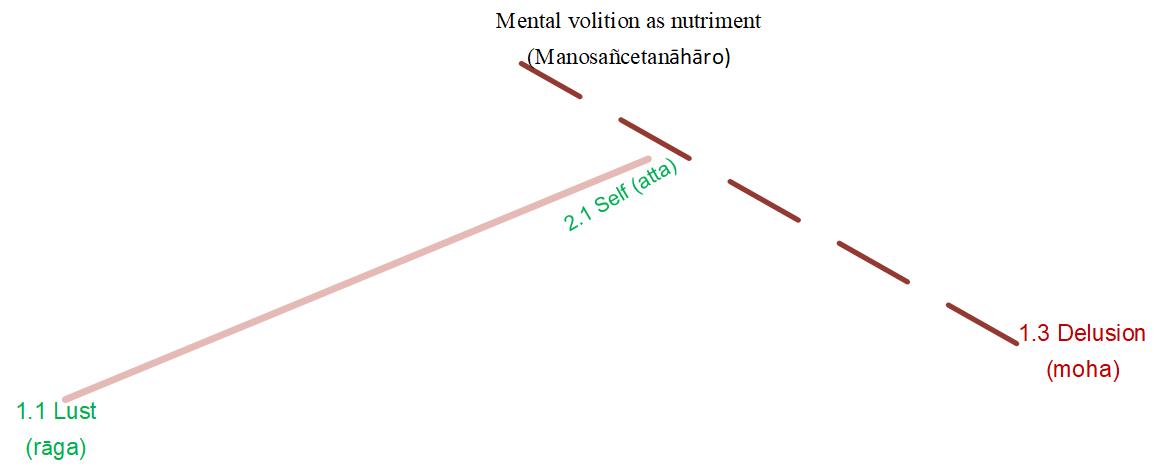
Now, you recall the diagram here where, below the mental volition as nutriment you have 2.1, self (atta), to the right in the diagram you have 1.3, delusion (moha) and to the left of it you have 1.1, lust (raga). Here lust considers the existence of element of heat as profitable (Radiance due to concentration has become the subject). Here the delusion is delusional by regarding the volitional formations constructing concentration as permanent.
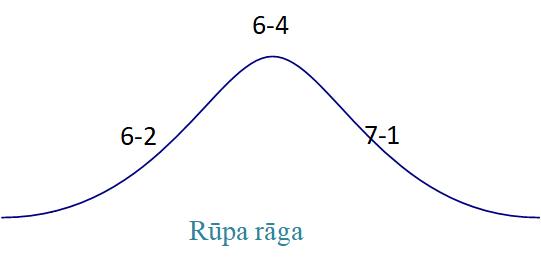
Now the form-lust (rupa-raga) curve mentioned in the meditation of 01/04/2018, comes to mind. Here, in round 4 step 4, pleasure enters into misapprehension. We regard it as self (atta) in round 5 step 5. In round 6 we take this gain due to taking as self exists. This gives rise to lust in form. Then pleasure (suka) enters misapprehension and during round 6 step 4 (6.4) it will escalate and peak. If you take care not to go through 8 rounds, then Nibbana could be reached.
This is the meditation I did.
To add more points to this:
1) In the case of lust provoking delight then the enlightenment factor of concentration (samādhi sambojjhaṅga), arising due to concentration with thinking and exploring (savitakka–savicāra samādhi) can be used.
2) In the case that there is an arising of a restlessness nature due to gratifying faculty (assādiyākindriya), the concentration without thinking and exploring (avitakka avicāra samādhi) can be used. The sign of non-dispersal (abyagganimitta) should be investigated.
3) In the case of lust provoking delight, meditating with mind focused on the sign of quiet (samatha nimitta), by means of concentration with thinking and exploring (savitakka–savicāra samādhi), by not adding permanency to the form, by understanding it as in the example of the slave, one can overcome the lust provoking delight.
4) In the case that there is an arising of a restlessness nature due to gratifying faculty (assādiyākindriya), by meditating with mind focused on the sign of non-dispersal (abyagganimitta) the mind does not establish in volitional formations, with the thinning of volitional formations arising from ignorance and if the equanimity is powerful enough to discard any jhana level as not mine, then by exceeding the subtle nature of the elements, one would have Nibbana as object and only Nibbana as goal. Here, in the case of lust provoking delight, even if one says that I do not want this, one may still allow a thought like, ‘if not apple, I will take orange instead’, the various oranges, that is, because the volitional formations (sankhara) that produce the various jhana planes were cultivated before, the mind is inclined not to repeat them, just as one letting go of every plane that is seen, thinking, ‘this too is not mine’, one should remove the attachment there, the element of cohesion (apo-dhātu), that is, the element that causes binding, should be removed so that one would have nibbana as object and only nibbana as goal, thereby bringing about the direct realization of nibbana.