The Noble Council of Akanittha Brahma Realm was remembered with faith.
I repeated the 20/12/2024 Nibbāna meditation. In there, when examining the doctrine “focused awareness” (cetaso abhiniropanā) where one establishes mindfulness that the first column in the dukkha table should not occur, just as karmic consequences take effect after eating a sambol (spicy condiment) and praising it, when contemplating that it is not worth dying and being reborn, one should keep in mind that there are consequences in the form of kamma when one praises the birth following death in previous existences.
What is being praised here is the new baby type soft body that a person whose body has become worn out receives. There should be adequate investigation (vimaṃsā) to highlight its danger. Keep in mind that some people may also see a woman's vagina here.
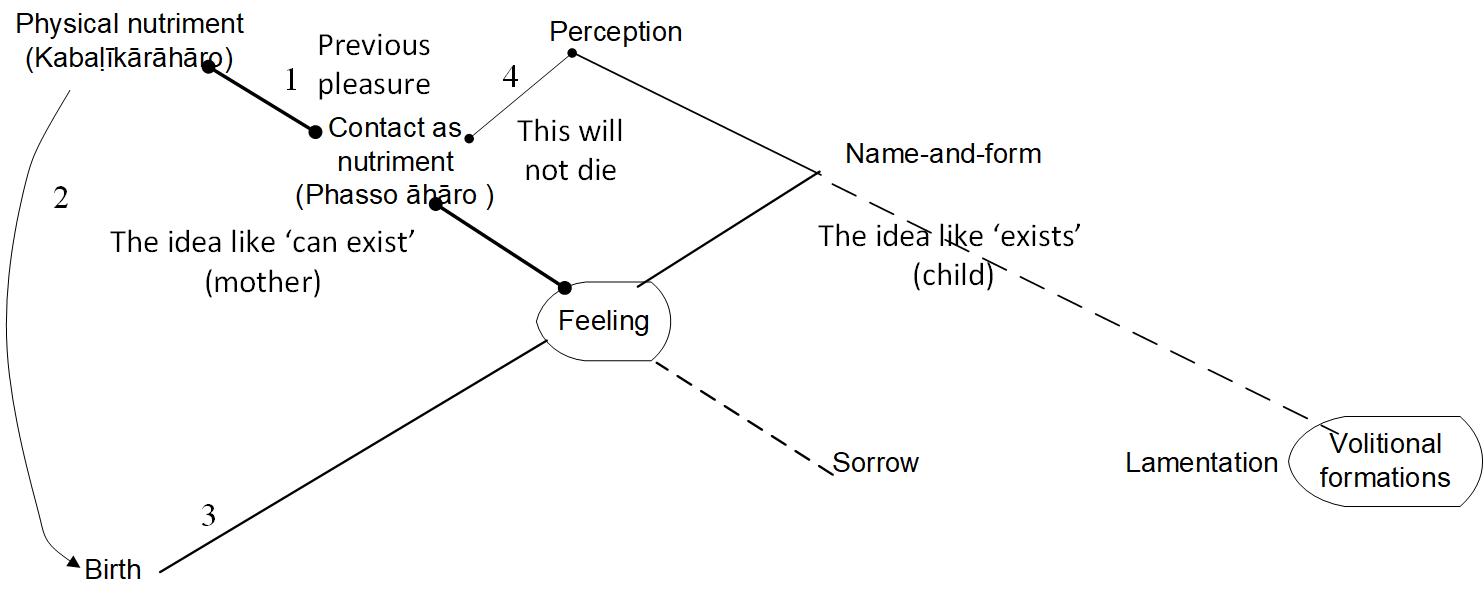
This can be well understood by examining this with the diagram given in the 14/07/2015 Nibbāna meditation,
That is, examine paths 1, 2, 3, and 4. When there is a certain doctrine arising due to sorrow, delight (nandi) arises through its progression towards going a bad way through desire (chanda-agati). Furthermore, we were examining the stoppage at point A at the moment, meaning examining the first round where we have, with ignorance as condition, volitional formations (avijjā paccaya saṅkhāra) and with volitional formations as condition, consciousness (saṅkhāra paccaya viññāṇam), to avoid creating volitional formations (saṅkhāra), one should have not proceeded from area 2 to area 6. Examine this together with the anusaya diagram.
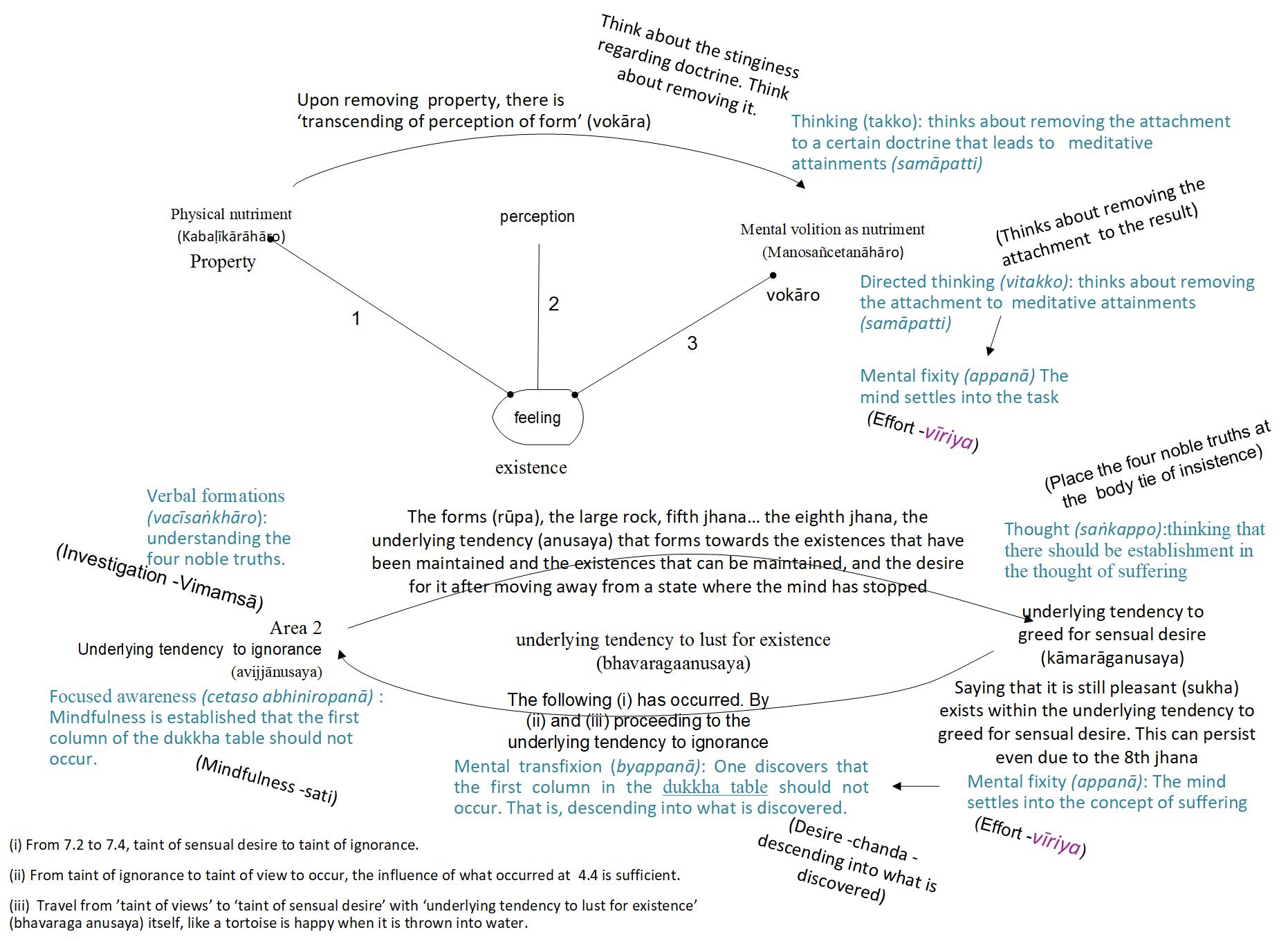
Volitional formations (saṅkhāra) are only created if we go to area 6, and this is a doctrine that should be avoided, having known with profound wisdom. This is also provided through the dhamma in the dukkha table. How? Examine slide 2 of the dukkha table.
There, we have learned about clinging to volition formations (saṅkhāra) due to elements (dhātu), and the misapprehension of elements (dhātu) because of the volitional formations that arise in this way. Knowing this, through right thought (sammā sankappa), one does not allow the mind to undertake any element (dhātu). The right thought (sammā-saṅkappa) should be nourished to the extent mentioned in the 10/01/2025 Nibbāna meditation.
That is the meditation.
To add a little more to this,
1. When practicing this meditation, examining the removal of stinginess regarding doctrine (dhammamacchariya) by contemplating on paths 1, 2, 3 in the diagram given in the 14/07/2015 Nibbāna meditation, together with the dhamma part; ‘directed thinking’ (vitakko) from the 10/01/2025 Nibbāna meditation, a change was felt like one luminous state falling upon another luminous state that was already being experienced. This occurs due to two types of dhamma processes. Firstly, liberation through wisdom (paññā-vimutti) falling upon liberation of mind (ceto-vimutti). Secondly, with directed thinking (vitakko), when thinking about removing the meditative attainments (samāpatti), liberation of mind (ceto-vimutti) falling upon liberation through wisdom (paññā-vimutti). Although there are differences in these luminosities, there is no discrimination between them. (*1)
2. Receiving the newly baby-like soft body; this is connected with the underlying tendency to lust for existence (Bhavarāga-anusaya).
3. If we go to area 6 then we create volitional formations (sankhāra). The desire to go from area 2 to area 6 occurs through underlying tendencies (anusaya dhamma).
It is unsuitable to consider that we are in area 6 when performing volitional formations (sankhāra) like killing (pāṇātipāta). That is, when creating any mental formations (citta sankhāra), they definitely include feeling values. If so, the name-and-form (nāmarūpa) region should be examined. For that, one should only recall that there is some prompting or influence from area 6. This is well understood when thinking in terms of layers.
Mental formations (citta sankhāra) that arise with ignorance (avijjā) as the condition are nourished by verbal formations (vacī sankhāra). If bodily formations (kāya sankhāra) are added to this, it's like being covered by another layer. Thus, the influence increases.
That's what needs to be added.
Footnotes added during the discussion
(*1) If I am to add little more here, thinking (takko)- giving up stinginess regarding doctrine (dhammamacchariya) one would get liberation of mind (ceto-vimutti). By abandoning this, one abandons a meditative attainment that is the liberation through wisdom. In ‘directed thinking’ (vitakko) abandoning a meditative attainment, one would get liberation through wisdom, and liberation of mind (ceto-vimutti) that occurs due to removal of stinginess regarding doctrine (dhammamacchariya) falls upon it.