The Noble Council of Akanittha Brahma Realm was remembered with faith.
I repeated the meditation of 17/01/2025. As mentioned in there, when contemplating that it is not worth dying and being reborn, one should keep in mind that there are consequences in the form of kamma when one praises the birth following death in previous existences. I recalled, there should be adequate investigation (vimaṃsā) to highlight its danger.
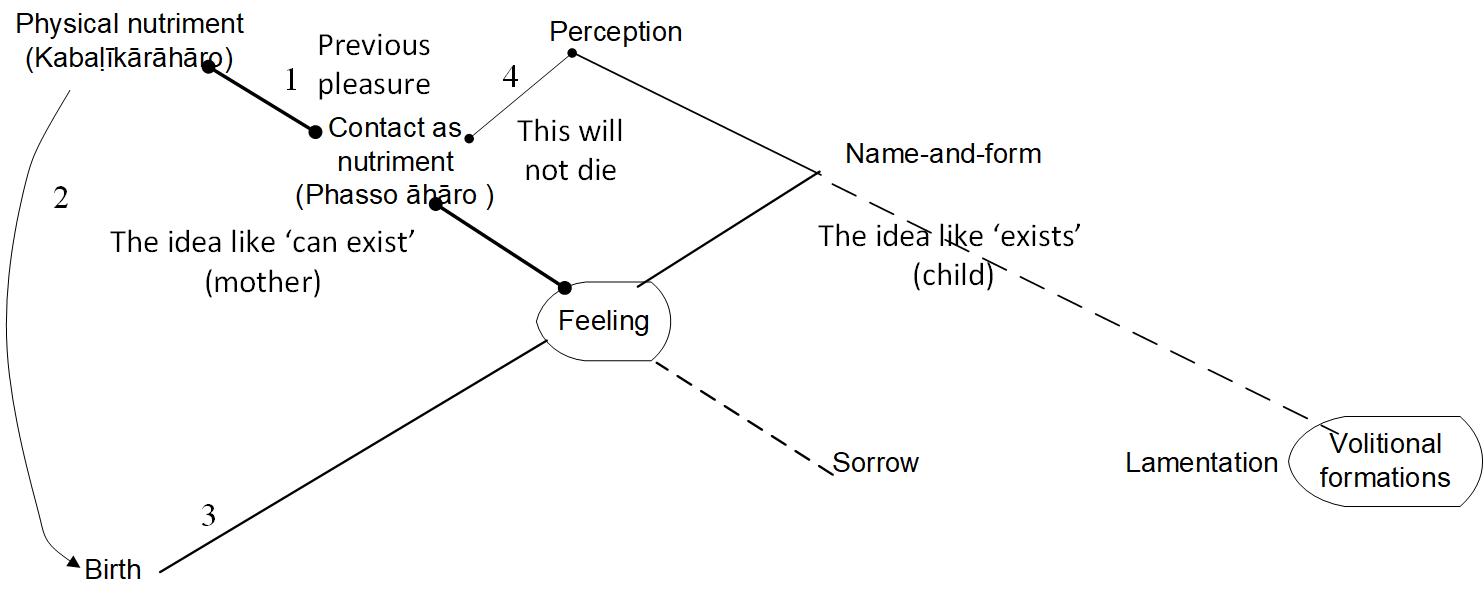
Investigating with the diagram given in the 14/07/2015 Nibbana meditation, if one has reached 1 and 2, then with the arising of ‘delight’ (nandi), reaching the 50% path occurs. If reaching the 50% path happens, it becomes the dominant factor leading to arising of ‘with consciousness as condition, name-and-form’ (viññāṇapaccayā nāmarūpaṃ).
If the path due to ‘sorrow’ (soka) is formed, as shown above, then going from 7.6 to 8.2 cannot be stopped, it is impossible to avoid ‘decision to make volitional formations” (sanskāra adhimokkha). By knowing to this extent and only if the ‘investigation’ (vīmaṃsā) is powerful enough to prevent the path formed by ‘sorrow,’ (soka), then it is possible to stop the arising of ‘with volitional formations as condition, consciousness’ (saṅkhārapaccayā viññāṇaṃ), that is, stopping at that point A itself, is possible.
This is the meditation I did.
If I am to add a little more to this.
1. At the very beginning of the meditation, paying gratitude to Tathagata, with the thought that, one should be no sorrowing (soka), there was an expansion of the mind. Remembering the Mandalādhipati Budu Piya, he appeared vast. Similarly, when remembering the Dhammādhipati-Vinayādhipati Budu Piya, the Dhammādhipati Budu Piya, The Vinayādhipati Budu Piya, the Dhammaratana Budu Piya, they all appeared vast. Similarly, when remembering all Deities, from God Natha up to God Kamalasana, all Devas, Deva Mothers, and Brahma Mothers, they all appeared vast. This happened because I was seeing those Divine Bodies from here. The Budu Piya advised me to be careful.
2. When there was a constriction in the throat during the meditation, thinking one should not be sorrowing about this, the value of not being sorrow was well understood. That is, the mind remained without any conflict. Likewise, during ‘repairing’, there was no ‘sorrow’ that the body has been subjected to ‘aging’ (jarā) and ‘sickness’ (byādhi). Here, when attempting to repair something subjected to ‘aging’ (jarā) and ‘sickness’ (byādhi), the repair was done with a mind apart from ‘kamma’ and ‘worry’. Here one can take this in the meaning of ‘not sorrowing over the past’ (Atītaṃ nānusocati). What is said by The Tathagata, ‘overcoming sorrow and lamentation’ (soka pariddavānaṃ samatikkamāya), remained in the mind from the beginning.
3. We learned in the Nibbana meditation of 14/07/2015, ‘perceptions and attentions (saññā manasikāra), enter him and assail the mind. The notion of ‘pleasure’ (sukha) is added to ‘form’ (rupa), across ‘sorrow’ (soka). Decision was made. Thus, it is investigated because of ‘feelings’ (vedanā), ‘contact’ (phasso) arises. If so, one should not sorrow. For this, mental transfixion (vyappanā) should be well established here. To that extent ‘spiritual power of desire’ (chandaiddhipāda) should be powerful enough. In the diagram given in 10/01/2025 Nibbana meditation, see the path of ‘desire’ (chanda), ‘mindfulness’ (sati) and ‘investigation’ (vīmaṃsā). To the extent one values Nibbāna, there is ‘investigation’ (vimamsā) to that extent. Understanding this, the clear meaning of ‘makes an investigation of them’ (parivīmaṁsamāpajjati) is also well understood. That is, after comparing with Nibbana, to have a desire for the cessation of all other things. Contemplation of this doctrine should be done, with examples. That is, as if lustful thoughts build up in one, who’s mind is dampened with lust, and as the urge arises by mind to enjoy something as tasty as chocolates, similarly, when one examining the occasions when notion of ‘pleasure’ (sukha), is added to ‘form’ (rupa), across ‘sorrow’ (soka), and when contemplating that it is not worth dying and being reborn, the mind stops.
4. The Budu Piya said it is because of ‘sorrow’ (soka) that we wander with our ‘mind-made body’ (manomaya kāya).
This is what I have to add.
Notes added at the end of discussion
When doing this meditation, look at, thinking (takko), directed thinking (vitakko), thought (saṅkappo), mental fixity (appanā), mental transfixion (byappanā), until the focused awareness (cetaso abhiniropanā) and establish the mind at the place where focused awareness (cetaso abhiniropanā) dhamma is marked. There, it is possible to escape from sorrow if one connects the path from birth to feeling with the rest of the path of sorrow diagram. Furthermore, the Budu Piya said that when asking about the love you received from your mother, take one that is touched by compassion and then ask, "Isn't this what I'm looking for?"