The Noble Council of Akanittha Brahma Realm was remembered with faith.
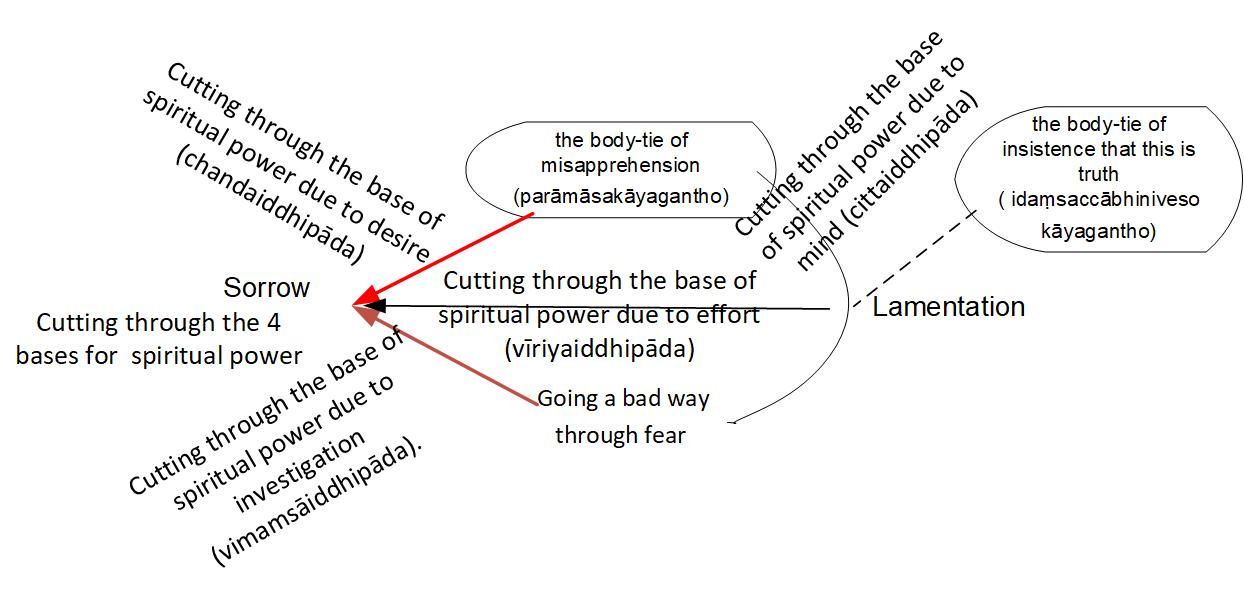
I repeated the Nibbana meditation of 07/02/2025. In there, I used the diagram learned in the 14/04/2015 Four bases of spiritual power (Cattaro iddhipada) meditation.
In the dhamma part added to the 4th item of 07/02/2025 Nibbana meditation, when remembering the doctrine of ‘spiritual power due to mind’ (citta-iddhipāda), the Bhūta diagram is remembered, there the ‘one-pointedness of mind’ (ekaggatā) reached is profound. Likewise, I inquired about the possibility of an existence of a doctrine like ‘Bhūta diagram’, to help re-collect the part where ‘area 2’ and ‘consciousness’ (viññāṇa) is marked. Budu Piya said that ‘there is’.
First, if one takes the decaying form as self (attā), then that ‘self’ contains suffering. If one becomes conceited (māna) about the decaying form, then that ‘conceit’ contains suffering. If one takes the decaying form as permanent (nicca) because of the above (two facts), then suffering is contained within that too. In this way, the aspects of ‘suffering’ (dukkha) in area 2, become connected to the area where ‘consciousness’ (viññāṇa) is marked.
Here arising of name-and-form (nāma-rūpa) with ‘consciousness’ as condition, should be investigated. That is, if a concept of ‘self’ (attā) arises accompanied by suffering, then the values of name-and-form (nāma-rūpa) arising from such a doctrine desended in suffering, are also embedded in the same suffering. When we descend into suffering in this way, we feel it more because we have inherited the showing of suffering in area 1 through ‘spiritual power due to mind’ (citta iddhipāda). It is so (*1). The suffering (dukkha) arising from name-and-form conditioned by ‘consciousness’ is one thing. The suffering (dukkha) arising from the ‘aging’ (jarā) of ‘form’ (rūpa) is another thing. If loss of the ‘spiritual power due to mind’ (citta iddhipāda) occurs, the meaning of the above will not be understood.
Furthermore, the ‘effort’(vīriya) remembered as “makes an effort, stirs up energy, exerts his mind and strives to prevent the arising of unarisen evil unwholesome mental states” (anuppannānaṃ pāpakānaṃ akusalānaṃ dhammānaṃ anuppādāya chandaṃ janeti vāyamati vīriyaṃ ārabhati cittaṃ paggaṇhāti padahati), remember this as the ‘dependently arising’ (paṭiccasamuppanna) of area 2. That is, if examining going from ‘birth’ (jāti) to ‘aging’ (jarā), in the reverse direction, from ‘aging’ to ‘birth’ then, while this helps establishing ‘suffering’ (dukkha) in ‘name’ (nāma) part, for the easy removal of the ‘name-and-form’ (nāmarūpa) doctrines, the use of the doctrine shown by ‘Thapassi Budu Piya’ as the ‘dependently arising’ (paṭiccasamuppanna) doctrine, the name-and-form doctrines will disappear. There is Nibbana as object and only Nibbana as goal.
This is the meditation I did.
If I am to add a little more to this-
1) If applying going from ‘birth’ (jāti) to ‘aging’ (jarā), in the reverse direction, from ‘aging’ to ‘birth’ then examining the establishment of suffering (dukkha) to the ‘name’ (nāma) part, this is like the path 1, 2, 3, 4 occurs due to sorrowing, just so, the arising of straying mind (vibhanta citta) due to ageing. Furthermore, if this is stopped through ‘effort’ (viriya), the weakening of the search for ‘forms’ by spinning with ‘barb of lust’ (rāga salla), also helps supports the ‘focused awareness’ (cetaso abhiniropanā) doctrine.
2) It is well understood that this first point leads to ‘train by higher wisdom’ (adhipaññāsikkhā). That is, examining going from ‘aging’ (jarā) to ‘birth’ (jāti), itself, prevents adding a permanency to ‘form’ (rūpa).
3) Here, the ‘spiritual power due to effort’ (viriya-iddhipada) is steady.
4) Through this meditation, one can stop at either the first round or the second round, and this happens depending on the level of the development.
This is what I have to add.
Footnote added during the discussion
(*1) So here one can look at the fourth point we added in the 07/02/2025 Nibbana meditation. It is shown in the part of spiritual power due to mind that the momentum of sorrowing also decreases, showing that it is not pleasurable, and that there is a feeling of suffering when looking at it. That means if we are sorrowing, that person is saying that it is pleasurable.