The Noble Council of Akanittha Brahma Realm was remembered with faith.
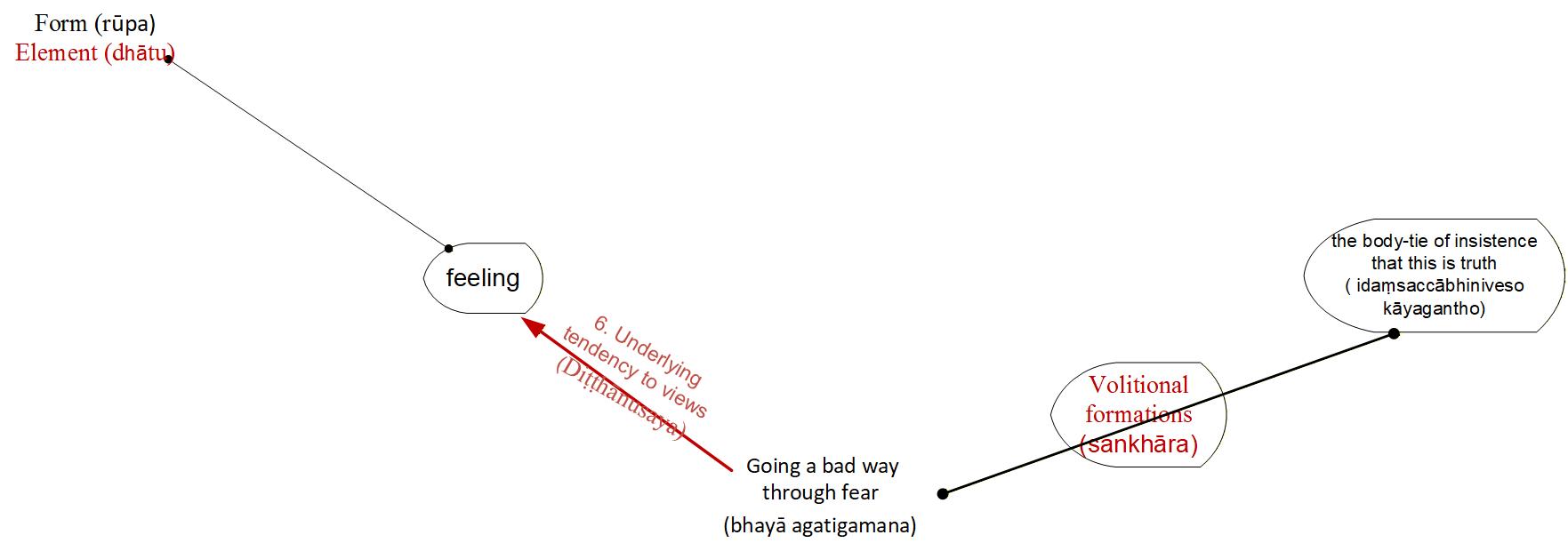
At the end of the Nibbana meditation on 17/01/2025, it was learned that ‘volitional formations’ are performed only if one goes to Area 6. The doctrine of going to Area 6 should be avoided by knowing this with well-developed wisdom. For this, slide 2 of the ‘dukkha’ table was examined.
Here, if ‘going a bad way through fear’ (bhayā agatigamana) occurs, then we learned on 21/02/2025 Nibbana meditation that due to this ‘going a bad way through fear’, the path due to sorrow occurs and a undying ‘perception of pleasure’ (sukha sañña) is created amidst ‘contact’ (phassa) and ‘perception’ (sañña). Furthermore, investigating these ‘volitional formations’ (sankhara) as ‘mental formations’ (citta sankhara) and praises them then the Budu Piya said that there is no ‘right view’ (samma ditthi). What helped in the praising of ‘mental formations’ (citta sankhara)? Investigate the influence coming from ‘insistence that this is truth’ (idaṃsacca). It should be remembered that when some doctrine is approved as good, that approval through ‘insistence that this is truth’ (idaṃsacca) occurs due to the influence of two kinds of factors.”
We can see there is an arrow from ‘consciousness’ to ‘insistence that this is truth’ (idaṃsacca), and another arrow labelled ‘beauty’ (subha) from ‘misapprehension’ (parāmāsa) to ‘insistence that this is truth’ (idaṃsacca).
Investigating in one way, if doctrines are praised as good due to the arising of ‘consciousness’ (viññāṇa), then the influence of this enters the ‘insistence that this is truth' (idaṃsacca). This is influenced by the 50% path. Moreover, when examining the 50% path originating from 'birth'; 'birth' (jāti), 'feeling' (vedanā), 'volition' (cetanā), and 'self' (attā), and subsequently lifted up by 'conceit' (māna) and going to 'permanence' (nicca), it contains the influence of the doctrines taught by Thapassi Budu Piya.
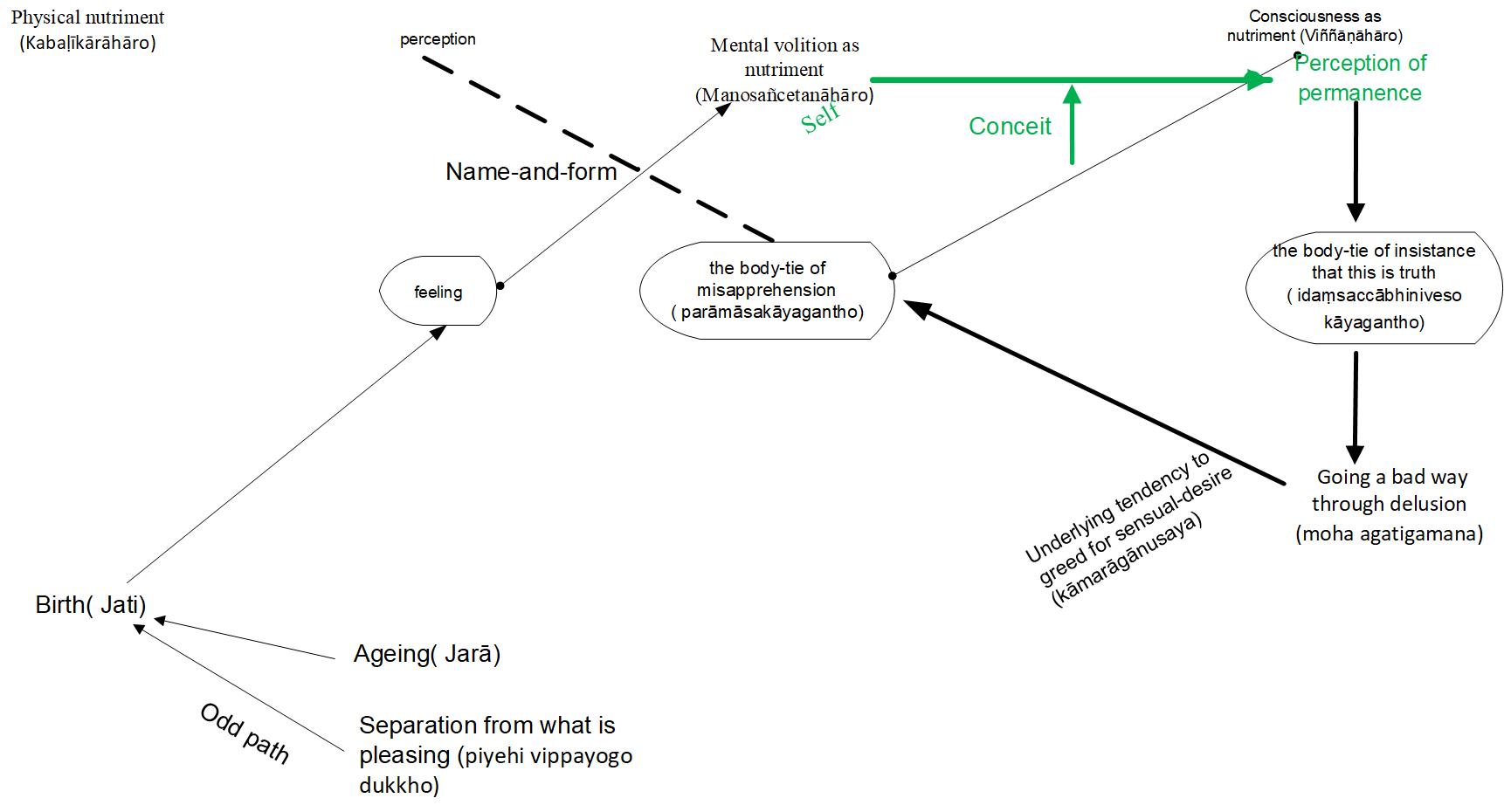
Thus, while the influence caused by the straying mind (vibhanta citta) should be understood, and if there is ignorance or lack of knowledge associated with it, due to these doctrines entering ‘insistence that this is the truth’ (idaṃsacca), can lead to praising of the ‘mental formations’ (citta sankhāra) and also the absence of 'right view' (sammā diṭṭhi). In this way, the absence of right view (sammā diṭṭhi) leads to sinking into mental formations (citta saṅkhāra); because of that, one misapprehends the elements (dhātu).
Thus, the path due to ‘sorrow’ (soka) has already arisen by this time and there is misapprehension of ‘elements’ (dhātu), because the undying ‘perception of pleasure’ (sukha saññā) has arrived at ‘contact’ (phassa), these misapprehended ‘elements’ (dhātu) themselves, should be understood as ‘mental formations’ (citta saṅkhāra).
Here, ‘elements’ ('dhātu') should be thought of as a stream. Thus, when investigating the ‘elements’ ('dhātu') as a stream, it has diversity. Investigating ‘elements of sensuality’ (kāma dhātu) was done during the Nibbana meditation on 06/12/2024. There, the process leading to the flow of the stream, maintained with sensual objects was investigated. The doctrine stated by The Budu Piya was remembered; within the ‘perception of sensuality’ (kāma saññā), attention to the ‘perception of pleasure’ (sukha saññā) created by the process is retained.
On the other hand, when examining the ‘renunciation element’ (nekkhamma dhātu), it can be understood as maintaining the process that leads to the flow of the stream by using the ‘meditative absorptions’ (jhāna) after letting go of ‘forms’ (rūpa). ‘If the mind is in a state where it cannot find a doctrine not supressed by ‘hindrances’ (nīvaraṇa), then the ‘element of ill-will’ (vyāpāda dhātu) is present in it, at least to some degree.
When one is able to find a doctrine where ‘hindrances’ (nīvaraṇa) are suppressed, due to immersion in that doctrine, ‘right view’ (sammā diṭṭhi) is lost and within the ‘insistence that this is truth’ (idaṃsacca) those doctrines that are praised are accepted as truth. Through this, one becomes deluded and doctrines of delusion arise.
Thus, through ‘straying mind’ (vibhanta citta), the path originating from ‘ageing’ (jarā) becomes active and attentions (manasikāra) associated with perceptions of pleasure (sukha saññā) remain in the mind. If ‘mental formations (citta saṅkhāra) are constructed this way, then there is no Nibbāna. There is saṃsāra. What is the refuge for the ‘beings’ who understand this? It should be said that it is the ‘four bases of spiritual power’ (iddhipāda) that have been developed.
This is the meditation I did.
If I am to add a little mor to this-
1. After reading this meditation and contemplation on the ‘contact’ (phassa) and ‘name-and-form’ (nāma-rūpa) as mother and child which arises through ‘sorrow’ (soka), the stopping of the mind and reaching a state of ‘cessation’ (nirodha) takes place.
2. Furthermore, the dragging as ‘beauty’ (subha) from misapprehension (parāmāsa), together with doctrines from ‘feeling’ (vedanā) to ‘misapprehension’ (parāmāsa), understand this as in the doctrine conducive to ‘imperturbability’ (āneñja-sappāya dhamma) and use it. There, entering to ‘insistence that this is truth’ (idaṃsacca) occurred due to something like ‘form’ that is like cotton (insubstantiality is meant here).
3. During this meditation, what supports the praise of ‘mental formations’ (citta saṅkhāra)? The influence that comes from ‘insistence that this is truth’ (idaṃsacca)” is examined with examples, and permanence is understood to be the main point here. Remembering up to the point the dragging as ‘beauty’ (subha), when understanding that misapprehended ‘elements’ (dhātu) themselves, are the ‘mental formations’ (citta saṅkhāra), the mind changed. Budu Piya said ‘Excellent’. There are no sorrow and lamentation there; these were transcended. While this mind remained unchanged for an extended period, retaining this dhamma in memory to share with others, it persists without fading. Budu Piya said that, it is a ‘gateway’ to ‘Nibbana’.
4. Due to the realisation from the third point above, doing this meditation is very difficult as the mind tends to stop at the very beginning
5. Praising ‘volitional formations’ (saṅkhāra) means praising ‘unwholesome states’ (akusala). This is understood through the meaning of the stanza: “whatever ‘suffering’ (dukkha) comes into play is all due to ‘volitional formations’ (saṅkhāra) as a requisite condition, with the cessation of this very ‘volitional formations’ (saṅkhāra), there is no coming into play of ‘suffering’ (dukkha); (yaṃ kiñci dukkhaṃ sambhoti sabbaṃ saṅkhāra paccayā" saṅkhārānaṃ nirodhena" natthi dukkhassa sambhavo). You feel the wedge. Light radiates from the mind. There is a ‘right view’ (sammā diṭṭhi) that is affected by the taints; partaking of merit (puññabhāgiya); ripening in the acquisitions(upadhi). This ‘right view’ (sammā diṭṭhi) falls into the category of ‘unwholesome states’ (akusala). Why is it so? Because it causes birth. If one praises ‘mental formations’ (citta saṅkhāra) in this way, then it should be understood that there is no ‘right view’ (sammā diṭṭhi) and that this falls into the category of ‘unwholesome states’ (akusala). Stating the Four Noble Truths is not an unwholesome action. When material offering (āmisa dāna) is given, it is partaking of merit (puññabhāgiya); ripening in the acquisitions(upadhi) and since it causes birth, it fall into the category of ‘unwholesome states’ (akusala). Nevertheless, due to the element of renunciation in the act of giving, that process falls into the category of ‘wholesome states’ (kusala).
6. If it is said that doctrines are beneficial due to the arising of consciousness (viññāṇa), its influence go inside ‘insistence that this is truth’ (idaṃsacca). It is more fitting to understand this in accordance with the fifth added point. Thus, it should be understood that when material offering (āmisa dāna) is given, the influence of the doctrines of partaking of merit (puññabhāgiya); ripening in the acquisitions(upadhi) strongly goes inside ‘insistence that this is truth’ (idaṃsacca). The value of the wholesome is vast; the unwholesome is small. Therefore, the influence of the wholesome going to ‘insistence that this is truth’ (idaṃsacca) is excessive. (*1)
7. When one is able to find a doctrine where ‘hindrances’ (nīvaraṇa) are suppressed, due to immersion in that doctrine, ‘right view’ (sammā diṭṭhi) is lost and within the ‘insistence that this is the truth’ (idaṃsacca) those doctrines that are praised are accepted as truth. Through this, one becomes deluded and doctrines of delusion arise. Further investigation of this doctrine it is understood that this is two-fold when examined with the added sixth factor. Not only the ‘meditative absorptions’ (jhāna), but also the doctrines that brings about the doctrines of partaking of merit (puññabhāgiya); ripening in the acquisitions(upadhi) result due to material offerings (āmisa dāna) can be used.
This is what I have to add.
The footnotes added during the discussion:
(*1) If I add a little more to this, remember that when material offering (āmisa dāna) is given, it includes both wholesome (kusala) and unwholesome (akusala). The doctrines of partaking of merit (puññabhāgiya); ripening in the acquisitions(upadhi) leads to things like holding the future. For that purpose, the doctrine that ‘it is good to give up’ enters ‘insistence that this is truth’ (idaṃsacca). If that giving up is well developed, then that leads to Nibbana. That is giving up everything.