The Noble Council of Akanittha Brahma Realm was remembered with faith.
The item 5 added in the 28/02/2025 Nibbana meditation states that when material offering (āmisa dāna) is given, it is partaking of merit (puññabhāgiya); ripening in the acquisitions(upadhi) and since it causes birth, it falls into the category of ‘unwholesome states’ (akusala). However, due to the element of renunciation in the act of giving, that process falls into the category of ‘wholesome states’ (kusala). This was further examined.
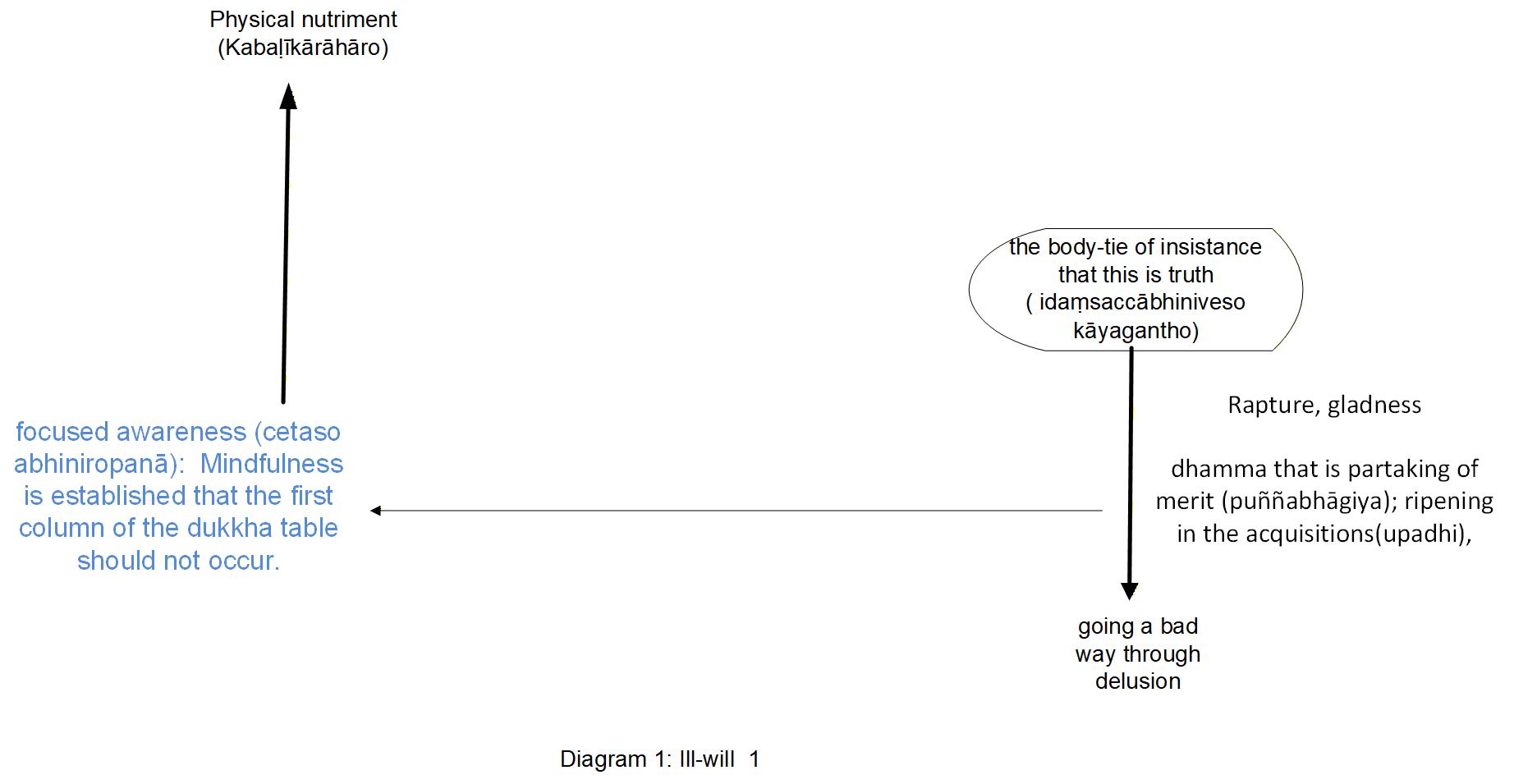
As one learned during the Nibbana meditation of 10/01/2025, where one attempts to establish in ‘right thought’ (sammā sankappa) and elevated the mind to ‘focussed awareness’ (cetaso abhiniropana), even though one thinks that I will not go to the ‘form’ (rūpa), however, just prior to beginning the meditation, one has given ‘alms’ (dāna), which results in experiencing ‘joy’ (pīti) and gladness (pāmojja), meaning one has performed actions that is partaking of merit (puññabhāgiya); ripening in the acquisitions(upadhi), these can be marked from ‘insistence that this is the truth’ (idaṃsacca) to ‘delusion’ (moha). These doctrines are parallel to the line from ‘focussed awareness’ (cetaso abhiniropana) to form (rūpa). However, the direction is opposite. See diagram 1.
The Great Arahant named above diagram as Ill-will 1 (Byāpāda 1).
Hence, when there is ‘attention to feelings’ (vedanā manasikāra), aglow with ‘joy’ (pīti) and ‘gladness’ (pāmojja), proper establishment of ‘focussed awareness’ (cetaso abhiniropanā) cannot be achieved. Then, The Great Arahant told me to connect this with the doctrine of Tapassi Budu Piya.
Refer to the given diagram 2.
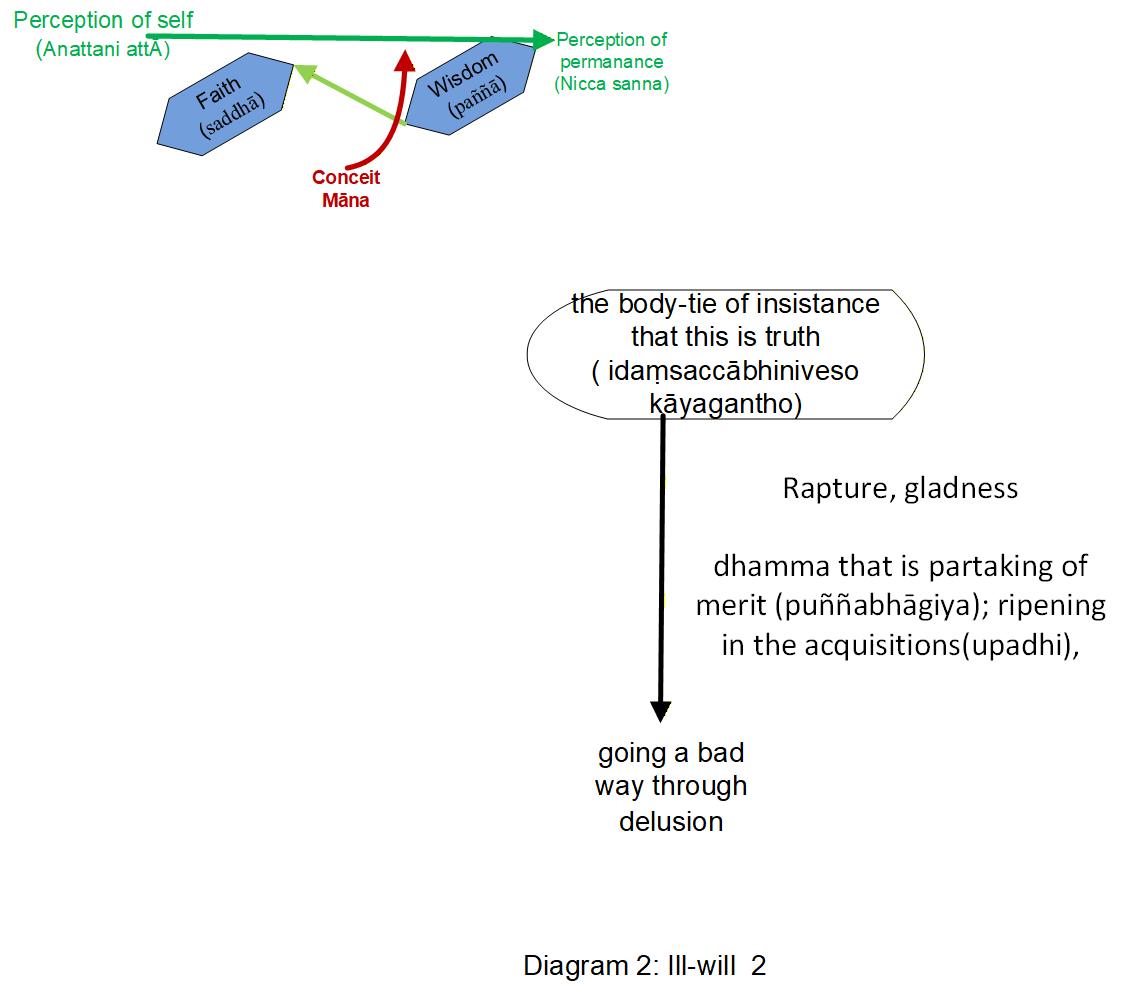
The Great Arahant named this diagram as Ill-will 2 (byāpāda 2).
Pointing downwards from ‘insistence that this is truth’ (idaṃsacca), dhamma that is partaking of merit (puññabhāgiya); ripening in the acquisitions(upadhi) are marked. Before this, there is the doctrine going from ‘self’ (attā) to ‘permanence’ (nicca) which is “jacked” up by ‘Conceit’ (māna). If it is not possible to have ‘conceit’ towards the dhamma that is partaking of merit (puññabhāgiya); ripening in the acquisitions(upadhi), then knowing that the bridge from ‘self’ (attā) to ‘permanency’ (nicca) cannot be maintained in some manner, if some effort should be made for it, if it cannot be accomplished, one falls into ill will (byāpāda). If one cannot carry out such process well through 'stinginess regarding doctrine’ (dhammamacchariya), then a nature of ill will (byāpāda) arises toward the phenomena related to feelings (vedanā). The ill-will (byāpāda) arising due to such phenomena, associated with ‘mundane right view’ is of a very worrying nature. Here, when the ‘taint of view’ (diṭṭhi āsava) is excessive to some degree, such a ‘being’ also goes seeking other doctrines.
Thus, a ‘being’ accompanying ‘ill-will’ (byāpāda), wandering through the saṃsāra, experiences great suffering. For what reason? Because the doctrines for reconnection to future existence (rebirth-linking dhamma) that one oneself should cultivate cannot be properly maintained.
To understand the dhamma arising from this, see diagram 3.

The Great Arahant named this diagram, Sorrow 2.
The path described above starts from 'self' (attā) to 'permanence' (nicca), the post 'perception' (saññā) of it is 'taint of views' (diṭṭhāsava). From the left side of 'taint of views' to 'taint of sensual desire' (kāmāsava), and down to 'barb of lust' (rāgasalla). Then from 'barb of lust' (rāgasalla) proceeds to 'form' (rūpa) and from there to 'birth' (jāti). From there the 50% path from ‘birth’ (jāti) to ‘feeling’ (vedanā), and then from ‘feeling’ (vedanā) to ‘sorrow’ (soka). So here too is that earlier point—the talk that when one comes to 'taint of sensual desire' (kāmāsava), that so called “pleasure” (sukha). Having given alms in former lives, perceptions of pleasure enjoyed like a king remain undying. Therefore, ‘contact’ (phasso), ‘feeling’ (vedanā) and ‘sorrow’ (soka) are thus marked—from feeling up to sorrow. The operation of this path has a greater influence.
Here there is no escape, doctrines of ‘ill-will’ (byāpāda), arising concerning future feelings, assail the mind. Letting go, when well maintained, is the only way to be freed from this.
This is the meditation I did.
If I am to add a little more to this-
1. When the ‘taint of view’ (diṭṭhi āsava) is excessive to some degree, it is said such a ‘being’ also goes seeking other doctrines. When someone hears from a monk that Buddha was born in Sri Lanka, that person feels compelled to go there. This is just an instance of talking about ‘partaking of merit (puññabhāgiya)’. There is a big worry that others are not taking me there, believing that this will lead to the attainment of ‘path and fruits’ (magga-phala) or similar goals. This is what is meant by such a ‘being’ goes seeking other doctrines. It is not the Tathāgata teaching that says Buddha was born in Sri Lanka.
2. The ill-will (byāpāda) arising due to such phenomena, associated with ‘mundane right view’ is of a very worrying nature. Buddha says not to disgrace others’ religions. This means people can become violent and tend to kill each other for criticising their religion. This is a major issue, when we talk about a religion, a doctrine. This type of ‘ill-will’ (byāpāda) is stronger than other forms of ‘ill-will’ (vyapada). This means the ‘view’ (diṭṭhi) of someone is excessive. A person thinks it is only through my religion that I will progress and have good benefits, I will be born like so, in the future. If you insult a person’s religion, that person thinks you are insulting his future. This is a very severe form of ‘ill-will’ (byāpāda). This started from the act of giving alms resulting in ‘ill-will’ (byāpāda) due to inability to do it properly.
3. Investigating as in the path in the Bhūta (becoming) diagram where ‘perception’ (saññā) is confirmed through ‘taint of views’ (diṭṭhi āsava), similarly via the path shown in diagram 3 above, the taint of sensual desire (kāma āsava) that is the post perception of pleasure (sukha saññā) previously experienced, confirm the highest values of forms (rūpa) via the ‘barb of lust’ (rāga salla). That is the ‘form’ values from favourable existences from previous births are confirmed.
4. When examining point 3 above, the ten (10) ‘acquisitions’ (upādi) is well understood. They are; Craving (taṇhā), Views (diṭṭhi), Defilements (kilesa), Kamma, Immorality (duccarita), Elements (dhātu), Four nutriments, Aversion (paṭigha), Internal sense bases (ajjhattika āyatana), Classes of consciousness (viññāṇakāya). Immorality (duccarita)- consider this as what you do, after becoming ‘conceit’ (māna) due to ‘volitional formations’, use diagram 3 for this. Investigate coming back to ‘form’ (rūpa) because of ‘views’ (diṭṭhi). Investigate defilements as ‘taints’ (āsava). Kamma is two-fold; being drawn into the mothers’ womb is one, seeking due to actions that is partaking of merit, is another one.
5. Budu piya said that the doctrines arising from 'sorrow 2' (soka 2) can only become evident once 'sorrow 1' (soka 1) is eliminated. In sorrow 1, there is a repeated demand for things that are being contacted and have been contacted, in this existence. If ‘perception of self now’ disappears, the dhamma arising from ‘sorrow 1’ (soka 1) is removed. However, the dhamma arising due to the permanence created by the previous ‘self’, still assail the mind. It is appropriate to consider that 'perception of pleasure' (sukha saññā), previously enjoyed like a king, leads to these phenomena. Through this process, activation of the path shown as ‘sorrow 2’ (soka 2) occurs.
This is what I have to add.
Footnotes added at the end of discussion
Although the perception of self is lost, dhamma shown by Tapassi Budu piya is still in effect. Why is so? If one becomes conceited (māna) about the decaying form, then that ‘conceit’ contains suffering. From this, taking the decaying form as permanent (nicca) occurs due to the self in past existence. That is why. For this investigate using the former self. We know that ‘former self’ is marked in between perception and feeling. Thus, the foundation for future lives is laid due to the influence of past lives.