The Noble Council of Akanittha Brahma Realm was remembered with faith.
One does not understand aging (jarā) because of delusion (moha). How so? When delusion (moha) is present, then the thought of suffering (dukkha) is absent there. Therefore, one cannot be convinced of the suffering nature of form (rūpa), by going along the path marked by ‘base of spiritual power due to mind’ (citta iddhipāda). If suffering is thus concealed, aging (jarā) is neither seen nor known.
Thus, one should understand that a person who has not found a doctrine which is not supressed by ‘hindrances’, then that person does not comprehend suffering. Investigating as in the Nibbana meditation of 28/02/2025, this is understood to be twofold. We have discussed there that, when one is able to find a doctrine where hindrances (nīvaraṇa) are suppressed, due to immersion in that doctrine, ‘right view’ (sammā diṭṭhi) is lost and within the ‘insistence that this is truth’ (idaṃsacca) those doctrines that are praised are accepted as truth and one becomes deluded and doctrines of delusion arise. Investigating with this, if doctrines of delusion arise even because of jhana, that too falls under the category of hindrances. Why is it so? Because doctrines of delusion occurred.
Delusion occurred after the permanency. Investigate the ‘straying mind’ path (vibbhantacittā).
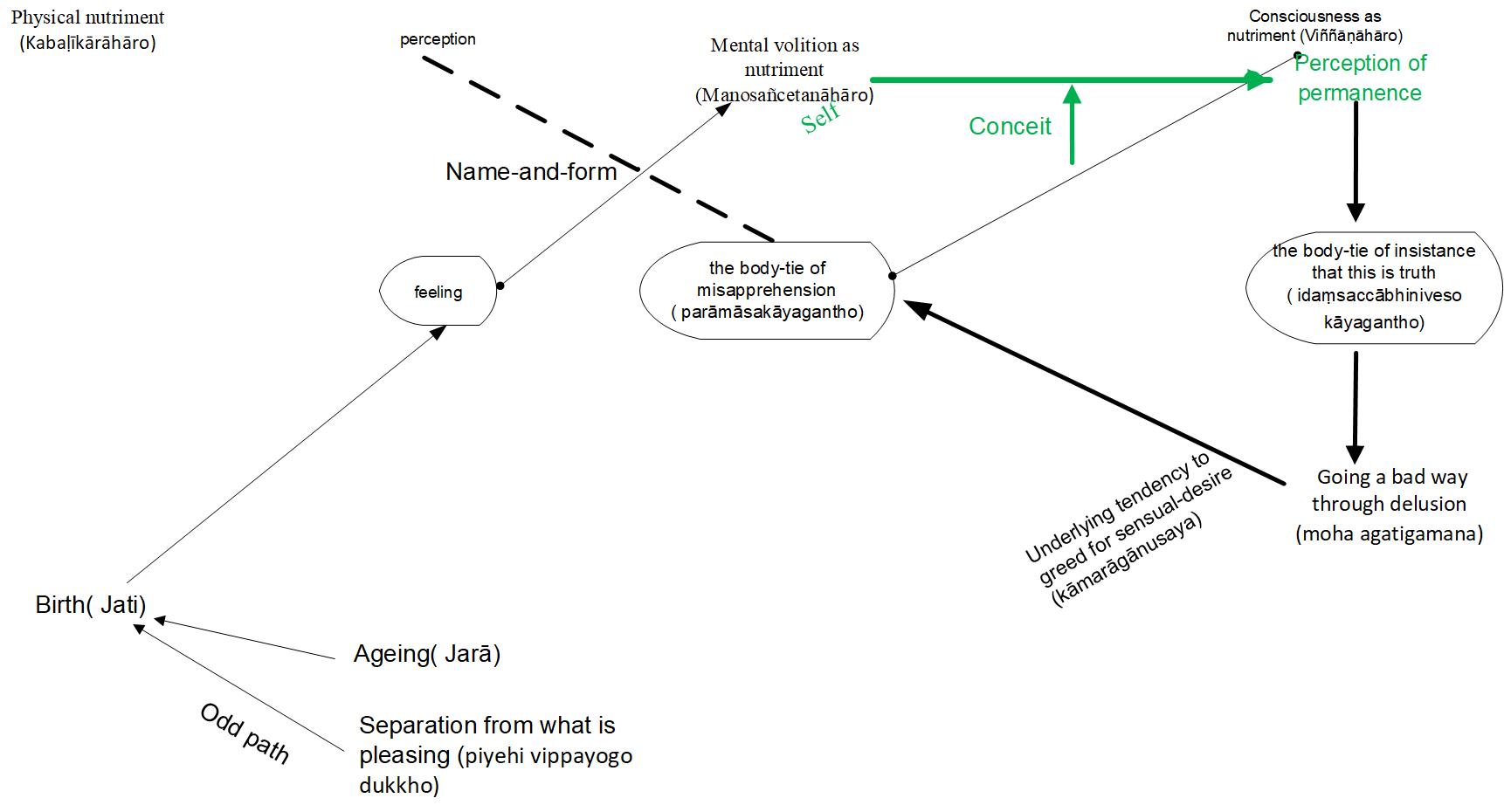
This originated from ageing (jara). We learned from the 3rd point added to the Nibbana meditation of 14/03/25, that craving (taṇhā) influences ‘separation from what is pleasing’ (piyehi vippayogo). Starting from aging (jarā), going through the path of ‘straying mind’ (vibbhantacittā), one has arrived at the state of permanence. That is, ‘separation from what is pleasing is suffering’ (piyehi vippayogo dukkho), birth (jāti), feeling (vedanā), volition (cetanā), and self (attā), one has arrived at the state of permanence. Forgetfulness of the origin—namely, not knowing that through a doctrine beginning from ageing (jarā), one has arrived at the state of permanence, is pregnant within delusion.
Therefore, investigating by applying the path marked by ‘base of spiritual power due to mind’ (cittaiddhipāda), that is, ‘going a bad way through fear’ (bhaya-agati), misapprehension (parāmāsa), feeling (vedanā), and up to contact (phassa), the momentum of which cannot be taken to rūpa (form). What momentum? The momentum to convince it is suffering (dukkha). Thus, due to the meditation formations (jhāna saṅkhāra) presently existing, there can be a strong grasping of future existence. The doctrine of ‘focused awareness’ (cetaso abhiniropanā) cannot be properly maintained.
This is the meditation I did.
If I am to add two more points to this;
1. Practising this meditation, ‘taintless mind’ (anāsava citta) occurs.
2. We, with our aged eye, ear etc, ceaselessly wish for these faculties to become better and healthy, we seek delight. Seeking delight thus, we think perhaps it will be possible to fix this by offering alms. In this way one becomes deluded. When this becomes futile, one falls into ‘ill-will’ (byāpāda).
This is what I have to add.
Additional notes to use in this meditation.