The Noble Council of Akanittha Brahma Realm was remembered with faith.
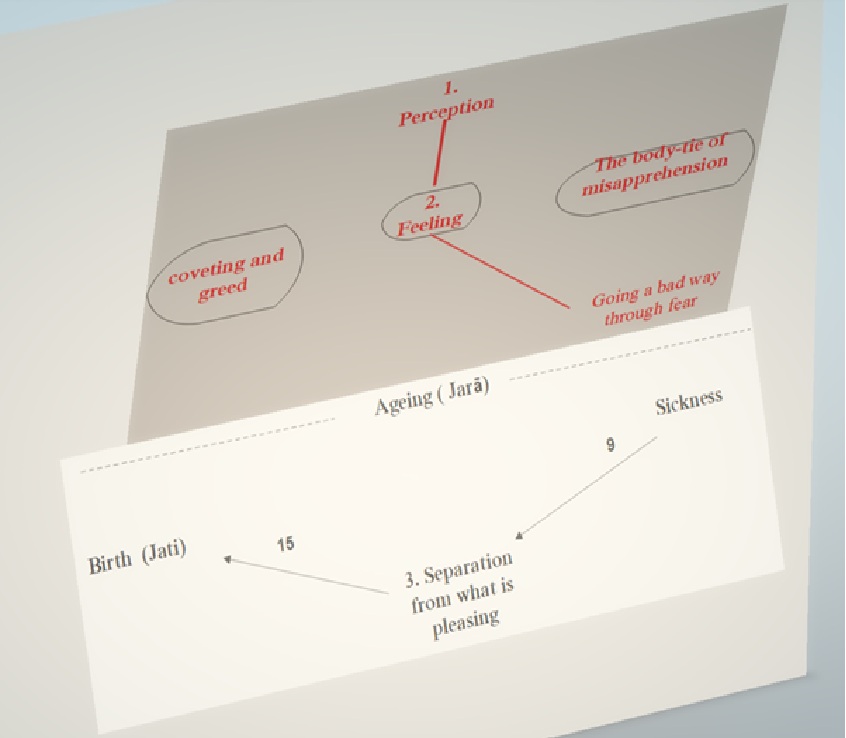
In the Amurtaya 5 meditation on 25/08/2023, the case where doctrines of 1. perception (saññā), 2. feeling (vedanā), 3. separation from what is pleasing (piyehi vippayogo) in a triangle, was drawn. We learned that this is the case of ‘Final Nibbana’ (Parinibbana).
Here, it should be taken as if one, with ‘pure perception’, were observing ‘separation from what is pleasing’ (priyehi vippayoga).
In the case of the doctrines of 1. perception (saññā), 2. feeling (vedanā), 3. separation from what is pleasing are in the same line ‘separation from what is pleasing’ (piyehi vippayogo) is not visible to ‘perception’(saññā).
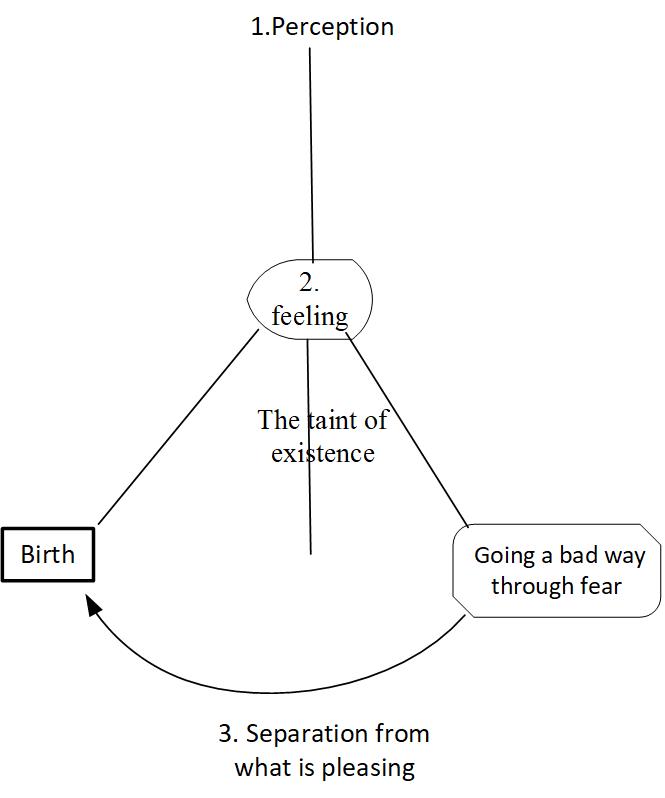
It should be understood that the path ‘straying mind’ (vibhanta citta) is in operation there, delusion (moha) arrives, surpassing the doctrines of feeling (vedanā). Therefore, this is not ‘Final Nibbana’ (parinibbāna).
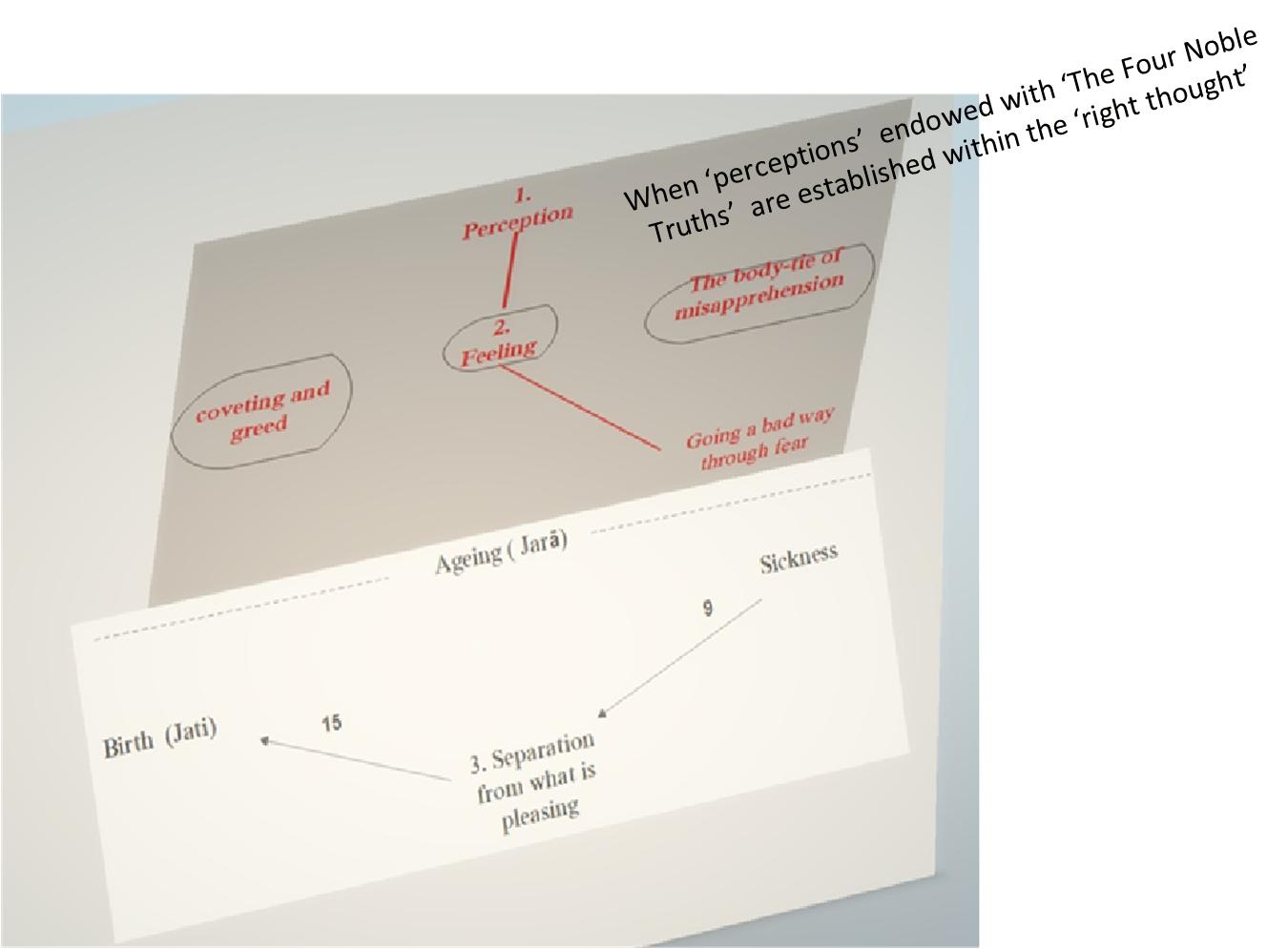
When speaking of ‘two planes’, it should be understood, the occasion when purified perceptions imbued with the Four Noble Truths are established within ‘right thought’ (sammā saṅkappa) and the occasion when this is not the case. Why is this so?
Even if one says, ‘I was separated from what is pleasing,’ the Four Noble Truths are not present there. However, if that same doctrine—namely the separation from what is pleasing —is recognized through concentration (samādhi) as suffering, then the Four Noble Truths are present there. This is how the separation of the planes is understood.
So, the ‘two planes’ may be identified as ‘right thought’ (sammā saṅkappa) and ‘wrong thought’ (micchā saṅkappa).
If one contemplates ‘right thought’ (sammā saṅkappa), then there is no ‘sorrow’ (soka) or ‘lamentation’ (parideva) related to it. ‘Mental formations’ (citta saṅkhāra) experienced in previous existences, living like a king, are not included in ‘right thought’ (sammā saṅkappa).
When contemplating ‘wrong thought’ (micchā saṅkappa), doctrines of ‘separation from what is pleasing’ (piyehi vippayogo), ageing (jarā), and ‘sickness’ (vyādhi), are included without ‘wisdom’ (paññā).
Thus, if there is proper wisdom, meaning when ‘perceptions’ (saññā) endowed with ‘The Four Noble Truths’ (cattāro ariyasaccā) are established within the ‘right thought’ (sammā saṅkappa), and if this becomes complete through the Nibbana meditations of 07/02/2025 and 14/02/2025, then Nibbana is pregnant here.
This is the meditation I did.
If I am to add more to this,
1. Here what is meant by ‘plane’? Consider it as an area where something can exist. See the following diagrams.

2. Contemplating ‘right thought’ (sammā saṅkappa)-, “And what bhikkhus is the right thought that is noble, without effluents, transcendental, a factor of the path? The thinking, directed thinking, thought, mental fixity, mental transfixion, focused awareness, and verbal formation in one developing the noble path whose mind is noble, whose mind is without effluents, who is fully possessed of the noble path. This is the right thought that is noble, without effluents, transcendent, a factor of the path. Reflecting on the doctrines, up to ‘thinking’ (takko), ‘directed thinking ' (vitakko) and 'thought' (sankappo), as in the Nibbana meditation of 10/01/2025, established in ‘right thought' (sammā saṅkappa) has occurred, and it repeatedly comes to mind that one should establish right thought without settling in ‘wrong thought’ (micchā saṅkappa). That is, abandoning harsh speech (parusā vācā), it comes to mind effortlessly that one should dwell fully in the Buddha’s word of ārati (desisting), virati (abstaining), and paṭivirati (refraining ). Thus, the establishment in the ten wholesome states (dasa kusala) occurred together with proper wisdom (paññā). There, the doctrines of ‘thought of suffering’ (dukha sankappa) and ‘decision to make volitional formations (sanskāra adhimokkha) not occurring’ happening simultaneously as given in the Nibbana meditation on 19/01/2024, were well present. Here the mind is in a state of profound peace.
3. While ‘Repairing’, reflecting on ‘beauty plus permanence results in pleasure’ (subha + nicca -> sukha), recalling that within ‘delusion’ (moha) lies the ignorance for not-knowing that a doctrine beginning with ageing (jarā) leads to the ‘permanence’ (nicca), the ‘pleasure’ (sukha) does not establish in ‘right thought’ (sammā sankappa). The peaceful state that arose in point 2, continues without fading away.
4. During Amurthaya 5 meditation on 25/08/2023, the thing to be taken here is the piece of wood – ‘form’ (rūpa), as pre-determined by ‘perception’ (saññā) as this sort of wood piece should be taken. It was discussed that this should be taken as what is being confirmed. This should be taken as an object brought forth by perception (saññā) by two kinds of phenomena, namely, the undying ‘perception of pleasure’ (sukha saññā) in this existence, due to ‘sorrow 1’ and the undying ‘perception of pleasure’ (sukha saññā) that was experienced in previous existences, living like a king, due to ‘sorrow 2’. This is the form (rūpa) that is selected.
5. In the 10/11/2023 adhimokka meditation the ideas associated with feeling (vedana dhamma) that exists with “bunny toy was like affection” should not be exceeded. That is, it is also accepted as necessary. The ideas associated with feeling that exists later should not be exceeded. Having thought like this, the decision was taken to separate from the bunny was investigated. Therefore, as stated in point 4 above, by offering alms (dana), virtue (sila), and meditation (bhāvanā) are undertaken without wisdom (paññā), one is seeking for both, present ideas associated with feeling (vedana dhamma) and the ideas associated with feeling that exists later that are based on past ‘volitional formations’ (sankhāra).
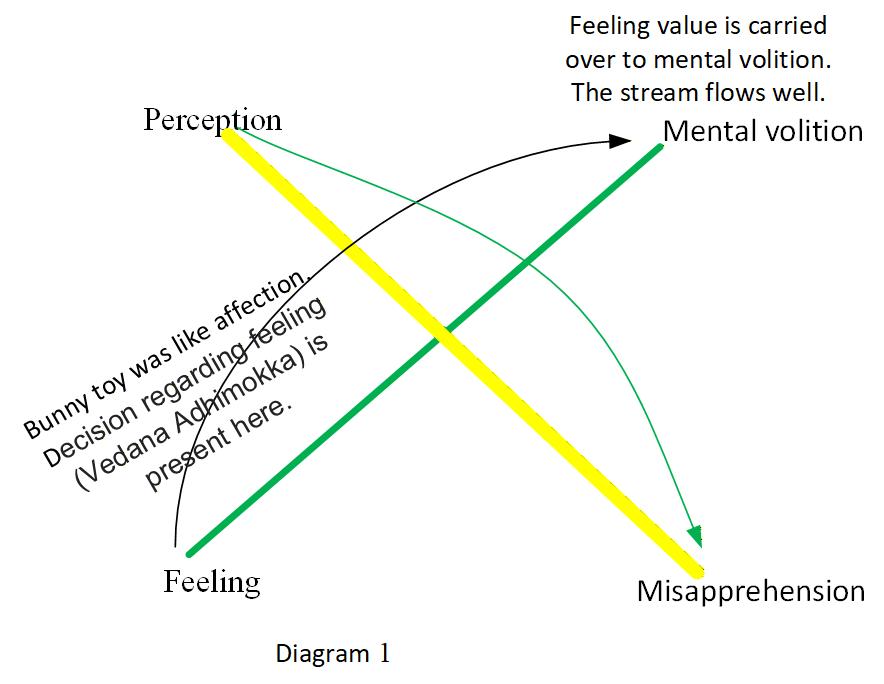
That is, not occurring of 'nāsīsati lokamimam parañca -he longs for neither — this world, the next’. Thinking this way, the mind becomes straight.
From point 2, while the ten wholesome states (dasa kusala) getting established in the mind and the mind becomes purified, and from point 4, as long as there is mindfulness that actions are based on ‘past volitional formations’, straightness of the mind remains unwavering.
This is what I have to add.