The Noble Council of Akanittha Brahma Realm was remembered with faith.
I further examined the fifth point that was added during the Nibbana meditation of 11/04/2025. That is, in the Adhimokkha meditation on 10/11/2023, the ideas associated with feeling (vedanā dhamma) that exists with “bunny (soft) toy was like affection” should not be exceeded. In other words, it is also accepted as necessary. The ideas associated with feeling that exists later should not be exceeded. It was examined that, having thought like this, the decision was taken to separate from the bunny (soft) toy. Thus, it was learned that by offering alms (dāna), virtue (sīla), and meditation (bhāvanā) are undertaken without wisdom (paññā), one is seeking for both, present ideas associated with feeling (vedana dhamma) and the ideas associated with feeling that exists later which are based on past ‘volitional formations’ (sankhāra).
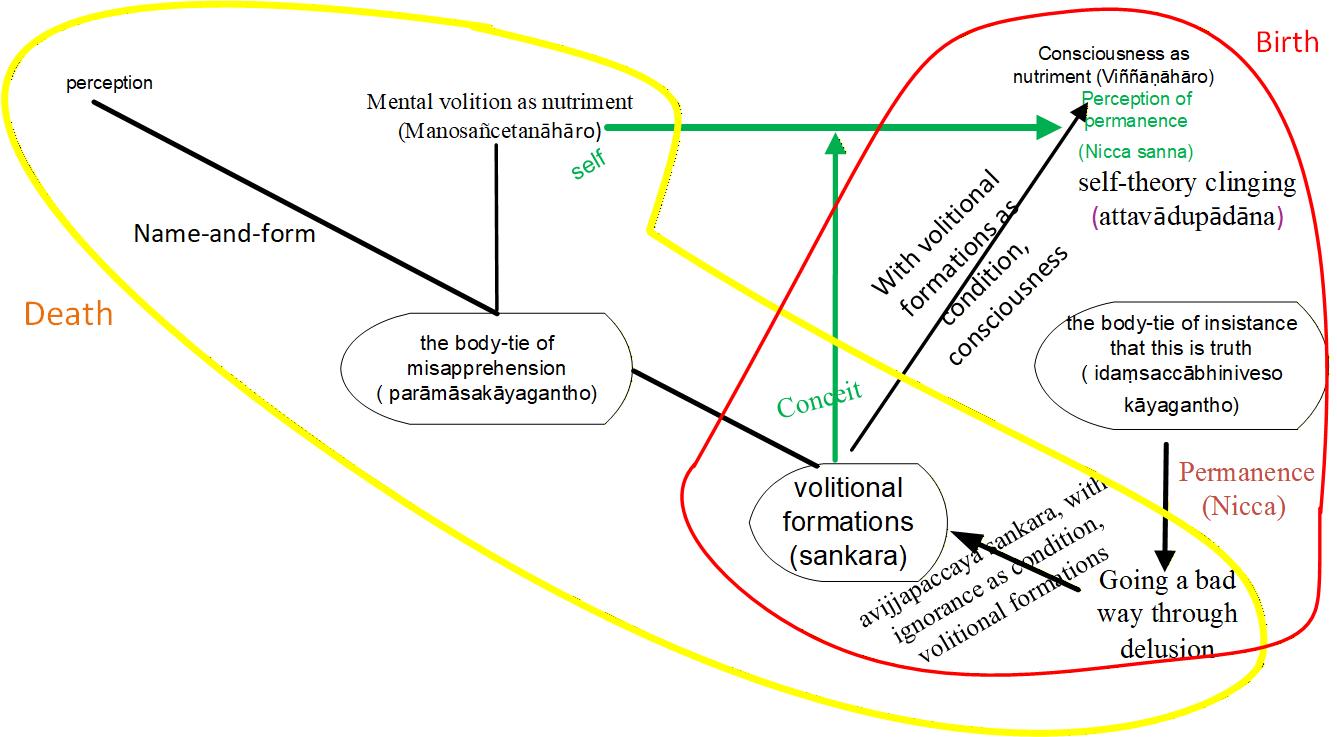
I recalled the third dhamma point added during the discussion on Adhimokkha meditation of 10/11/2023. That is, I remembered that the Budu Piyawaru taught that self-theory clinging (attavāda-upādāna) applies to both birth and death, and this was well understood. Refer to the given diagram. (*1)
1. Recalling the area marked in red denoting birth; as per the teaching of Tapassi Budu Piya, consciousness (viññana) forms, and delusion (moha) occurs through self-theory clinging (attavāda-upādāna) and there is establishment in pleasure (sukha). It is understood that because the foundation for birth was thus established, birth occurs through self-theory clinging (attavāda-upādāna).
2. Thus, when the idea of permanence that arose exists; not knowing that permanence occurred having started from ageing (jarā), and due to delusion (moha), having perceptions that it’s pleasurable to go forth by killing the mind-made body, one established in volitional formations (saṅkhāra) such as killing and stealing. Examine the area marked in yellow which denotes death. Thus, death occurred due to the self-theory clinging (attavāda-upādāna) that arose after this idea of permanence.
That is the meditation.
To add a little more to this:
1. In this meditation, there is strong concentration (samādhi). A luminous, radiant light nature is present. There is no nature of grasping anything in it, and there is no tension.
2. The area marked in red connects with the 'P' section of self-theory clinging (attavāda-upādāna), which is marked from sorrow (soka) to feeling (vedanā). Why is so? Because the formation of consciousness (viññāṇa) occurs thus causing the arising of the ideas associated with feeling (vedanā dhamma)
3. The area marked in yellow corresponds to the 'Q' section of self-theory clinging (attavāda-upādāna), which is marked from feeling (vedanā) to the body-tie of misapprehension (parāmāsakāyagantho). Why so? Because of not knowing that permanence occurred having started from ageing (jarā) delusion (moha) itself has entered the body-tie of misapprehension (parāmāsakāyagantho) as pleasure (sukha). That is why.
That's what needs to be added.
Footnotes added during the discussion
(*1) In that diagram we have shown that, Ignorance as condition volitional formation, volitional formation as condition consciousness marked in red. There, it includes the construction of consciousness with the doctrine going from self (attā) to permanence (nicca) jacked up by conceit (māna). We have labelled that section as ‘birth.’ The section in yellow, we have labelled as ‘death.’