The Noble Council of Akanitta Brahma Realm was remembered with faith.
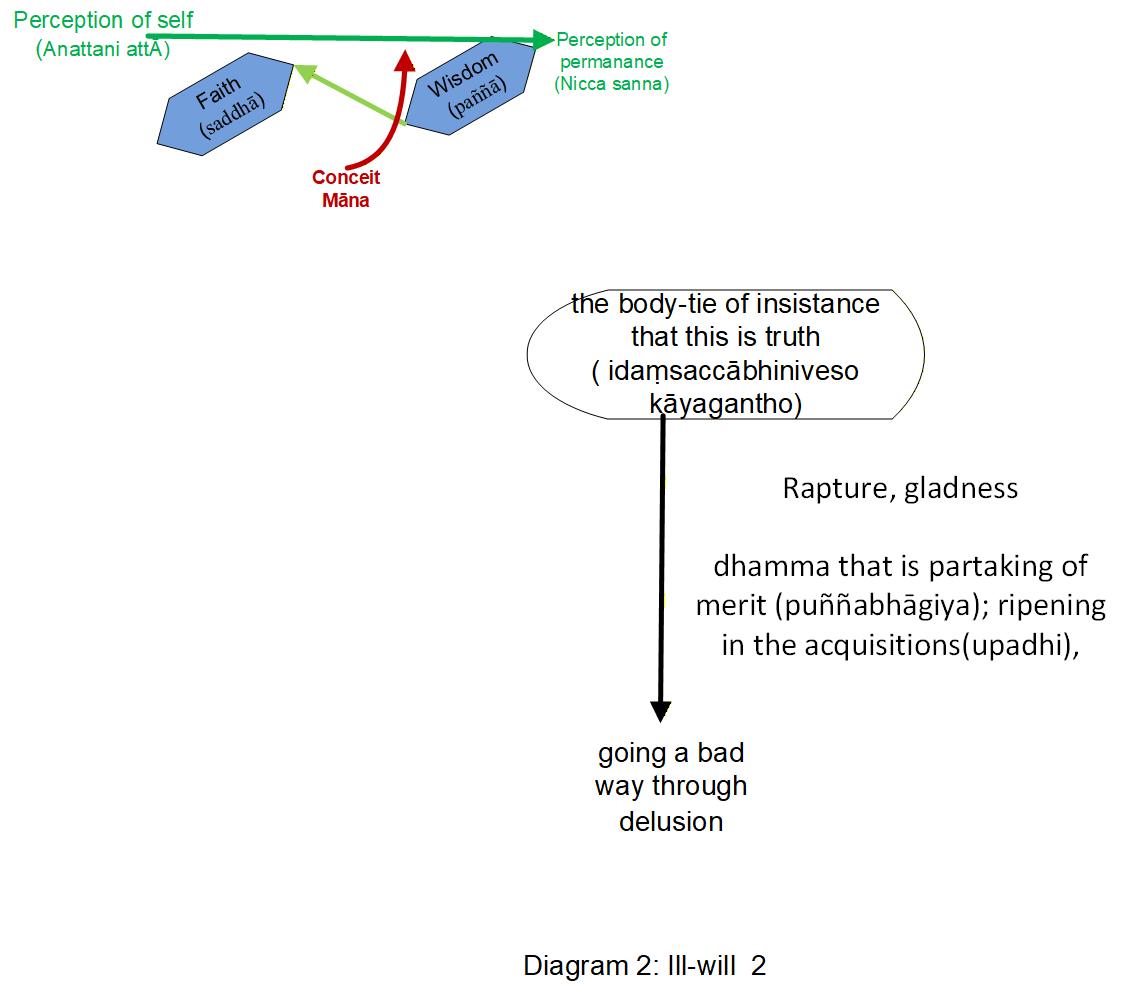
I revisited the Ill-will 2 (vyāpāda 2) diagram that was discussed during the Nibbāna meditation on 14/03/2025.
From ‘insistence that this is truth’ (idamsacca), flowing downwards, dhamma that is partaking of merit (puññabhāgiya); ripening in the acquisitions (upadhi). Before that, there is the doctrine of self (atta) to permanence (nicca) lifted by conceit (mana). If it cannot be conceited for the doctrines that is partaking of merit (puññabhāgiya); ripening in the acquisitions(upadhi), then knowing that the bridge from ‘self’ (attā) to ‘permanency’ (nicca) cannot be maintained in some manner, if some effort should be made for it, if it cannot be accomplished, one falls into ill-will (byāpāda). It was learned that if one cannot carry out such a process well through 'stinginess regarding doctrine’ (dhammamacchariya), then a nature of ill-will (byāpāda) arises towards the phenomena related to feelings (vedanā).
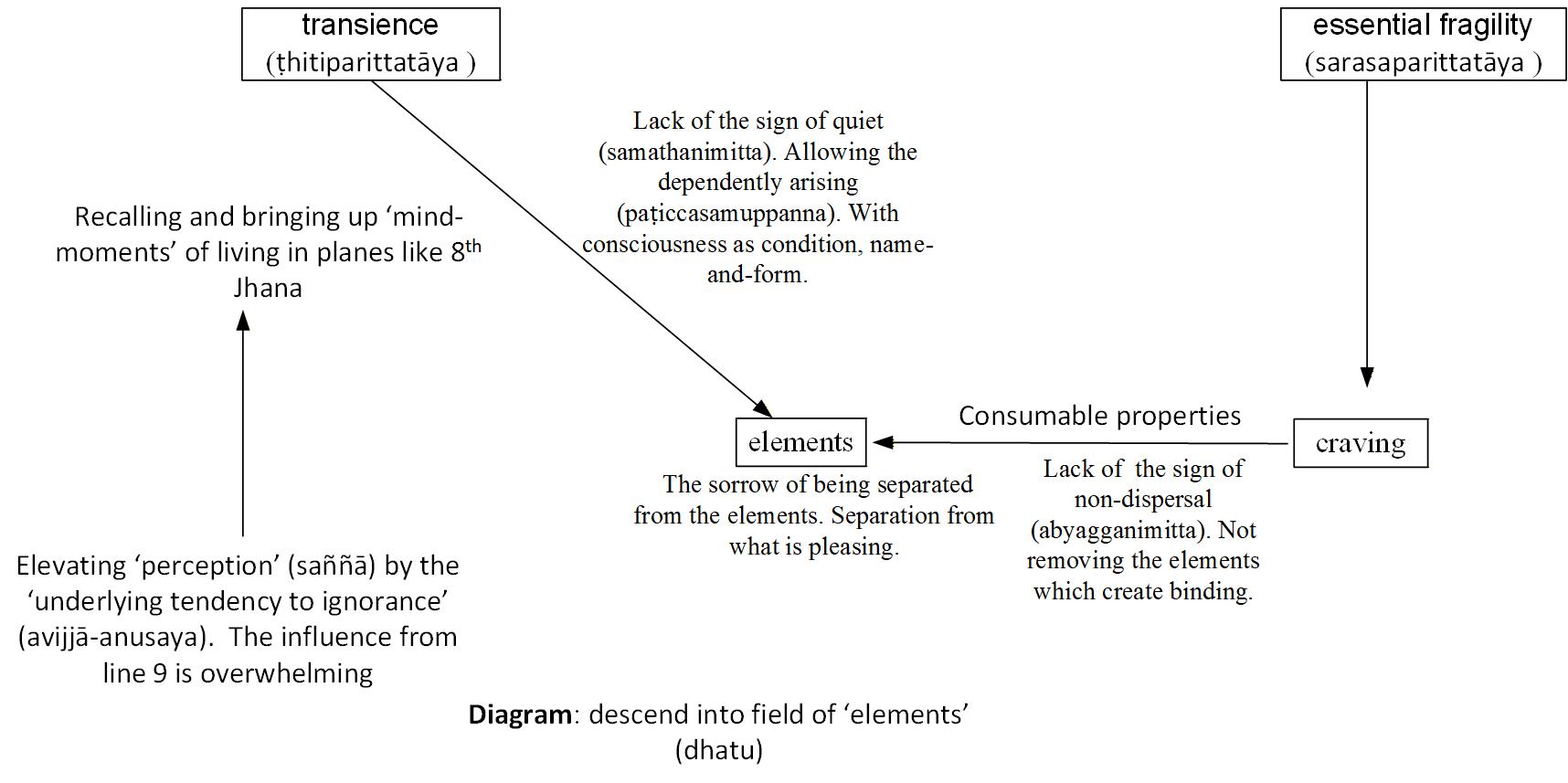
Doctrines of essential fragility (sarasaparittatāya) are used for maintaining this bridge. If there is any difference in it, and it cannot be maintained in a way that is subject to consciousness, then suffering begins to arise. Whatever descent there is here, if one continues to make effort, stinginess regarding doctrine (dhamma maccariya) influences it, and transience (ṭhitiparittatāya) should obey to it. If this doesn’t occur, there is strong conflict. One succumbs to weariness. Here, weariness arises through two types of doctrines - transience (ṭhitiparittatāya) and essential fragility (sarasaparittatāya), and what happens if the bridge cannot be maintained through any other doctrine?
Let's apply and examine the doctrine that was added as the third part in Nibbāna meditation on 14/03/2025.
a) When the influence of Line 9 is strong, regardless of what anyone says, one becomes weary trying to exceed what one is capable of doing.
b) If the lack of clear comprehension (asampajaña) is high, meaning if value of craving (taṇhā) is high, doctrines of essential fragility (sarasaparittatāya) transcend delusion (moha). Using consciousness as nutriment (viññāṇa āhāra) as an example of essential fragility (sarasaparittatāya), as the heavy load of consciousness arrives, the arrival of notion of attā (self) occurs concealing delusion (moha) and transcending the foolish notion of pleasure (sukha) in delusion. Here there is no escape. Why so? Because if one takes any doctrine (dhamma) as self (attā), one is swept away like someone caught in a strong current. If the arrival of notion of self (attā) occurs transcending delusion (moha), good and bad cannot be discerned. In such a situation, perception-born body (saññāmaya kāya) does not hold, it has slipped away. Thus falling into vyāpāda (ill-will), and with it increasing, hate (dosa) arises. Due to this hate, birth (jāti) occurs.
That is the meditation.
To add a little more to this,
1. When the heavy load of consciousness arrives, the arrival of notion of self (attā) occurs concealing delusion (moha) and transcending the foolish notion of pleasure (sukha) in ‘delusion’. Investigating this as in how delusion arrives transcending doctrines of feeling (vedanā dhamma) when the path of straying mind (vibhantacitta) is operational, it becomes apparent that the accumulation of pleasure (sukha) in ‘self’ (attā) is greater than the accumulation of pleasure (sukha) in ‘delusion’.
2. Thus, having understood the accumulation of pleasure (sukha) in the ‘self’ is greater than the accumulation of pleasure (sukha) in ‘delusion’, it was understood that beings have the perception that living is pleasurable (sukha). Since there is influence of consumption of nutriments to this, it was realised that beings have the notion that all nutriments are pleasurable (sukha). In this way, they have created a foundation for birth anywhere in the universe.
3. It is understood that the doctrines of transience (ṭhitiparittatāya) and essential fragility (sarasaparittatāya) are positioned on two sides of the bridge shown by the Thapassi Budu Piyā. Having applied these two doctrines and examining, taintless (anāsava) state occurs, and if the doctrines of transience (ṭhitiparittatāya) and essential fragility (sarasaparittatāya) are not present, then area 1 and area 6 would remain separated.
Discussion 24/05/2025
Notes added at the end of the discussion
Another point can be mentioned.
Examining further, regardless of what anyone says, one becomes weary trying to exceed what one is capable of doing in the case where the influence of Line 9 is strong, we know that we mark “exists” at where ageing (jarā) is, because of the value coming from Line 6. Here, a stopping of the mind occurs, and when examined with examples, this becomes well understood. Taking one example: when someone’s hair has turned white and reached the nature of aging, and that person dyes it to add colour, it is done with the feeling that the what is aged persists. That is so. Let's look at another example: suppose someone has a lot of work to do the next morning, yet when guests arrive that person spends the night making hoppers and then icing a cake, and so on; taking on many tasks during the same night. Here, what's happening is similar to covering up the nature of ageing (jarā) with icing. We realise that we do this frequently.