The Noble Council of Akanittha Brahma Realm was remembered with faith.
In the Nibbana meditation of 16/08/2024, we investigated ‘beauty (subha) + permanence (nicca), leading to pleasure (sukha)’ , and in that, beauty (subha) as ‘perversion of thought’ (citta vipallāsa), permanence (nicca) as ‘perversion of view’ (diṭṭhi vipallāsa), and pleasure (sukha) as ‘perversion of perception’ (saññā vipallāsa). We learned what is deeply rooted (grounded) within the ‘thought of ‘self’ (atta saṅkappa), is the ‘perversion of thought’ (citta vipallāsa) that sees beauty (subha). Why is it said so? It is because the stream of consciousness carries only the ‘form’ (rupa) values, which are insubstantial like cotton. Doctrines like feeling (vedanā), perceptions (saññā) are like snot wrapped around that cotton.
In the ‘hate’ (dosa) meditation on 09/05/2025, we discussed that the accumulation of pleasure (sukha) within the ‘thought of self’ (atta saṅkappa) is greater than the accumulation of pleasure (sukha) within delusion. If, what is deeply rooted (grounded) within ‘thought of self’ (atta saṅkappa), is the ‘perversion of thought’ (citta vipallāsa) that sees beauty (subha), then it becomes clear that this is the same phenomena that helped in the accumulation of pleasure (sukha).
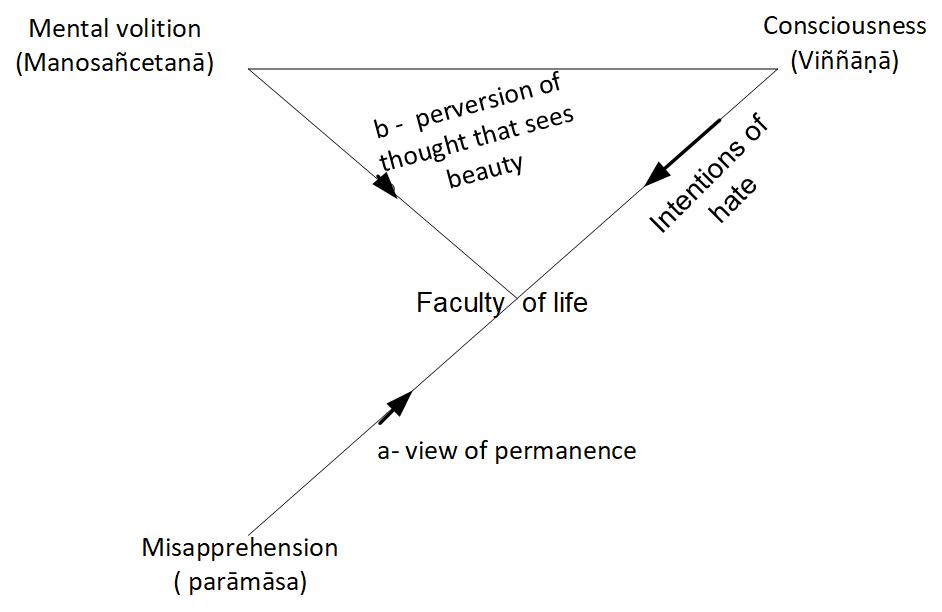
I investigated the diagram given in the 27/09/2024 Jivitha Indriya meditation.
We learned that, if the two values, a- ‘view of permanency’ (nicca diṭṭhi) and b- ‘perversion of thought’ (citta vipallāsa) that sees beauty (suba), are sufficient for the functioning of the ‘faculty of life’ (jīvitindriya), and then, only for the purpose of understanding its capability, the values of ‘intentions of hate’ (paduṭṭhamanasaṅkappa) coming from consciousness (viññāṇa) are investigated.
Thinking about what has influenced the accumulation of pleasure within the ‘thought of self’ (atta saṅkappa), it seems this occurs because living for a very long time in ‘consciousness as nutriment’; through ‘intentions of hate’ (paduṭṭhamanasaṅkappa), with the addition of ‘perversion of thought that sees beauty’ (subha citta vipallāsa) the ‘faculty of life’ (jīvitindriya) is nourished, and doctrines that have been entered ‘misapprehension’ (paramāsa) by means of that very ‘faculty of life’ (jīvitindriya). It is understood that we have taken as beauty (subha) for a long time. That is so. So, it is clear that the combination of the other 3 nutriments has helped to sustain the living for a very long time in ‘consciousness as nutriment’.
Recalling the doctrine (dhamma) pointed out by the Mandaladhipati Budu Piya, seeing perception (saññā) as suffering (dukkha), then perception (saññā) does not travel towards form(rūpa), or towards volition (cetanā), or towards feeling (vedanā). Here, the ‘perversion of perception of pleasure’ (sukha saññā vipallāsa) does not remain. If so, we learned that in 16/08/2024 Nibbana meditation, with the removal of the ‘perversion of thought that sees beauty’ (subha citta vipallāsa), the mind will not get established anywhere. Thus, with the removal of ‘perversion of thought that sees beauty’ (subha citta vipallāsa), abiding in ‘consciousness as nutriment’ (viññāṇa āhāra) becomes impossible. As such, it forms the foundation for Nibbana. To descent into this, the ‘four bases of spiritual power’ (cattāro iddhipādā) should be used. For this purpose, ‘four bases of spiritual power’ (cattāro iddhipādā) should be well-developed according to the Nibbāna meditations of 07/02/2025 and 14/02/2025.
This is the meditation I did.
If I am to add a little more to this,
1. Having read this meditation and doing the meditation, reflecting on the first paragraph, I recalled the dragging as beauty (subha) from misapprehension (parāmāsa) to ‘insistence that this is truth’ (idaṃsaccā) in the Imperturbable (Āneñjasappāya) diagrams. With this, my mind became taintless (anāsava), which persisted throughout the entire meditation. I found recalling the remaining parts to be very difficult. Knowing how the pleasure (sukha) gets accumulated within the ‘thought of self’ (atta saṅkappa), is the cause (hetu) and condition (paccaya) for this. After the meditation, even the ‘repair’ was very difficult. This is due to the mind becoming very slow.
2. Not recalling the dragging as ‘beauty’ (subha) from misapprehension (parāmāsa) to ‘insistence that this is truth’ (idaṃsaccā) in the ‘Imperturbable’ (Āneñjasappāya) diagrams, recalling the doctrine pointed out by the Mandaladhipati Budu Piya up to where it says one does not go to the ‘feeling’ side, and contemplating that ‘pleasure’ (sukha) accumulated within the ‘thought of self’ (atta saṅkappa), is greater than the accumulation of ‘pleasure’ (sukha) within ‘moha’ (delusion) and delusion (moha)- ‘pleasure’ (sukha) arrives, surpassing the doctrines of feeling (vedanā) - ‘suffering’ (dukkha), my mind became ‘taintless’ (anāsava).
3. I recalled the dhamma as pointed out by the Mandaladhipati Budu Piya. Seeing ‘perception’ (saññā) as ‘suffering’ (dukkha), perception does not go both ways, it does not go to either form (rūpa) side or volition (cetanā) side. Seen this, the stream of consciousness (viññāṇa) slows down. Then there is no movement towards the third side. That is, not going towards feeling (vedanā). One becomes free from feelings. Here, I investigated the reason why it does not go to the feeling side. If it does not go to the form side, then it will not go towards feeling along the 10% path. If it does not go to the volition (cetanā) side, then it will not go to the feeling along the ‘underlying tendency to view’ (diṭṭhānusaya) path, which is the 40% path. Furthermore, if it does not go to the ‘volition’ side, then the ‘underlying tendency to sensual desire’ (kāmarāga anusaya) is not eager to declare perception (saññā) as pleasurable (sukha) from the ‘delusion’ (moha) which arose as a result of not going to ‘volition’ side and this prevents going from ‘taint of ignorance’ (avijjāsava) to ‘taint of sensual desire’ (kāmāsava). One does not travel to ‘feeling’ along the ‘planned thoughts’ (saṅkappa) path, which is the 50% path. Here the stream of consciousness becoming slow is a crucial point. Seeing the perception as suffering, the taint of sensual desire does not occur, meaning ‘post-perceptions’ do not emerge and consequently ‘perversion of perception of pleasure’ (sukha saññā vipallāsa) does not remain. (*1)
4. Investigating with reference to the given diagram,
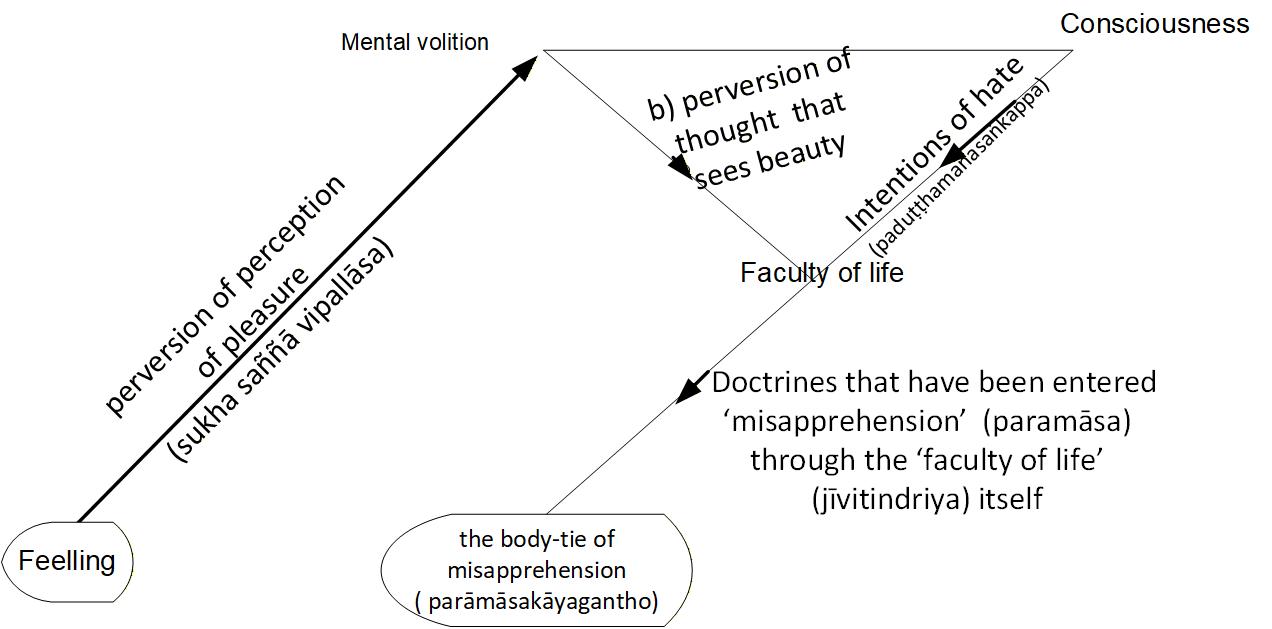
the things influenced the accumulation of ‘pleasure’ (sukha), within the ‘thought of ‘self’ (atta saṅkappa) are now clearly understood. This occurred through two doctrines; the ‘perversion of perception of pleasure’ (sukha saññā vipallāsa) coming from ‘feeling’ (vedanā) up to ‘volition’ (cetanā) and doctrines of pleasure that have been entered ‘misapprehension’ (paramāsa) through the ‘faculty of life’ (jīvitindriya) itself.
5. If the accumulation of pleasure (sukha), within the ‘thought of self’ (atta saṅkappa), is greater than the accumulation of pleasure (sukha) within delusion (moha), and since we have roamed in the samsara for a very long time as stated in 'Avijjā hayaṃ mahāmoho, yenidaṃ saṃsitaṃ ciraṃ', meaning, it is because of ignorance, this great delusion that one has wandered on for so long, with the addition of the ‘perversion of thought that sees beauty’ (subha citta vipallāsa), the ‘faculty of life’ (jīvitindriya) has been nourished for a long, it helped us to understand that for a long time we have taken as ‘beauty’ (subha). (*2)
This is what I have to add.
Discussion 07/06/2025
Footnotes added after the discussion
(*1) meaning not having sorrow-2.
(*2) This means that these two concepts – ‘permanence’ (nicca) and ‘beauty’ (subha) - have existed together for a long time.