The Noble Council of Akanitta Brahma Realm was remembered with faith.
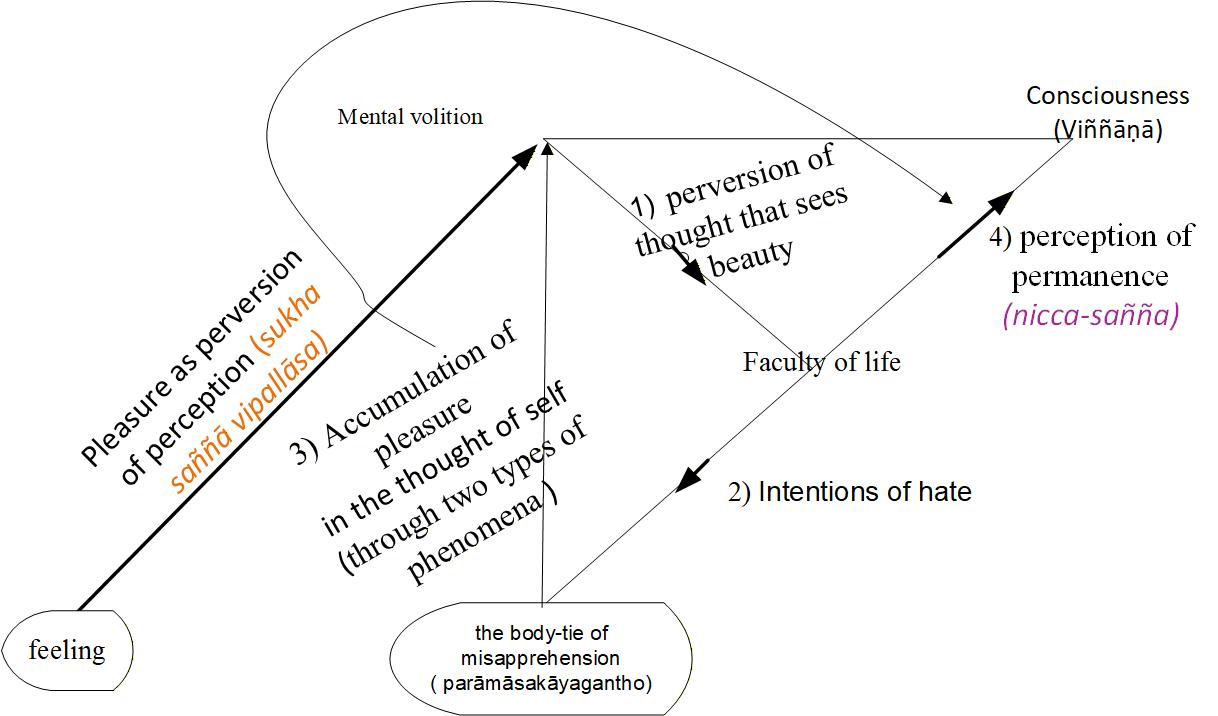
Contemplating the 30/05/2025 Nibbāna meditation followed by the repair meditation, during the bases of spiritual power (Iddhipada) section; when contemplating how the base of spiritual power due to investigation (Vīmaṃsa Iddhipada) removes the gratification in intentions of hate (paduttha-manasankappa), it was understood that this gratification is the ‘pleasure as perversion of perception’ (sukha saññā vipallāsa) accumulated in the consciousness as nutriment (viññāṇa-āhāra), through the perception of permanence (nicca-sañña) arising from the perversion of thought that sees beauty itself. See the diagram provided.
Here, we have marked 1) the perversion of thought that sees beauty (subha citta vipallāsa), 2) combined with intentions of hate (paduttha-manasankappa) and entering the body-tie of misapprehension (parāmāsakāyagantho), 3) accumulation of pleasure in thought of self through two types of phenomena (dhamma) namely: the ‘pleasure as perversion of perception’ (‘sukha sañña vipallāsa) that comes from feeling (vedanā) to volition (cetanā) and the doctrines of pleasure that have been entered ‘misapprehension’ (paramāsa) through the ‘faculty of life’ (jīvitindriya) itself. The perception of permanence (nicca-sañña) that arises from this is marked as 4). Through this, ‘pleasure as perversion of perception’ (sukha sañña vipallāsa) becomes accumulated in consciousness as nutriment (viññāna-āhāra).
If so, when using the path of spiritual powers in the Acchariyo abbhuto dhamma meditation of 15/05/2015, how does the base of spiritual power due to investigation (vimamsa-iddhipāda) become nourished enough to remove this gratification? Investigating the doctrine (dhamma) of Tapassi Budu Piya; having removed even volitional formations and formless jhanas using the other bases of spiritual power (Iddhipada), it should be nourished to the extent that no bridge can be built from self to permanence. That is, using the doctrine shown by the Mandaladhipathi Budu Piya, the mind must reach a state where the ‘pleasure as perversion of perception’ (sukha sañña vipallāsa) does not remain.
If it is not so, an accumulation, an emergence of pleasure in the self (atta) occurs and Nibbāna is not attained. Thinking thus, it is understood that all doctrines of sorrow should be removed through the base of spiritual power due to mind (citta-iddhipāda). This is so.
For this, removing the formless jhanas,through effort (viriya) which is used thirdly in the path of spiritual powers, thereafter the investigation (vimamsa) must become powerful enough so that nothing enters the body-tie of misapprehension (parāmāsakāyagantho) through the faculty of life (Jivita indriya) as permanent (nicca). When this happens, the consciousness as nutriment (viññāna-āhāra) becomes isolated. Subsequently, ‘pleasure as perversion of perception’ (sukha sañña vipallāsa) disappears. That is, just as someone goes dry when not receiving any nutriment, similarly it extinguishes. For example, if firewood is not supplied to a fire, it goes dry and extinguishes - it should be understood in this way.
That is the meditation.
To add a little more to this:
1) In the Dosa meditation of 09/05/2025, it is well understood that when the value of craving (tanha) is high, the essential fragility (sarasaparittatāya) doctrines arise surpassing delusion (moha). That is, when the value of craving is high, the essential fragility (sarasaparittatāya) doctrines flow through the ‘pleasure as perversion of perception’ (sukha sañña vipallāsa). (*1)
2) When examining that the mind must reach a state where the ‘pleasure as perversion of perception’ (sukha sañña vipallāsa) does not remain, the process done here through desire (chanda) marked on the left side, is well understood. The subsiding of delight (nandi) there leads to the removal of the 50% path. If so, thinking of the non-remaining of the ‘pleasure as perversion of perception’ (sukha sañña vipallāsa), as the cessation of pleasures previously experienced like a king, arising from the path of sorrow (soka) 2, a very peaceful mind arose.
3) The ‘pleasure as perversion of perception’ (sukha sañña vipallāsa) is removed when there is no flow from the taint of ignorance (avijjā āsava) to the taint of sensual desire (kama āsava). One should not go seeking the contact (phasso) that leads to taints (āsava). That is, the removal of sorrow (soka) 2, delight (nandi), the removal of the 50% path should occur. When contemplating this meditation in this way, a coolness is felt in the face.(*2)
That is what needs to be added.
Discussion 21/06/2025
Notes added during the discussion
(*1) This means that within the accumulation of pleasure in the thought of self (atta), the upper portion, that is, the portion from feeling (vedanā) to volition (cetanā) is being utilised.
(*2) So here, one can observe the process done through effort (viriya). This was shown in the second point of what we added to the Nibbāna meditation on 23/06/2023. It is the removal using the power of effort (viriya balaya) without forming views towards the objects that arose in the mind. So it shows that if delight (nandi) is removed through desire (chanda), then the 50% path is cut off, and the ‘pleasure as perversion of perception’ (sukha sañña vipallāsa) is removed. We know that the view (diṭṭi) is between the body-tie of misapprehension (parāmāsakāyagantho) and volition (cetanā) and there can be views that I was residing here or that there was a steadying of consciousness because of residing. At this point, 'not associating with views' means that, those views should not be there. It shows that the immersion in investigation (vimansa) took place only because the base of spiritual power due to effort (viriya-iddhipāda) that became steady. If one uses that part, then the meditation is very good.