The Noble Council of Akanittha Brahma Realm was remembered with faith.
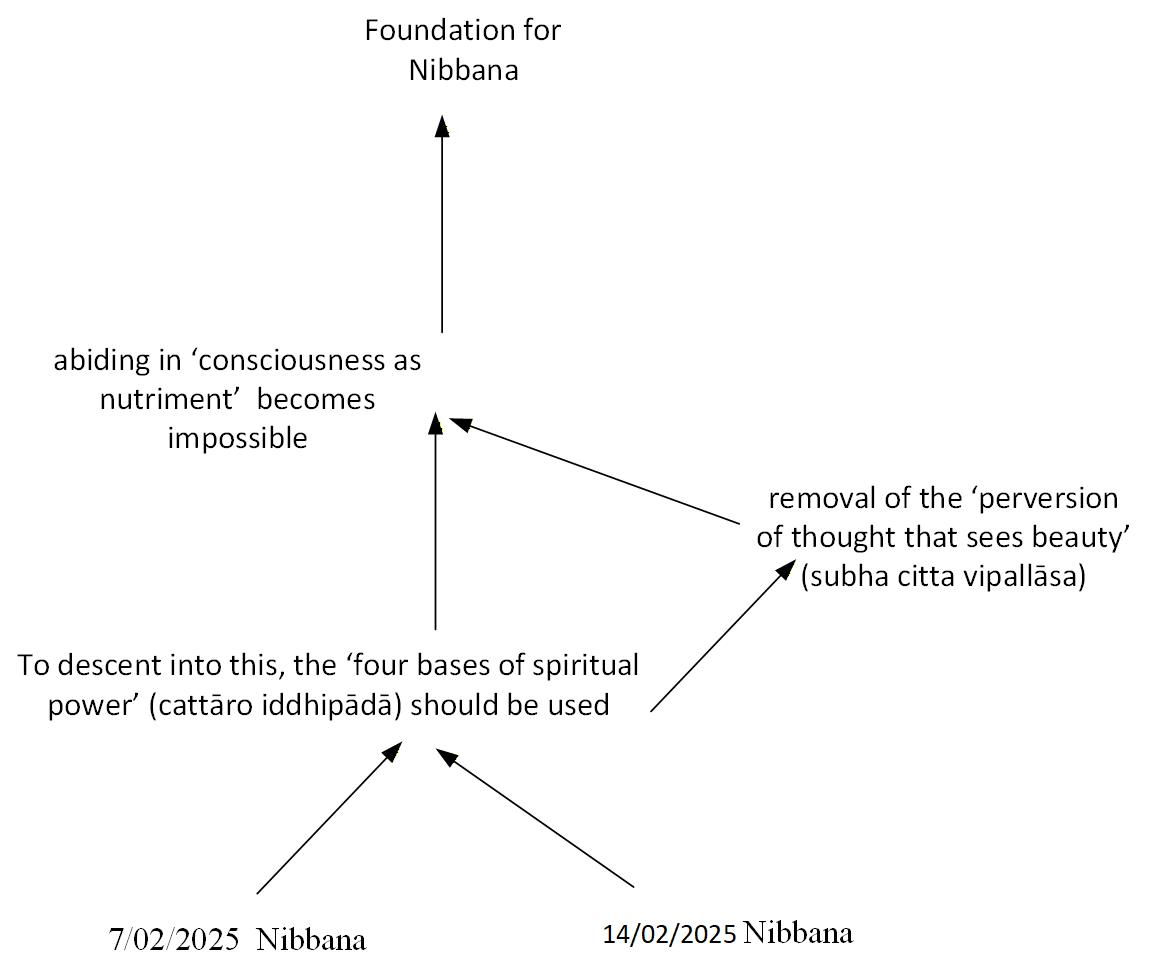
I repeated the Nibbana meditation of 30/05/2025. I focussed my mind to the section mentioned at the end of that meditation. That is, with the removal of perversion of thought that sees beauty (subha citta vipallāsa), it becomes impossible to dwell in ‘consciousness as nutriment’ (viññāṇa-āhāra), and this itself creates the foundation for Nibbana. To descend into this dhamma, one should utilise the ‘four bases of spiritual power’ (cattāro iddhipādā). For this purpose, the ‘four bases of spiritual power’ should be well-developed as outlined in the Nibbāna meditations of 07/02/2025 and 14/02/2025.
This can be marked in a diagram. Refer to the diagram given below.
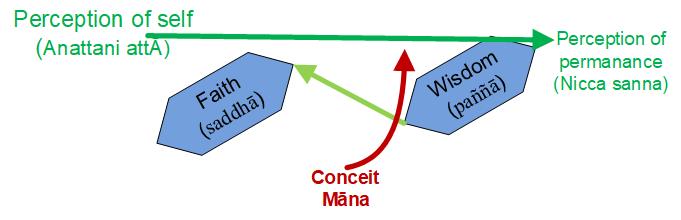
Reflecting on the points in the Nibbana 14/02/2025 meditation first, my mind focussed on the bridge from ‘self’ (attā) to ‘permanence’ (nicca) as shown by Tapassi Budu Piya.
We learned that, once the suffering in area 1 was highlighted through the ‘base of spiritual power due to mind’ (citta iddhipāda) and we had inherited that highlighting, it came to be felt more strongly. If we do not take as ‘beauty’ because of this, then there is no spinning of the belt in area 1. This affects area 6. This leads to the destruction of doctrines of ‘delusion’ (moha) there, both past and present. How so? With the removal of ‘volitional formations’ (saṅkhāra) by ‘concentration due to desire’ (chanda-samādhi), thereby the harm done to ‘delusion’ (moha) is one thing (*1). Due to establishment in thought of suffering (dukha sankappa), the difficulty to speak of ‘pleasure’ (sukha) is another thing (*2). Through ‘effort’ (viriya), to say that things like ‘forms’ (rupa), TV etc. should not be used is another thing.
Thus, if these two doctrines; suffering in area1 and suffering in area 6 exist, then the bridge from ‘self’ (attā) to ‘permanence’ (nicca) cannot be maintained. For what reason? Due to the suffering in area 1, ‘perversion of perception of pleasure’ (sukha saññā vipallāsa) does not exist. Due to suffering in area 6, it becomes firmly established as such (*3). That is, it says that there is not a ‘perception of pleasure’ (sukha saññā) but rather a ‘perception of suffering’ (dukkha saññā). Thus, because there is nothing to be taken as ‘self’ (attā), the bridge from ‘self’ to ‘permanence’ (nicca) does not exist. This is like there is a shortage of food.
According to the Nibbana meditation of 07/02/2025, the case where ‘the base of spiritual power due to desire’ (chanda iddhipāda) becomes active, is like someone repeatedly pointing the finger at the continuously decaying ‘form’ (rupa), has been discussed previously. If one takes the continuously decaying ‘form’ marked in area 2 as ‘self’ (atta), then ‘suffering’ is included in that ‘self’. If one becomes conceited about the continuously decaying ‘form’, then ‘suffering’ is also included in that conceit. Thereby, if one regards the continuously decaying ‘form’ as ‘permanent’ (nicca), suffering is included in that as well. Thus, the doctrine of ‘suffering’ (dukkha) present in area 2, become connected to the area where consciousness is marked. Thus, both area 2 and the area where consciousness is marked, indicate ‘suffering’. How then is the ‘perversion of thought that sees beauty’ (subha citta vipallāsa) eliminated from this?
This is connected with ‘sensuality’ (kāma). When recalling the definition of ‘volition’ (cetanā), this becomes clear. Kāmesu saṃyutto viharati bhāvito ajjhosanno ayaṃ cetanā - Dwelling connected with those sensual desires, developed and remain holding to them - this is the ‘volition’. If there is ‘suffering’ in area 2, then it becomes difficult to arrive at ‘volition’ along the 50% path. If so, it becomes impossible to maintain ‘self’. However, there may be a coming to feeling along the 40% path. How can this be prevented? Investigate ‘going a bad way through fear’ (bhayā agatigamana) from ‘consciousness’ through the mode value of volitional formations. If ‘the area where consciousness(viññāṇa) is marked is ‘suffering (dukkha), then ‘mode-volitional formations’ become impossible, thus making it difficult to arrive at ‘feeling’ through ‘going a bad way through fear’. Thus, it becomes difficult to reach ‘volition’ (cetanā) through these two doctrines, stopping the processes occurring through post volitions.
In this way, it should be understood that it is impossible to dwell in ‘consciousness as nutriment’ (viññāṇa-āhāra) from the 07/02/2025 and 14/02/2025 Nibbana meditations.
This is the meditation I did.
If I am to add a little more to this,
1. If the area where ‘consciousness’ is marked is suffering (dukkha), the impossibility to perform ‘mode volitional formations’, is like an animal that has become accustomed to stealing food from a house but later gets beaten, can no longer perform its habitual ‘mode volitional formations’.
2. Doing this meditation, while expansion of the mind and stopping of the mind occurring from time to time, the mind remained very pure.
3. When examining the bridge from ‘self’ to ‘permanence’, shown by Tapassi Budu Piya, and connecting it with the continuously decaying ‘form’ (rūpa), the arising of ‘fruit of attainment’ (phala citta) occurs, the universe becomes visible.
This is what I have to add.
Discussion 26/05/2025
Footnotes added after the discussion
(*1) that is present
(*2) that is past
(*3) that is, “underlying tendency to greed for sensual desire” (kāmarāganusaya) is not going to say that perception is pleasurable.