The Noble Council of Akanitta Brahma Realm was remembered with faith.
During the 20/03/2015 Samma Naana (Right Knowledge) meditation, it is stated that the faculty of mindfulness (sati indriya) should be well maintained. How?
The mindfulness that arose through the practice of the 04/07/2025 Nibbāna meditation - that is, the understanding that the idea ‘exists’ in ageing (jarā) does not exist when sickness (vyādhi) is well understood, has to be penetrated in the faculty of mindfulness (sati indriya), and when one is mindful in this way, Right Mindfulness (sammā sati) exists within Right View (sammā diṭṭi). Within such Right View (samma diṭṭi), there is Right Wisdom (sammā-paññā). Because of such Right Wisdom (sammā-paññā), there is Right Knowledge (sammā-ñañā). It is understood that there is Right Liberation (sammā-vimutti) arisen from that.
With this, the meaning of the star appearing near the body-tie of misapprehension (parāmāsakāyagantho) becomes clear. This is like the star learned during the Sabbāsava (Discourse on all the taints) meditations. The difference is its vast expansion. To understand this well, carefully examine pages 6, 8, and 9 of the Sabbāsava Sutta diagrams 3. On the sixth page, it states that if the view breaks, the wrong view (micchā- diṭṭi) does not get the support. That is, as understood in the 27/06/2025 Asmiti maana meditation, when there is no ‘view’ (diṭṭhi) between ‘misapprehension’ (paramasa) and ‘mental volition’ (manosañcetanā), perception values that ‘there is something’ within the stream of consciousness, by way of consciousness as condition (viññāṇa paccaya), can enter separately into ‘misapprehension’ (parāmāsa) and ‘mental volition’ (cetanā), from both ends. Even in such situations, if one doesn't take it, wrong view (micchā- diṭṭi) does not occur. If so, there is no support for I-making (ahiṃkāra). How is this so?
Examine Area 2. If there is suffering (dukkha) there, the flow from the taint of ignorance (avijjā āsava) to the taint of sensual desire (kāma āsava) does not occur, then the flow from the taint of sensual desire (kāma āsava) to the taint of ignorance (avijjā āsava) is also prevented.
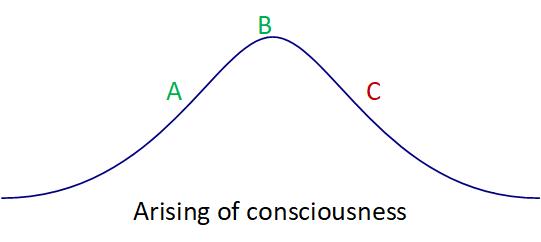
The B point of the Bell-shaped curve cannot be formed due to ageing (jarā). The gratification (assāda) that arises due to spinning within the taint of ignorance (avijjā āsava) does not remain. The co-existence of I-making (ahankāra) and my-making (mamankāra) ceases. My-making (mamankāra) and I-making (ahankāra) together made the self (Attā). Because of this, doctrines that occurring with consciousness (viññāṇa) as condition at both ends, for volition (cetanā) and the body-tie of misapprehension (parāmāsakāyagantho) fall away. Why? Because all four bases of spiritual power (iddhipāda) are active.
That is the meditation.
To add a little more to this,
1. When doing this meditation, the mind becomes straight and serious. It doesn't grasp at anything.
2. While repairing, and contemplating pleasure (sukha) occurring through beauty (subha) + permanence (nicca), it was remembered that the view (diṭṭi) has broken, and a large star appeared again at the body-tie of misapprehension (parāmāsakāyagantho).
3. Having studied this meditation well, and on starting the meditation, remembering that when there is no ‘view’ (diṭṭhi) between ‘misapprehension’ (paramasa) and ‘mental volition’ (manosañcetanā), perception values that ‘there is something’ within the stream of consciousness, by way of consciousness as condition (viññāṇa paccaya), can enter separately into ‘misapprehension’ (parāmāsa) and ‘mental volition’ (cetanā), from both ends and that even in such situations, if one doesn't take it, wrong view (micchā- diṭṭi) does not occur, taintless (anāsava) mind occurs in an amazing way. Here the liberated mind (vimutti-citta) remains unwavering. This is a wonderful and marvellous (Acchariyaabbhuta) dhamma. Through this meditation, 100 [people] will realise Nibbāna.
4. One should not have conceit (māna) thinking that values have entered the body-tie of misapprehension (parāmāsakāyagantho) and volition (cetanā) from both ends separately, by way of consciousness as condition. If this is not the case, wrong view (micchā- diṭṭi) will arise.
5. The idea ‘exists’ in ageing (jarā) does not exist when sickness (vyādhi) is well understood. For this, one should know that the misapprehension (parāmāsa) does not last (‘exists’). That is, one should realise that wrong understanding does not last. Then, one realises the value of placing the Four Noble Truths (Caturaārya-sacca) near the body-tie of insistence that this is truth (idaṃsaccābhiniveso kāyagantho). It shows that it does not exist.
6. Investigating if the flow from the taint of ignorance (avijjā āsava) to the taint of sensual desire (kāma āsava) does not occur, then the flow from the taint of sensual desire (kāma āsava) to the taint of ignorance (avijjā āsava) is also prevented, through this, my-making (mamankāra) is removed. Along with that I-making (ahankāra) is also removed. Why is so? Because the absence of proliferation through craving (taṇhā-papañca) leads to the removal of my-making (mamankāra), while the removal of the proliferation through views (diṭṭi-papañca) influences the removal of I-making (ahankāra). When investigating in this way, a peaceful, well-liberated mind (santa-suvimutta-citta) arises.
That is what needs to be added.
Discussion 19/07/2025
Notes added at the end of the discussion
Another point can be added to this:
When further investigating that “doctrines that occurring with consciousness (viññāṇa) as condition at both ends fall away due to this” it is understood that if there is no formation of self (attā), then consciousness does not arise with volitional formations as condition (saṅkhāra-paccaya-viññāṇa). Just as when someone tries to give something to another who doesn't accept it, the giver gives up trying, so it is like that.
That is what needs to be newly added.