The Noble Council of Akanitta Brahma Realm was remembered with faith.
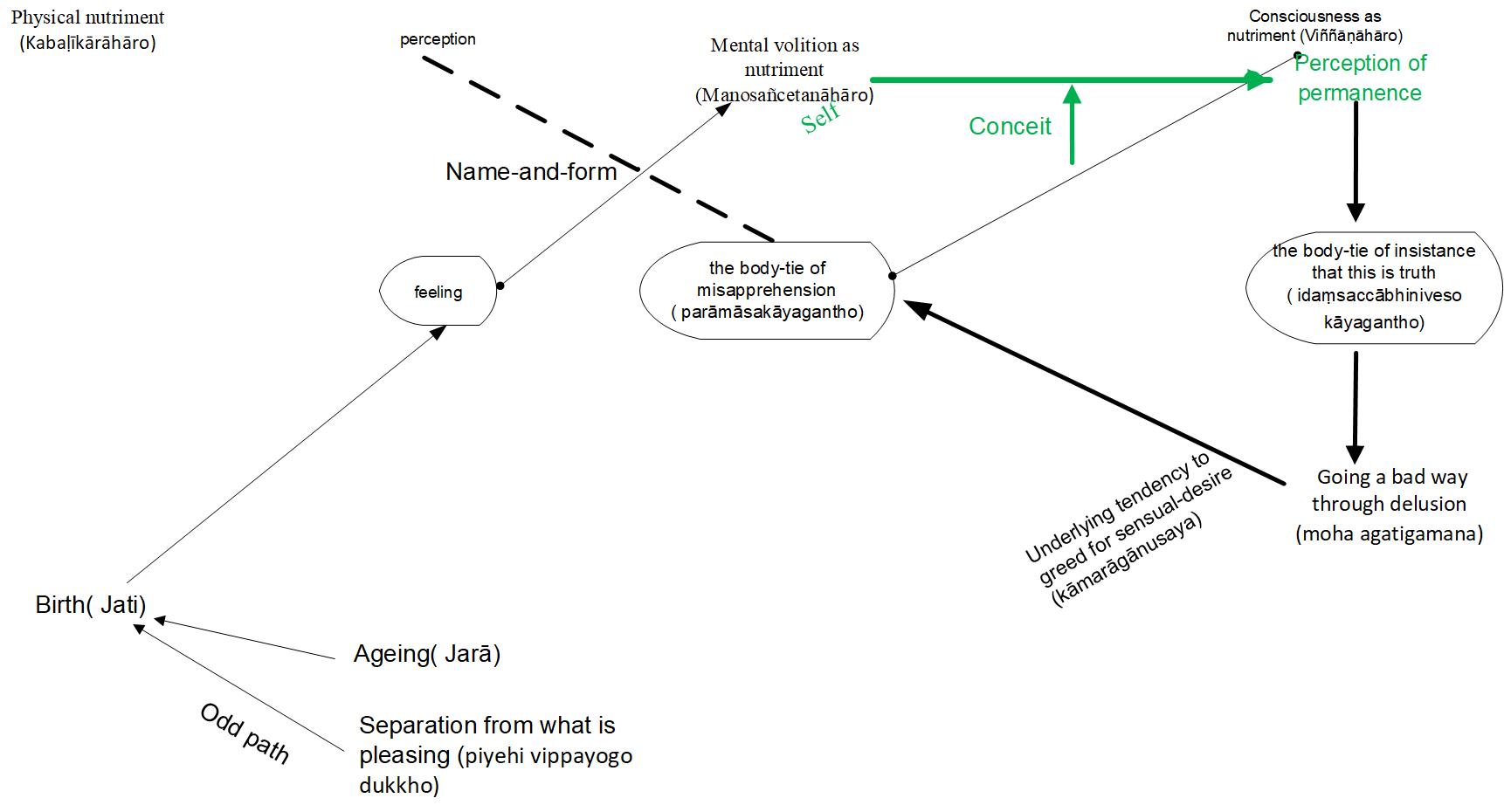
I repeated the 11/07/2025 Samma Vimutti meditation. The mind focused on the fourth point that was added there. That is, one should not have conceit (māna) that values have entered the body-tie of misapprehension (parāmāsakāyagantho) and volition (cetanā) from both ends separately, by way of consciousness as condition. If this is not the case, wrong view (micchā- diṭṭi) will arise.
While examining with the 21/02/2025 Nibbāna meditation, if there is mindfulness (sati) that “the idea ‘exists’ in ageing (jarā) does not exist when sickness (vyādhi) is well understood” then just as values come from both ends through consciousness (viññāṇa) as condition, the acceptance of them, the path of straying mind (vibhantacitta) does not arise, and wrong view (micchā-diṭṭi) does not occur.
That is, separation from what is pleasing (piyehi vippayogopi dukkho), birth (jāti), feeling (vedanā), volition (cetanā), from self (attā) to permanence (nicca), going a bad way through delusion (mohā agatigamanaṃ), and perception (saññā) through underlying tendency to greed for sensual desire (kāmarāga anusaya). Thus, it can be seen that from the separation from what is pleasing (piyehi vippayogopi dukkho) up to the perception of pleasure (sukha saññā), the journey is driven by delusion.
One should not seek delight in ageing (jarā). If one does, then through the above path, perception (saññā) will be declared as pleasure (sukha). If declared so, just as self (attā) 1 and self (attā) 2 combine, it will unite with the values coming from both ends through consciousness (viññāṇa) as condition. How to prevent this? It is through all four bases of spiritual power (iddhipāda) being active.
That is the meditation.
To add a little more to this,
1. When doing this meditation, while examining the arrival of values from both ends through consciousness (viññāṇa) as condition, one should understand that these values coming through consciousness (viññāṇa) as condition also arrived at delusion (moha). It is like hitting carrom pieces. Its spread is evident all the way down to the delusion (moha) below. Therefore, one should ensure that area 6 where delusion (moha) exists and area 2 where aging (jarā) exists are not bound together by craving for sensual desire (kāma taṇhā). The nature of the stream of consciousness (viññāṇa) should be understood thus. It is like an octopus. It has extended tentacles everywhere.
2. Here, one should examine the path; the body-tie of insistence that this is truth (idaṃsaccābhiniveso kāyagantho), the body-tie of misapprehension (parāmāsakāyagantho), sickness (vyādhi), and aging (jarā), and having placed the Four Noble Truths (Caturaārya-sacca) near the body-tie of insistence that this is truth (idaṃsaccābhiniveso kāyagantho) one should understand that the idea ‘exists’ in ageing (jarā) does not persist.
That is what needs to be added.
Discussion 02/08/2025
Notes added at the end of the discussion
To add another point to this,
3. After thoroughly developing the understanding of the nature of suffering in Area 1 and Area 6, then developing the impermanence of perception through the Anicca Saññā Sutta, when examining the arising phenomenon (samudaya) part, if there appears the plane of nothingness (ākiñcaññāyatana), and thereafter:
- If one takes the decaying form marked in Area 2 as self (attā), then that ‘self’ contains suffering.
-If one becomes conceited (māna) about the decaying form, then that ‘conceit’ contains suffering.
-Through that, if one takes the decaying form as permanent (nicca), then suffering is contained within that too.
When connecting these aspects of suffering (dukkha) in Area 2 to the area where consciousness (viññāṇa) is marked, and to the nature of mind thus arisen, when the impermanence (anicca) of perception (saññā) is developed, if there occurs a dragging into deep space, one should not take it as "I am skilled." This too should be considered as taking the decaying form as self (attā). In this way, one should understand that one should not have conceit (māna) that values have come from both ends separately, by way of consciousness as condition.
That is what needs to be added.