The Noble Council of Akanitta Brahma Realm was remembered with faith.
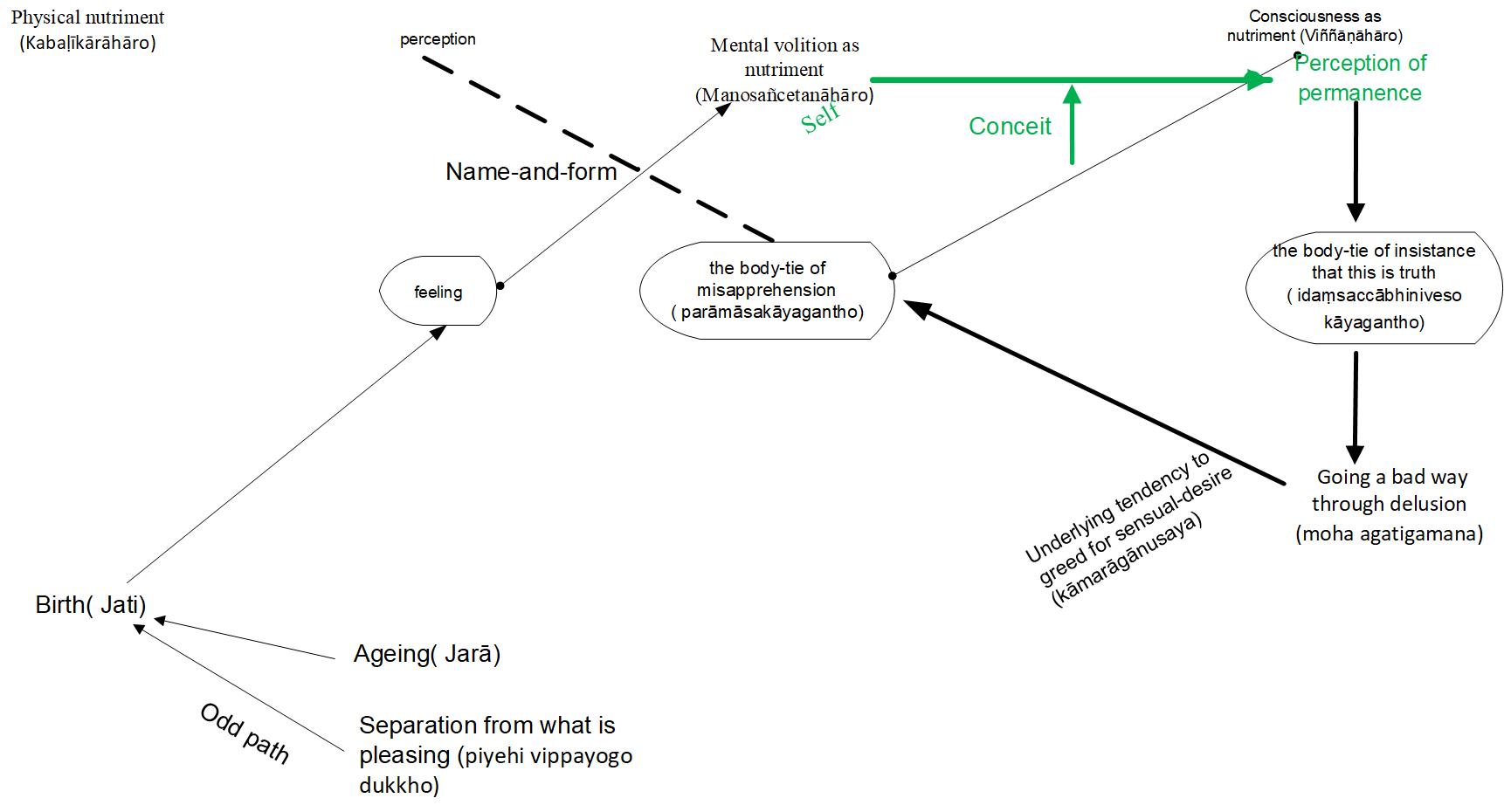
I repeated the 18/07/2025 Samma Vimutti 2 meditation. I again examined the second point that was added there. From the ‘insistence that this is truth' (idaṃsacca) to misapprehension (parāmāsa) and if due to the agitation of misapprehension (parāmāsa), if there is the flow from misapprehension (parāmāsa), sickness (vyādhi), and the arrival at ageing (jarā), then as mentioned there, the path – separation from what is pleasing (piyehi vippayogopi dukkho), birth (jāti), feeling (vedanā), volition (cetanā), from self (attā) to permanence (nicca), going a bad way through delusion (mohā agatigamanaṃ), and perception (saññā) through underlying tendency to greed for sensual desire (kāmarāga anusaya) occurs – and declaring the perception as pleasurable (sukha), just as self (attā) 1 and self (attā) 2 combine, it will combine with the values coming from both ends through consciousness (viññāṇa) as condition.
Here, to come from the ‘insistence that this is truth' (idaṃsacca), something needs to be added by self-theory clinging (attavāda-upādāna). What is it? Permanence (nicca) must be added. This becomes clear when examining through the dhamma of the Tapassi Budu Piya; from self (atta) to permanence (nicca). However, as discussed in the 30/05/2025 Nibbāna meditation, because of living for a very long time in ‘consciousness as nutriment’; through ‘intentions of hate’ (paduṭṭhamanasaṅkappa), with the addition of ‘perversion of thought that sees beauty’ (subha citta vipallāsa) the ‘faculty of life’ (jīvitindriya) is nourished, and if doctrines do not enter ‘misapprehension’ (paramāsa) by means of that very ‘faculty of life’ (jīvitindriya) then consciousness won't be convinced of its momentum and profundity.
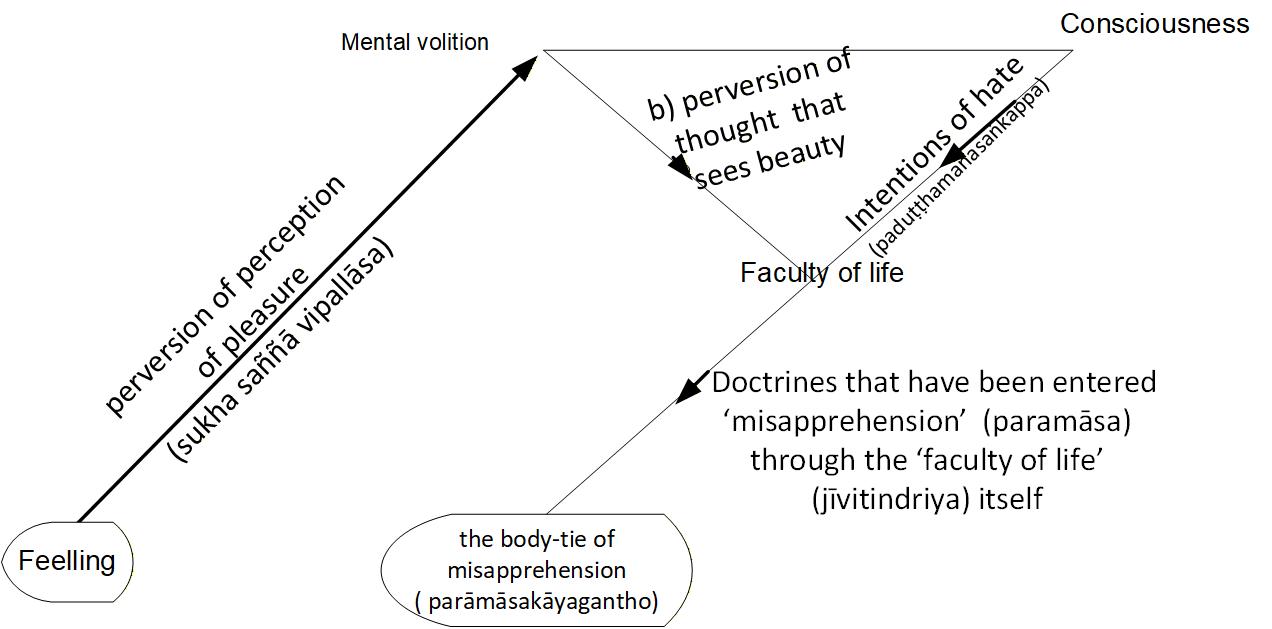
Thus, a certain permanence (nicca) entering into both the misapprehension (parāmāsa) and the ‘insistence that this is truth' (idaṃsacca), birth (jāti) cannot be stopped. Thus, due to this very permanence (nicca), with the drawing of beauty (subha) from the ‘insistence that this is truth' (idaṃsacca) to the misapprehension (parāmāsa), the agitation of the misapprehension (parāmāsa) occurs. It should not be forgotten that the stream of consciousness (viññāṇa) living like an octopus, has now reached to delusion (moha).
Due to the alignment of these three factors, birth cannot be prevented. That is, birth cannot be prevented due to the impregnation of permanence (nicca) in the three dhamma: misapprehension (parāmāsa), ‘insistence that this is truth' (idaṃsacca), and delusion (moha).
Good development of the four bases of spiritual power (Iddhipāda) is necessary to prevent this, and when the basis of spiritual power due to investigation (vīmaṃsā-iddhipāda) becomes strong, this agitation of the misapprehension (parāmāsa) ceases. Thus Nibbāna occurs.
That is the meditation.
To add a little more to this,
1. The mind was drawn to the dhamma presented on the 4th page of the Bhayabherava diagrams.
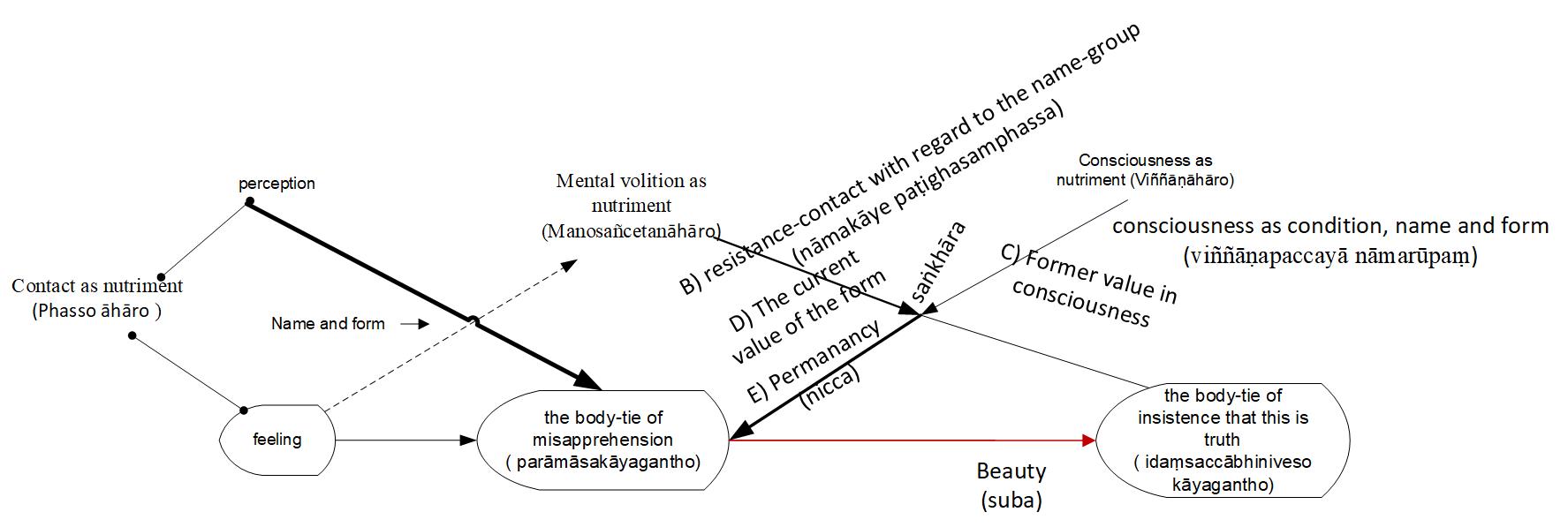
In the second round, was there a value within consciousness, that is compared with the resistance-contact with regard to the name group (nāmakāye paṭigha-samphassa). The value that was in consciousness (viññāṇa) should be thought of as the previous value. The value given by the resistance-contact with regard to the name group (nāmakāye paṭigha-samphassa) should be thought of as the value in the form (rūpa). It has been learned that if these two values are compared and the stream of consciousness is flowing, perception of permanence (nicca-saññā) arises. Therefore, it is understood that the drawing of beauty (subha) from the ‘insistence that this is truth’ (idaṃsacca) to the misapprehension (parāmāsa) occurs along with the arrival of permanence (nicca) to the misapprehension (parāmāsa).(*1)
2. When practicing this meditation properly, a star appears at the point where the misapprehension (parāmāsa) is marked, the entire diagram fades away, and a peaceful white luminosity appears. Even then, understanding these as mental objects (ārammaṇa) that arise in the mind, one should skilfully use the basis of spiritual power due to effort (viriya-iddhipāda) to avoid falling into views (diṭṭi), and if this leads to deep absorption in investigation (vīmaṃsā), through such strengthened basis of spiritual power due to investigation (vīmaṃsā-iddhipāda), one would have nibbana as object and only nibbana as goal.
3. As mentioned in the Nibbāna meditation of 23/06/2023, there should not be a steadying-point for consciousness (viññāṇaṭṭhitīhi) because one has dwelled before. ‘Conceit I am’ (asmimāna) and ‘Desire I am’ (asmiti-canda) should be removed. Here, as in the second point added above, when the entire diagram fades, and a peaceful white luminosity appears, as happened in the mind during previous days, there should not be any settling or dwelling in it. Otherwise, ‘Conceit I am’ (asmimāna) will arise thinking 'I have such abilities’.
4. Contemplating the 3rd point added above, a taintless mind arises.
That is what needs to be added.
Discussion 02/08/2025
Notes added during the discussion
(*1) So at this point, it can be said that the Budu Piya stated that it is more suitable to take the drawing of beauty (subha) from the ‘insistence that this is truth’ (idaṃsacca) to the misapprehension (parāmāsa) as round 2 step 3.