The Noble Council of Akanittha Brahma Realm was remembered with faith.
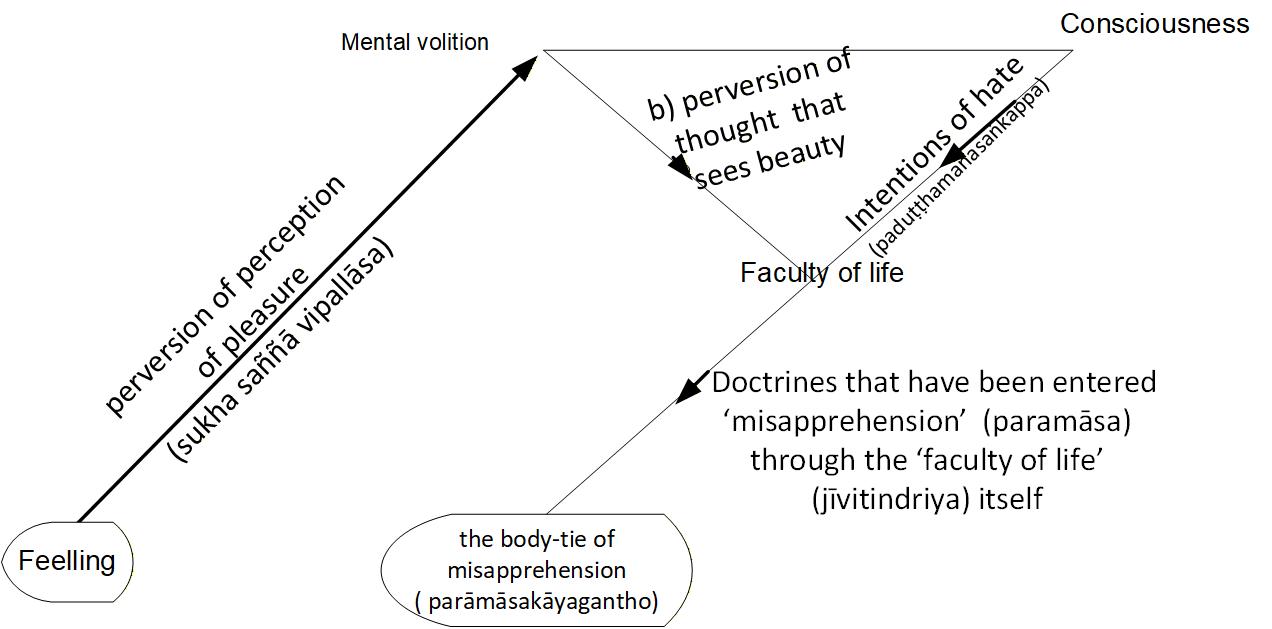
I repeated the Nibbana meditation of 25/07/2025. There we examined that, because of living for a very long time in consciousness as nutriment; through intentions of hate (paduṭṭhamanasaṅkappa), with the addition of perversion of thought that sees beauty (subha citta vipallāsa) the faculty of life (jīvitindriya) is nourished, and if doctrines that do not enter misapprehension (paramāsa) by means of that very ‘faculty of life’ (jīvitindriya) then consciousness will not be convinced of its momentum and profundity.
Investigating this matter further, a connection is made with the facts learned during the Nibbana meditation on 08/11/2024. See diagram 1 below.
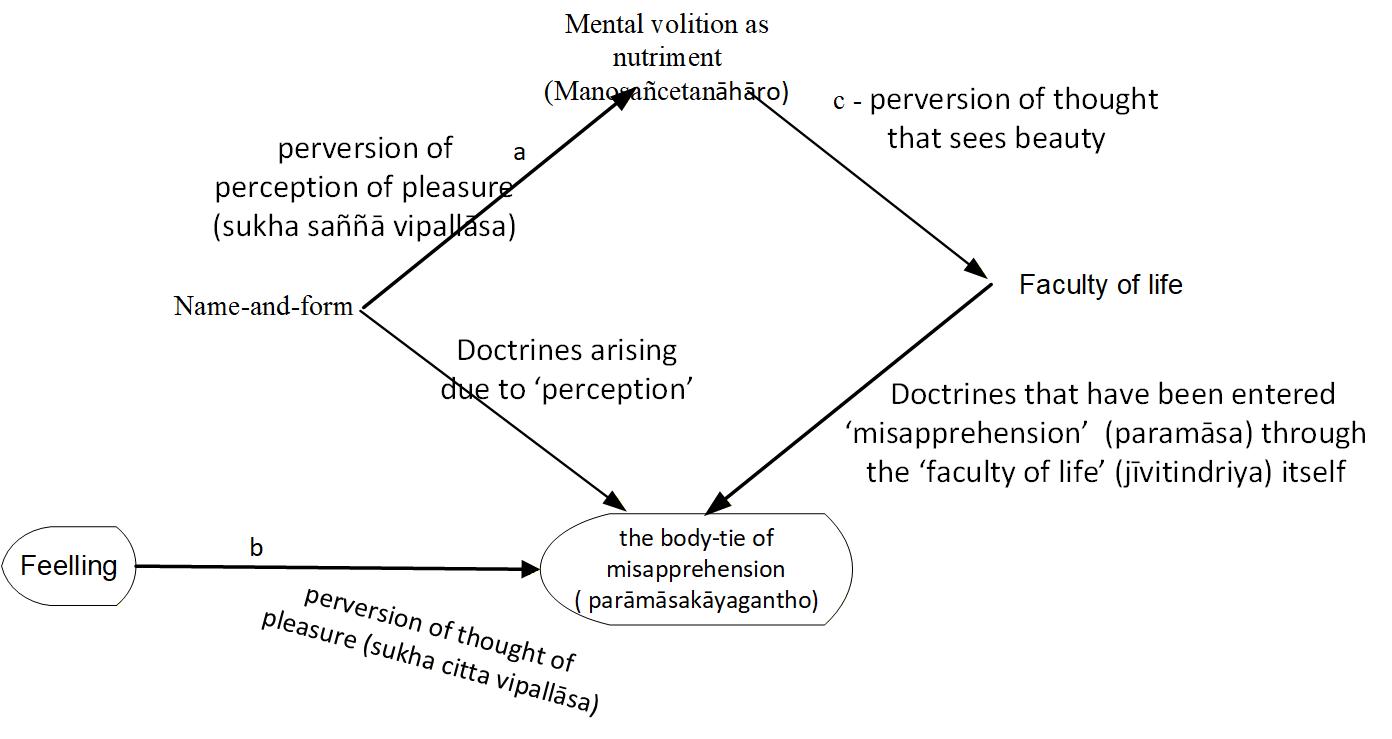
Diagram 1
The doctrines arising due to perception entering ‘misapprehension’ is marked here. Which doctrines? Any doctrine, from the right side of misapprehension (parāmāsa) that can lead to the agitation of misapprehension (parāmāsa) through the stream of consciousness, can be taken for this. Let us examine by applying the subtle case of this. That is, examine the doctrines when there is no view (diṭṭhi) between misapprehension (paramasa) and mental volition (manosañcetanā), perception values that ‘there is something’ within the stream of consciousness, by way of consciousness as condition (viññāṇa paccaya), can enter separately into misapprehension (parāmāsa) and mental volition (cetanā).
It includes the entering of beauty (subha) to misapprehension via the insistence that this is the truth (idaṃsacca), and, because of living for a very long time in consciousness as nutriment; with the addition of the influence of doctrines entering misapprehension (paramāsa) through ‘faculty of life’ (jīvitindriya) itself, two types of doctrines, the arising and the establishment, of wrong understanding of pleasure (sukha) within misapprehension take place. Thus, the impact by generating (*1) pleasure within misapprehension is very strong. This is so.
Thus, the agitation of misapprehension (parāmāsa) occurs. This reflects across the line misapprehension - volition (parāmāsa-cetanā), where it is understood that the doctrines arising due to perception enter misapprehension, from the left side, appearing like a mirage. See the given diagram 2.
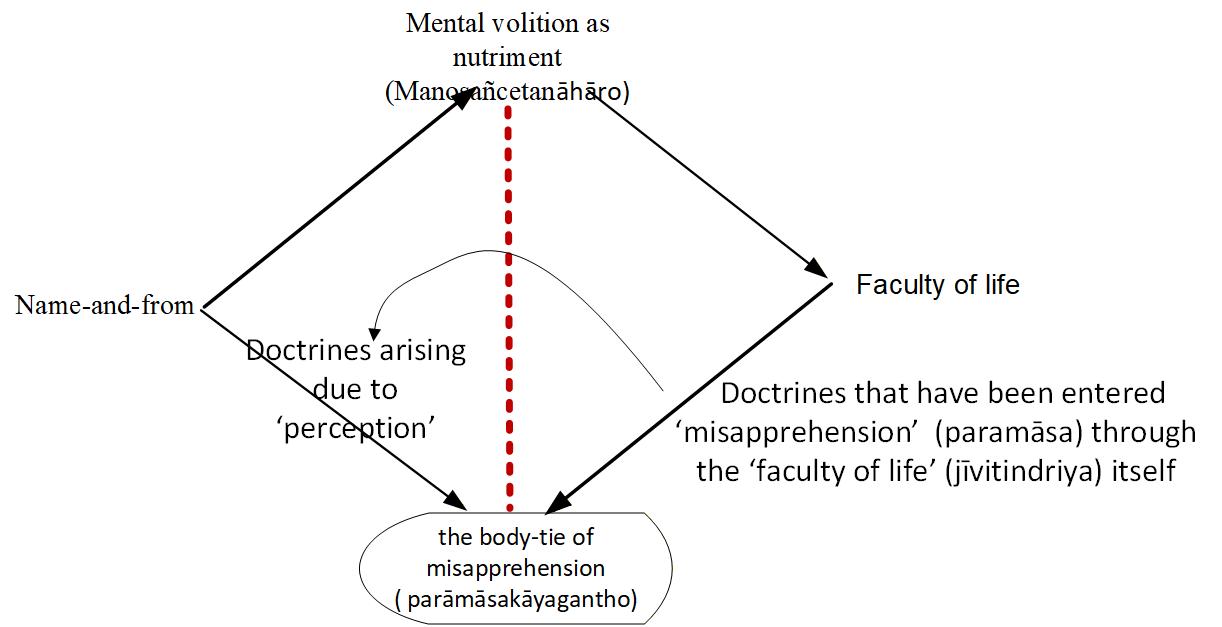
Diagram 2
How does the cessation of this come about? It is through the practice of the noble doctrine as taught by The Mandaladhipathi Budu Piya. Through the practice of the doctrine of the Mandaladhipathi Budu Piya’, we have learned that after removal of the perversion of thought that sees beauty (subha citta vipallāsa), the mere presence of mindfulness alone is enough to remove the perversion of thought of pleasure (sukha citta vipallāsa). What mindfulness? Mindfulness (sati) that “the idea ‘exists’ in ageing (jarā) does not exist when sickness (vyādhi) is well understood” is sufficient for this. Why is it so? Because it is marvellous and unmeasurable. Because it includes the knowledge that all beings have inherited sickness. This is understood when one investigating in terms of ‘form realms’ (rūpa loka) and ‘formless realms’ (arūpa loka).
This is the meditation I did.
If I am to add a little more,
1. Attention was drawn to the given diagram 1. Recalling this, together with the segment of dhamma written at the end, that is mindfulness (sati) that “the idea ‘exists’ in ageing (jarā) does not exist when sickness (vyādhi) is well understood” is sufficient for this, if one inherits the perversion of thought that sees beauty (subha citta vipallāsa), there will be sickness. It has the concept of ‘separation from what is pleasing’ (piyehi vippayogo). It was understood that this is sufficient to rotate the line aging, feeling and absence of awareness (asampajañña), the elimination of perversion of thought of pleasure (sukha citta vipallāsa) will not occur.
2. Practicing this meditation and through this practice itself, a mind worthy of attaining Nibbāna is cultivated.
This is what I have to add.
Discussion 16/08/2025
Footnotes added during the discussion
(*1) generate inside it
Notes added after the discussion
If I am to add a little more to this, as point 3,
3. ‘Nibbana is the incomparable Jewel, Nibbana is marvellous and immeasurable’ (Nibbānaṃ ratanaṃti karitvā acchariyabhāvena atulaṃ). Nibbāna is the cessation of all ‘cravings’ (taṇhā). When examining this in conjunction with the first point added above, if one inherits the perversion of thought that sees beauty (subha citta vipallāsa), sickness arise. This is sufficient to rotate the line aging, feeling and absence of awareness (asampajañña), resulting in the arising of craving. If this does not occur, craving ceases, and ‘Nibbana’ manifests like a jewel.
This is what I have to add.