The Noble Council of Akanitta Brahma Realm was remembered with faith.
I repeated the 25/07/2025 Nibbāna meditation. Thus, due to the alignment of three factors, birth (jāti) cannot be prevented. That is, birth cannot be prevented due to the impregnation of permanence (nicca) in the three dhamma: misapprehension (parāmāsa), ‘insistence that this is truth' (idaṃsacca), and delusion (moha). This phenomenon was understood as the postcondition for no Nibbāna.
There we mention that a certain permanence (nicca) entering into both the misapprehension (parāmāsa) and the ‘insistence that this is truth' (idaṃsacca), then birth (jāti) cannot be stopped. This phenomenon was understood as the precondition for no Nibbāna.
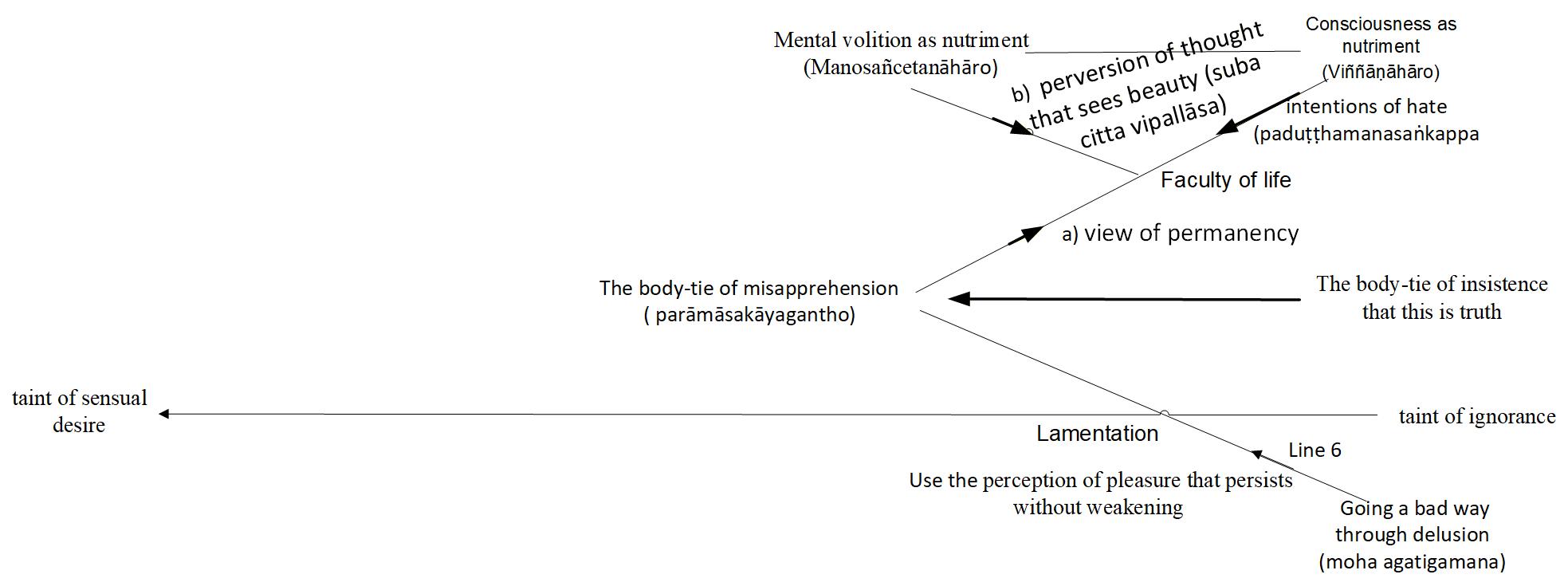
Let us first examine the postcondition for no Nibbāna. In the 27/09/2024 Jivitha Indriya (faculty of life) meditation, it was learned that if a) ‘view of permanency’ (nicca diṭṭhi) and b) ‘perversion of thought that sees beauty (suba citta vipallāsa), are sufficient for the functioning of the ‘faculty of life’ (jīvitindriya), then, only for discerning its capability, the values of ‘intentions of hate’ (paduṭṭhamanasaṅkappa) coming from ‘consciousness’ are examined. See the given diagram.
Here, recall that permanence (nicca) has also entered the ‘insistence that this is truth’ (idaṃsacca), and since the perception of pleasure (sukha sannā) that persists without weakening, flows via line 6 from the delusion (moha) below, the flow from the taint of ignorance (avijjāsava) to the taint of sensual desire (kāmāsava) occurs. The taint of sensual desire (kāmāsava) is the post perception of pleasure (sukha). Thus, with the impact of the construction of pleasure (sukha) within the misapprehension (parāmāsa) being strong, an accumulation and emergence of the notion that ‘there is something that is pleasurable (sukha)’ in consciousness (viññāṇa) occurs with the flow from the taint of ignorance (avijjāsava) to the taint of sensual desire (kāmāsava), from the path, birth (jāti), feeling (vedanā), and volition (cetanā).
Since the notion that ‘there is something that is pleasurable (sukha)’ has proliferated within consciousness (viññāṇa), it is said that, birth (jāti) cannot be prevented due to the impregnation of permanence (nicca) in the three phenomena (dhamma): misapprehension (parāmāsa), insistence that this is truth (idaṃsacca), and delusion (moha). Therefore, along the line from the misapprehension (parāmāsa) to the faculty of life (jīvitindriya), the view of permanence (nicca-diṭṭi) is marked pointing toward the faculty of life (jīvitindriya). This may not be a case where the faculty of life (jīvitindriya) is exhausted, and from this even birth (jāti) within the jhāna planes can occur. Yet it can also be applied to the case where the faculty of life (jīvitindriya) is exhausted. How so? It is because, having the meditation gone well, taking the nature of concentration (samādhi) that has occurred as ‘good’, and not progressing further, gives rise to sloth and torpor (thīna-middha).
Let us examine the case “precondition for no Nibbāna”. That is, examining the case that a certain permanence (nicca) entering into both the misapprehension (parāmāsa) and the ‘insistence that this is truth' (idaṃsacca), then birth (jāti) cannot be stopped, it was examined what needs to exist for descending in it.
This is as the third case of the 27/09/2024 Jivitha Indriya (faculty of life) meditation. That is, what happens if the perversion that there is thought of self, breaks upon having come to the faculty of life (jīvitindriya)?
Here, within the misapprehension (parāmāsa), the phenomenon (dhamma) of pleasure (sukha) has been constructed, and it has been taken as self (attā) to some extent. Because of that phenomenon (dhamma), the marking of the weakened perception of self on line 7 can be understood. Here, a) the view of permanence (nicca-diṭṭi) is weak, b) the value of the perversion of thought that sees beauty (suba citta vipallāsa) is stronger than a) ( b) >a) ). The faculty of life (jīvitindriya) is exhausted. Therefore, birth (jāti) in jhāna planes does not occur.
If there is even some degree of appropriation as self (attā) in this way, that itself becomes cause and condition for the non-occurrence of Nibbāna.
That is the meditation.
To add a little more to this,
1. In the case of precondition for no Nibbāna whatever phenomenon (dhamma) seems to have been obtained cannot be said to be well obtained. Why is so? There is no confidence in accurately stating the existence or non-existence of perception (saññā), which is created by reflection, like a mirage. That is why. Here the birth is in the realm of hell, the animal realm and the plane of the departed (peta-loka). In this case there is no occasion where the faculty of life (jīvitindriya) is not weak. Why? Because sloth-and-torpor (thīna-middha) is excessive. That is the reason.
2. In this meditation, the star appears from the very beginning, and it remains throughout the entire meditation.
3. Firstly developing the four bases of spiritual power (iddhipāda), thereafter recalling that “with the impact of the construction of pleasure (sukha) within the misapprehension (parāmāsa) being strong, an accumulation and emergence of the notion that ‘there is something that is pleasurable (sukha)’ in consciousness (viññāṇa) occurs with the flow from the taint of ignorance (avijjāsava) to the taint of sensual desire (kāmāsava), from the path, birth (jāti), feeling (vedanā), and volition (cetanā)” a star was seen where consciousness (viññāṇa) is marked.
4. It was understood that the proliferation of the notion that ‘there is something that is pleasurable (sukha)’ within consciousness (viññāṇa) occurs because of the phenomena (dhamma) that arise due to perception (saññā) entering the misapprehension (parāmāsa) quite well from the left side, like a mirage.
5. The Budu Piya said to examine the fourth point added above, together with the phenomenon (dhamma) shown in the 06/06/2025 Vimamsa Iddhipada meditation.
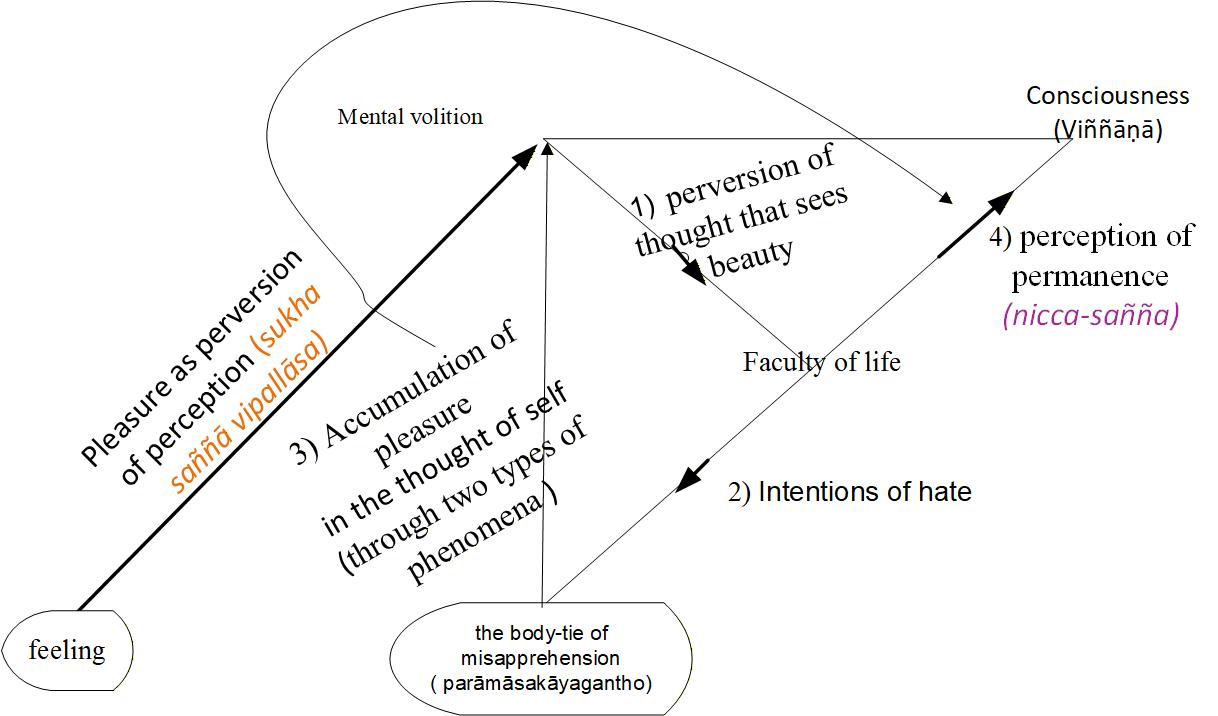
There, 1) the perversion of thought that sees beauty (subha citta vipallāsa), 2) combined with intentions of hate (paduttha-manasankappa) and entering the misapprehension (parāmāsa), 3) accumulation of pleasure in thought of self through two types of phenomena (dhamma) namely: the ‘pleasure as perversion of perception’ (‘sukha sañña vipallāsa) that comes from feeling (vedanā) to volition (cetanā) and the doctrines of pleasure that have been entered the ‘misapprehension’ (paramāsa) through the ‘faculty of life’ (jīvitindriya) itself is marked. The perception of permanence (nicca-sañña) that arises from this is marked as 4). Through this, ‘pleasure as perversion of perception’ (sukha sañña vipallāsa) becomes accumulated in consciousness as nutriment (viññāna-āhāra). As added in the fourth point, if there is entering to the misapprehension (parāmāsa) quite well from the left side, like a mirage, one forms volitions (cetanā) with the notion of pleasure (sukha). This arises by way of the path, birth (jāti), feeling (vedanā), and volition (cetanā).
That is what needs to be added.
Discussion 30/08/2025