The Noble Council of Akanitta Brahma Realm was remembered with faith.
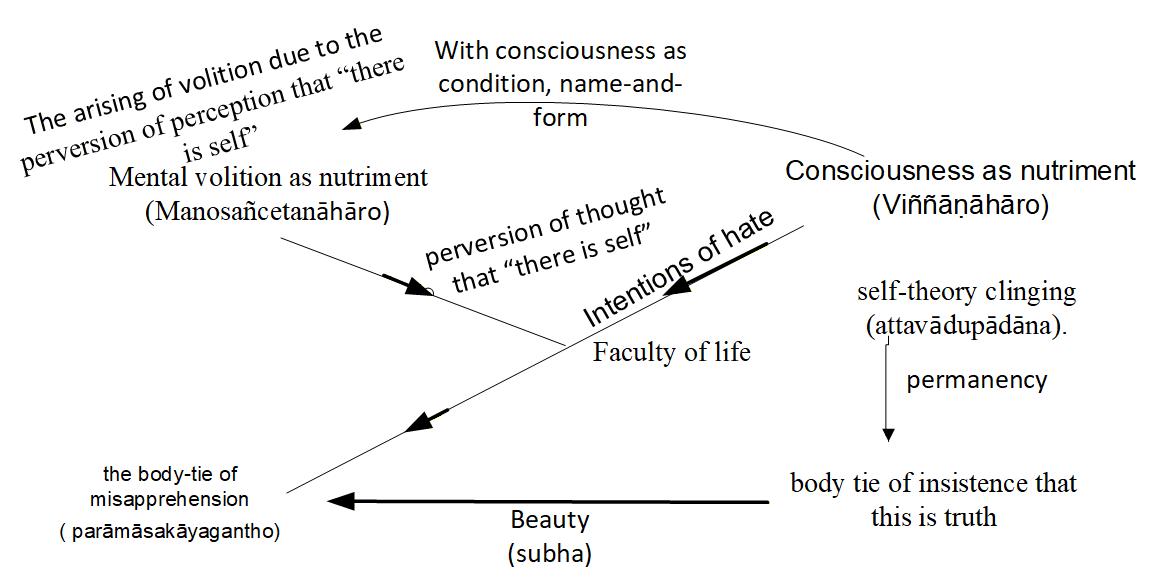
I repeated the 22/08/2025 Nibbāna meditation. What will happen when ‘faculty of life’ (jivitha indriya) is not exhausted and the perversion of thought that “there is self” comes up to the ‘faculty of life’ (jīvitindriya) and then breaks down? Let us look at it together with the phenomena (dhamma) examined in the 18/01/2016 Upekkha Appamana meditation. See diagram 1 provided.
Diagram 1
There, with the occurrence of name-and-form with consciousness as condition (viññāṇa paccāya nāma-rūpa), the arising of volition (cetanā) due to the perversion of perception that “there is self” is marked. Here also, both the construction and the accumulation of pleasure (sukha) within misapprehension (parāmāsa) have occurred with the flow of beauty (subha) from the insistence that this is truth (idaṃsacca) to misapprehension (parāmāsa) due to self-theory clinging (attavāda-upādāna). There, permanence (nicca) flows due to the self-theory clinging (attavāda-upādāna) to the extent that its momentum and profundity is felt well by consciousness (viññāṇa).
Here, a certain notion of permanence (nicca), together with pleasure (sukha), arises from misapprehension (parāmāsa) towards the faculty of life (jīvitindriya). The nature of this view of permanence (nicca-diṭṭhi) is sufficient for the existence of the faculty of life (jīvitindriya). With this, this has become an instance where the influence of the perception of self (attā-saññā) arriving at volition (cetanā), through consciousness (viññāṇa) as condition, is felt as sufficient by the faculty of life (jīvitindriya), and by means of two kinds of phenomena (dhamma), the faculty of life (jīvitindriya) is thus nourished. See diagram 2 provided.
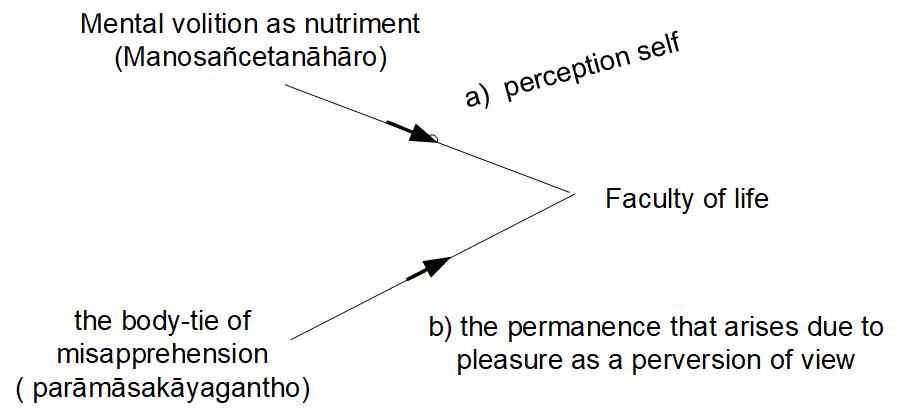
Diagram 2
As denoted in this diagram, the nourishment of the faculty of life (jīvitindriya) by two kinds of phenomena (dhamma); a) the perception self and b) the permanence that arises due to pleasure (sukha) as a perversion of view (diṭṭi-vipallāsa), are very important. There, delusion, which has helped to sustain the existence of faculty of life, maintains perception as pleasurable by means of the underlying tendency to greed for sensual desire (kāmarāga-anusaya); thus, perception continuously flows toward volition as pleasurable (sukha).
In this way, because volition (cetanā) arises together with the perception of pleasure (sukha), without thought of pleasure, rebirth in higher jhāna planes starting from the fourth jhāna can occur in such cases where there is no view (diṭṭi) between volition (cetanā) and misapprehension (parāmāsa).
That is the meditation.
To add a little more to this,
1. Practising this mediation, and remembering that permanence flows because of self-theory clinging (attavāda-upādāna), to the extent that the momentum and profundity are clearly felt by consciousness (viññāṇa), here it was understood that, because of previously dwelling in those jhānas, there exist phenomena (dhamma) that were accompanied by self-theory clinging (attavāda-upādāna); and permanence flows because of self-theory clinging (attavāda-upādāna) itself, to the extent that the profundity is clearly felt by consciousness (viññāṇa). “Excellent,” was heard.
2. Practising this meditation, the mind abided from measureless state of equanimity (upekkhā-appamāṇa) up to the peaceful, well-liberated mind (santa suvimutta citta).
3. It was investigated that, “For what reason does the perception of self (attā-saññā) arise dependent on consciousness (viññāṇa). When one regards the sphere of nothingness (ākiñcaññāyatana) as “not mine” then there is a drawing into deep space. Then it was understood because of the joy that arises at the thought “it has become so,” the perception of self is formed. “Excellent,” was heard. Here, the area of the face just below the right eye, close to that eye, was felt as pleasant (sukha). This is experienced when the drawing into deep space persists and as long as the notion “it has become so” remains in mindfulness. The Budu Piya said that this is because the faculty of life (jīvitindriya) is delighted. The faculty of life (jīvitindriya) is situated a little internally behind the bone below the eye, and below it lies the mind-faculty (manindriya). Whenever there is a delighting of the faculty of life (jīvitindriya), since it is the primary condition for the delighting of the mind-faculty (manindriya), the area of the face just below the right eye, near that eye, is felt as pleasant to such an extent that it is hard to discern the difference.
4. When the faculty of life (jīvitindriya) is delighted, the delighting of the mind-faculty (manindriya) occurs in this way, the appearance of jhāna planes also occurs. Asking why this is so, the Budu Piya inquired, “What do you think?”. “Having cognized the mental phenomena with the mind (manasā dhammaṁ viññāya).” It was understood that that was the thing which had come within the range of the delighted mind-faculty. “Excellent,” was heard. Repairing can be done very easily together with the delighting of the faculty of life (jīvitindriya).
5. This pleasure persists for a long time even after the meditation, and regarding things like cold or heat or the taste of food taken, it is understood that there is no concern; Budu Piya said the nature that is felt when dwelling in the jhāna planes, is like this.
That is what needs to be added.
Discussion 13/09/2025