The Noble Council of Akanittha Brahma Realm was remembered with faith.
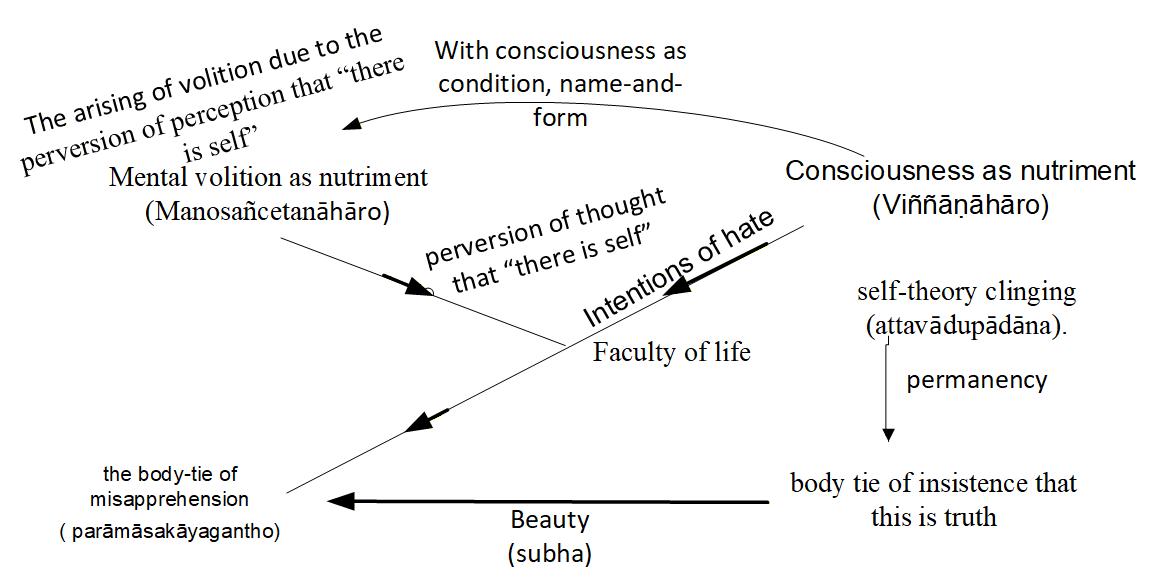
I repeated the 29/08/2025 upekka appamana meditation. What will happen when ‘faculty of life’ (jivitha indriya) is not exhausted and the perversion of thought that “there is self” comes up to the ‘faculty of life’ (jīvitindriya) and then breaks down was investigated in conjunction with the given diagram 1.
Here, due to the form like cotton being taken as self, there arises perversion of perception that “there is self”. This is a subtle phenomenon. There are no feelings being taken as self here. The form which is insubstantial like cotton being taken as self has reached such a subtle state, and it is accumulated in the ‘consciousness as nutriment’. Thus, there is My-making due to the self that arises at the top of the diagram.
In the Amurtaya 5 meditation of 25/08/2023, the anticlockwise rotation of the trident diagram from the ‘barb of views’ (diṭṭhisalla) was investigated. Refer to diagram 1, below.
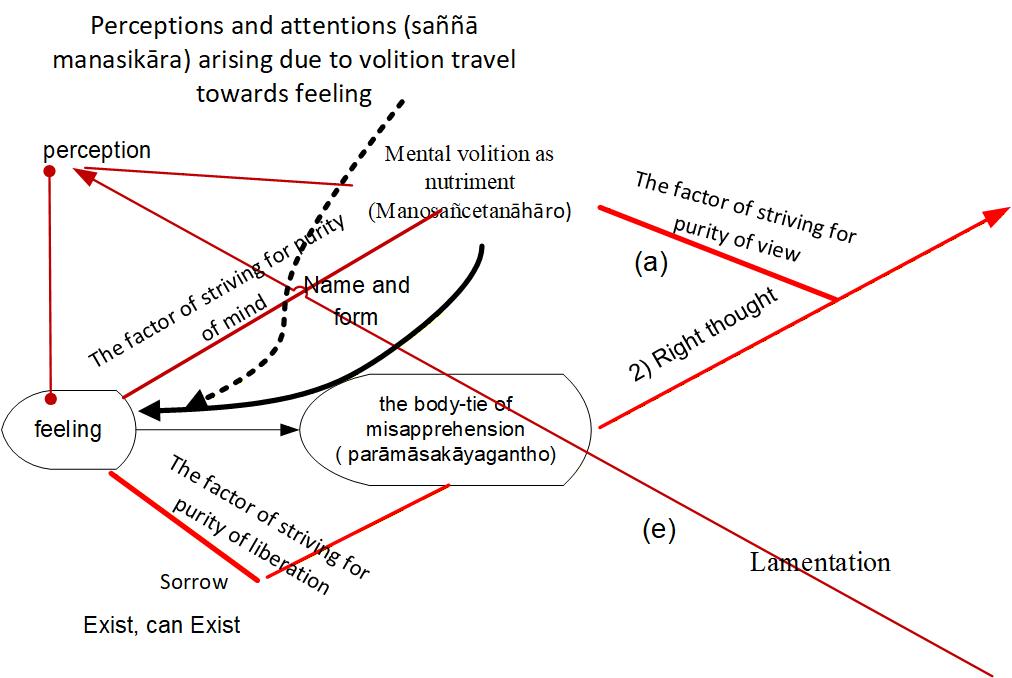
Diagram 1
What will happen if perceptions and attentions (saññā manasikāra) arising due to volition travel towards feeling? The anticlockwise rotation of the trident’ (trishūlaya) diagram takes place. Here, comparing with the dhamma learned in the amurthaya 5 meditation of 25/08/2023, it is not the movement of ‘feeling values’ toward ‘volition’, but rather, due to ‘volition’ there is a movement towards ‘feeling’, which causes the trident diagram to rotate anticlockwise. If this happens, then because volition arises in this way taking a subtle form as its object, rebirth occurs in the plane of the fourth jhana due to that form.
The ‘barb of views’ (diṭṭhi-salla) affects the rotation of the trident diagram in this manner. This case is, coming to ‘taint of views’ (diṭṭhāsava) due to permanency, that is, it occurs due to leading to ‘taint of views’ (diṭṭhāsava). This is well understood if one examines this together with the bhūta diagram given in the 07/11/2015 bhūta meditation.
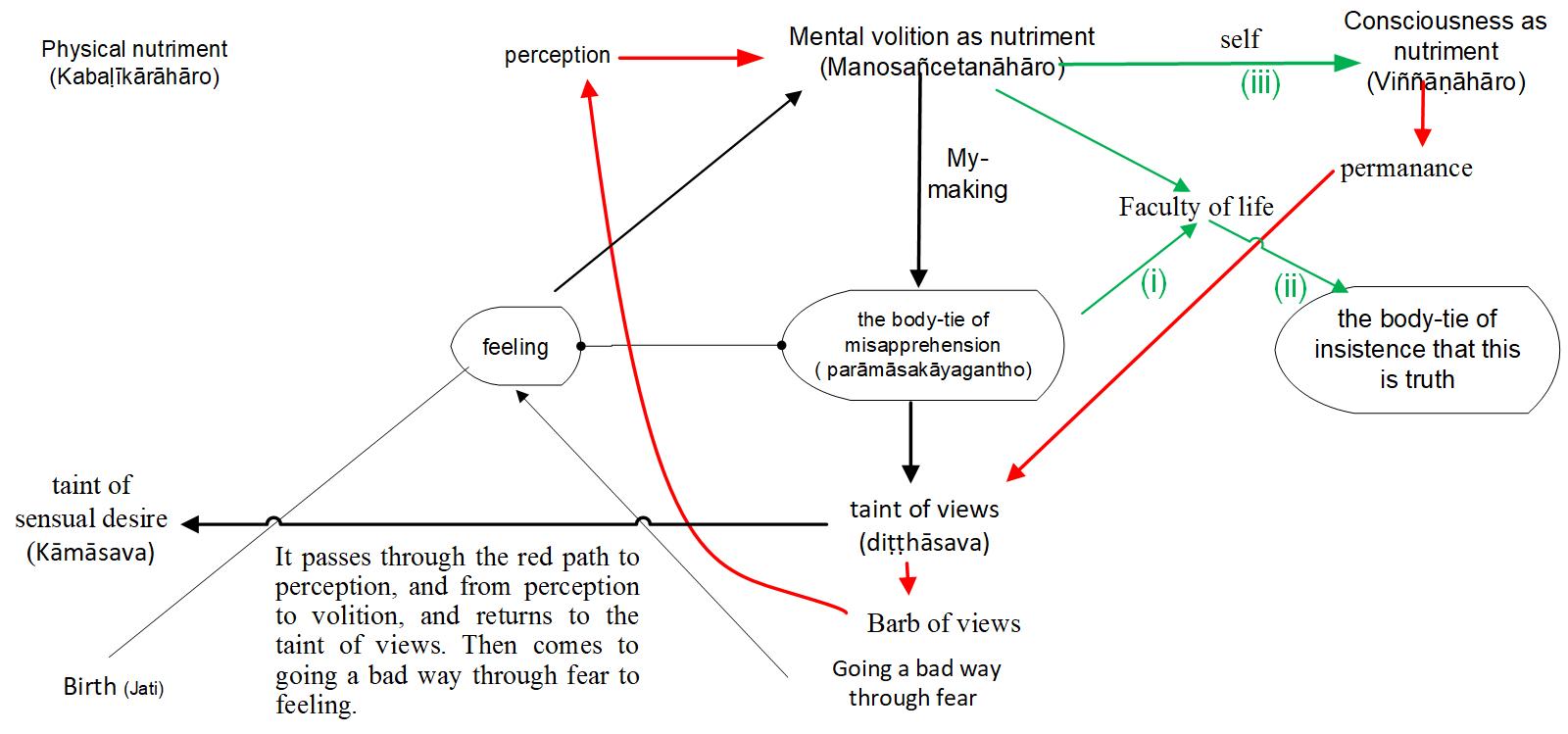
That is, the ‘perception’ (saññā) is carried along on its shoulders by the ‘barb of views’ (diṭṭhi-salla) caused by the ‘taint of views’ (diṭṭhāsava). Going along the path marked in red, from perception to volition (cetanā) and returning to the taint of views. There is a feeling that everything is complete in this taint of views. Take it as ‘mind-made body’ (manomaya kāya) is beautifully formed and appears before oneself. Thus, there is going from ‘taint of views’ to ‘taint of sensual desire’ (kāmāsava).
Using noble doctrine of Mandaladhipati Budu Piya effectively, that doctrine must have been nourished to the extent that ‘craving’ (taṇhā) does not arise. In this way, birth in the fourth jhāna plane can be avoided.
This is the meditation I did.
If I am to add a little more to this,
1. Here, the form that appears to be permanent - the mind-made body, is like daydreaming. It is said so because it emerged without producing anything.
2. Investigating the anticlockwise rotation of the trident diagram because of arriving at ‘feeling’ due to ‘volition’, three arrows became visible: from ‘volition’ to ‘feeling’, from ‘volition’ to ‘perception’ and from ‘volition’ to ‘misapprehension’ (parāmāsa). Thus, it was understood that the flow of dhamma happens more in living beings in this manner, that is, it occurs more due to volition than due to form, feeling, and perception. That is so, The Budu Piya said. It is also understood that this is due to dwelling in the formless jhāna planes for a long time. The process that occurs due to volition is understood in this way, the statement “Monks, I say that volition is kamma” (cetanāhaṁ bhikkhave kammaṁ vadāmi) is also understood. In this way, because of volition, one goes in search of feeling; for that, bodily, verbal, and mental formations are carried out, and actions ( kamma) are constructed. Refer to given diagram 2.
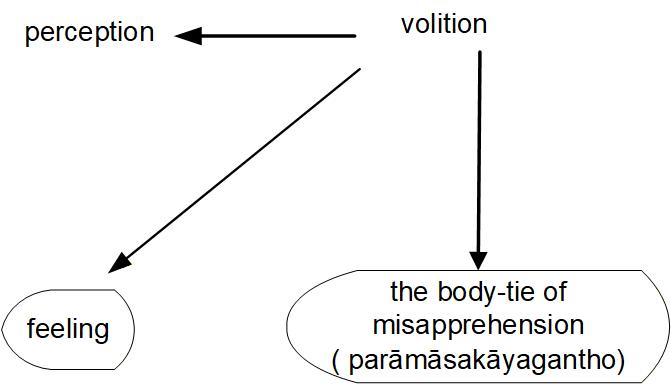
Diagram 2
Mental volition (mano-sañcetana) is also understood. This is not the volition that arises dependent on form and feeling, but the volition arising with ‘consciousness as condition’ (viññāṇa-paccaya).
3. The application of the noble doctrine of Mandalādhipati Budu Piya here is also well understood. Seeing perception (saññā) as suffering (dukkha), misapprehension is removed. Thereby, the values of ‘misapprehension’ (parāmāsa) decline. Seeing perception as suffering slows down the stream of consciousness, thus it becomes difficult, by means of the barb of views to carry the volition value towards feeling, then its momentum declines. In this way ‘Nibbana as object and only Nibbana as goal’ can be achieved.
This is what I have to add.