The Noble Council of Akanittha Brahma Realm was remembered with faith.
How should one develop doctrines such as contemplation of impermanence, contemplation of dispassion, and contemplation of relinquishment?
Contemplation of impermanence should be developed as described in 20/06/2025 Asmiti Chanda (“Desire I am”) meditation. Recall the portion of dhamma that was added in that discussion. That is, it should be thoroughly understood that the ‘impermanence of perception’ (anicca saññā) should be developed to the extent that the nature of ‘suffering’ (dukkha) does not fade. Having well developed the nature of ‘suffering’ in area 1 and area 6, as in the Nibbana meditation of 13/06/2025, and subsequently develops perception of impermanence through the discourse on Perception of Impermanence (Anicca Sañña sutta), and when investigating the arising phenomenon, if the ‘sphere of nothingness’ (akiñcaññāyatana) appears, then the presence of suffering there, that is, the suffering in area 6 must remain without fading. Due to the establishment in the thought of suffering, the difficulty to speak of ‘pleasure’ (sukha) should occur well and one should not forget that the four noble truths are placed at the body tie of insistence’ (idaṃsacca). If this happens, when developing the ‘passing away’ phenomenon of perception, withdrawal and distancing from it become clearly visible. Why is this so? Because wisdom (paññā) has emerged. Thus, even in situations where there is no view (diṭṭhi) between ‘misapprehension’ (parāmāsa) and ‘mental volition’ (manosañcetanā), it is possible to prevent rebirth in the plane of the seventh jhāna.
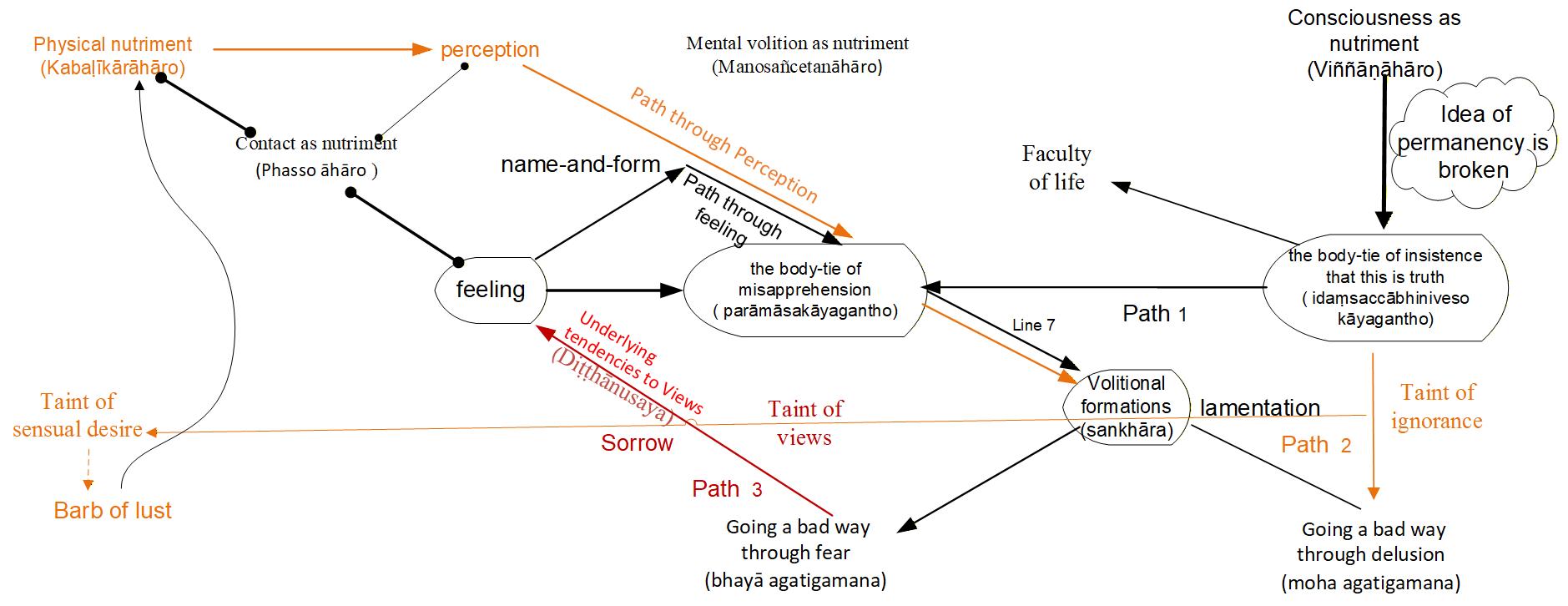
To develop contemplation of dispassion, one should make use of any withdrawal resulting from the above development of contemplation of impermanence. Here the path 2 of the diagram of 21/05/2021 Nibbana meditation was remembered.
Path 2, when going from taint of ignorance to taint of sensual desire occurs, form to be contacted via the barb of lust, and then perception, name-and-form, misapprehension (parāmāsa), lamentation occurs secondly. This flow reconstructs and confirms previously constructed mental volitional formations (citta sanskāra). This is the arising of volitional formations conditioned by ignorance (avijjā paccayā sankārā). Preventing this from happening is dispassion (virāga). Here, recall the noise at 8th Jhana case we learnt in the meditation on 05/09/2025 Upekkha appamana. Think of it as reconstructing the mental volitional formations that existed previously. How do we stop this path from happening? If we are not spinning with the barb of delusion here, then consciousness not holding to volitional formations, the perception that “As after, so before” (yathā paccā, thathā purē) is not destroyed, the dispassion that has thus arisen has knowledge and vision of liberation (vimuttignānadassana) as its meaning, and arises with knowledge and vision of liberation (vimuttignānadassana) as its benefit. One should make a great effort in this. Equanimity must be pure to that extent. That is, even if past lives up to this point become visible, one must be wise enough to remain established only in the thought of suffering. One should be nourished by the four noble truths to that extent. For this, the eye of wisdom should be well developed. This is like restraining faculties. The forms of past lives shown by consciousness should be looked at with the eye of wisdom and discarded.
How does one develop contemplation of relinquishment? It is, as explained in meditations on Upekkha Appamana (Immeasurable Equanimity) from 29/08/2025 to 19/09/2025 one must be skilled in transcending every jhāna plane. In this way, when perception is set aside, no room is given for the taint of views that leads to the third path. One would have nibbana as object and only nibbana as goal. Why is so? I recalled dhamma stated by the Great Arahant in 23/07/2021 Vimuttignānadassana meditation, that it is because faith (saddhā), effort (viriya), mindfulness (sati), concentration (samādhi) and wisdom (paññā) have deepened.
This is the meditation I did.
If I am to add a little more,
1. Developing the nature of ‘suffering’ in area 1 and area 6 well, and subsequently developing perception of impermanence through the discourse on Perception of Impermanence (Anicca Sañña sutta), and when investigating the arising phenomenon, if the ‘sphere of nothingness’ (akiñcaññāyatana) appears, then the presence of suffering there, that is, the suffering in area 6 must remain without fading. Further investigating this, because of the suffering nature in area 6, mirage-like perception does not properly enter the misapprehension (parāmāsa) from the left side through delusion. Why is so? It was realized that there is no mirror to reflect that way along the line of mental volitions (manosañcetanā) and misapprehension (parāmāsa). “Excellent” was heard. Therefore, the ability to create a mirage through delusion has been lost. The reason for this is that the four noble truths are placed at the “insistence that this is truth” (idaṃsacca) and hence no ‘beauty’ (Subha) enters the misapprehension (parāmāsa). Budu Piya said because of this, there is no mirror called misapprehension (parāmāsa).
2. When doing this meditation, at the beginning both cheeks felt pleasant. When examining the arising of perception there, just as due to aging, people in the human world become unable to do certain things because of growing old, so too in those higher jhāna planes it was thought that, due to aging, certain things cannot be done. “It is so,” said Budu Piya while writing this. That is, there are difficulties in maintaining the jhāna state. It was thought that even in the higher jhāna planes, because of aging, certain things cannot be done; and when recalling of placing the four noble truths at the “insistence that this is truth” (idaṃsacca), a ‘star’ appeared there.
3. When remembering the development of contemplation of dispassion along with the dhamma points of path 2, it was clearly understood that the “knowledge and vision of liberation” arises. This is felt when I was recalling of placing the four noble truths at the “insistence that this is truth” (idaṃsacca), there is no “beauty” (subha) entering the misapprehension (parāmāsa), and also that through delusion, perception does not enter like a mirage from the left side of misapprehension (parāmāsa), and the meditative planes are abandoned, and consciousness is not holding to volitional formations, the perception that “as after, so before” (Yathā paccā, thathā purē) is not destroyed. Here, it was also remembered that through the path 2, if lamentation occurs then covetousness (abhijjā) arises, and through that false speech arises and, we have placed the four noble truths at the “insistence that this is truth” (idaṃsacca).
4. Recalling the dhamma part of relinquishment, when remembering the Bhūta (becoming) diagram, the chin area, all the way up to the lips felt pleasurable. Even there, that pleasure should not be taken. By properly using the noble dhamma of Mandaladhipathi Budu Piya, that noble dhamma should have been sufficiently nurtured to the extent that craving does not arise.
That is what needs to be added.
Discussion 11/10/2025