The Noble Council of Akanitta Brahma Realm was remembered with faith.
I recalled the points learned during the 04/03/2022 Anupaada Aparitassa meditation. We have examined the feeling (vedanā) as ‘this is mine’ (etaṁ mama), ‘this I am’ (eso’ hamasmi), ‘this is my self’(eso me attāti).
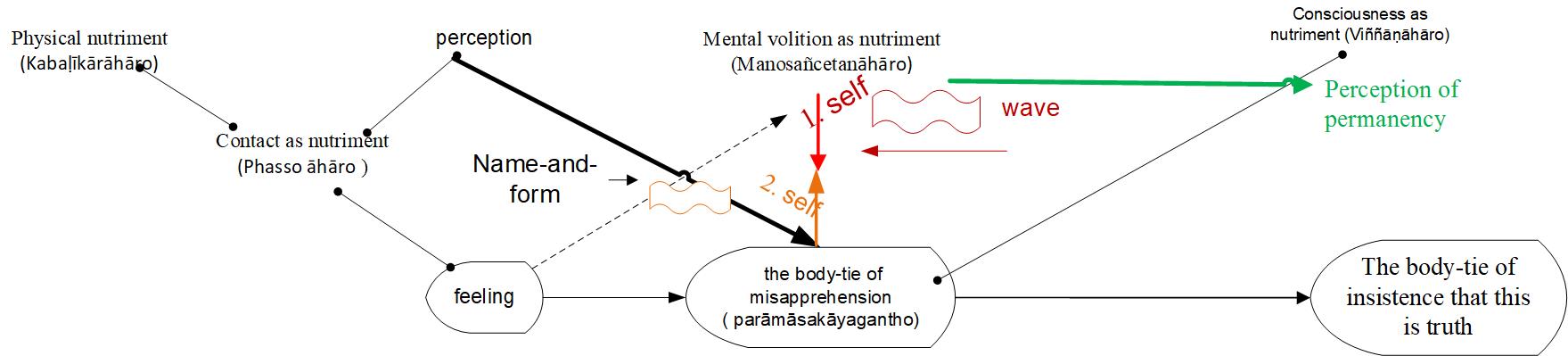
Feeling (vedanā) is recognised by perception (saññā). If there is any craving (taṇhā) therein, volition (cetanā) arises. The value of perception (saññā) enters the misapprehension (parāmāsa). If this turns into identity view (sakkāya-diṭṭi) that is constructed by the combining ‘self (atta) 1’ and ‘self (atta) 2’, then the construction of consciousness (viññāṇa) becomes unavoidable. If the consciousness is constructed, then the feeling (vedanā) is perceived and known. If there is a nature of certainty therein, that itself enters the body-tie of insistence that this is truth (idaṃsaccābhiniveso kāyagantho). That is, it is certain that ‘it is so’. Decision (adhimokkha) occurs.
Examining this further, the value of volition (cetanā) reflecting around the line: misapprehension (parāmāsa), the faculty of life (jīvitindriya) and consciousness (viññāṇa); the values enter the body-tie of insistence that this is truth (idaṃsaccābhiniveso kāyagantho). Which values? As learnt in the 29/08/2025 Upekka appamana meditation, with the occurrence of name-and-form with consciousness as condition (viññāṇa paccāya nāma-rūpa), these are the volition (cetanā) values arising due to the perversion of perception that ‘there is self’. Use diagram 1 given in the 29/08/2025 Upekka appamana meditation.
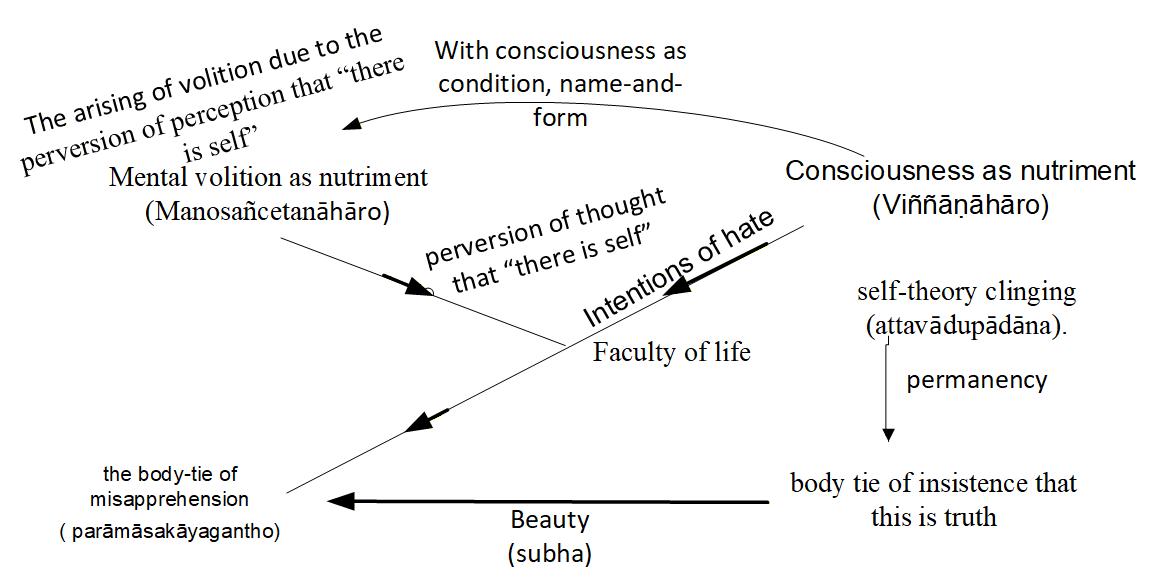
When a certain phenomenon(dhamma), created by combining ‘self (atta) 1’ and ‘self (atta) 2’ in the manner described above, turns into identity view (sakkāya-diṭṭi), and the construction of consciousness (viññāṇa) thereby becomes unavoidable, those phenomena (dhamma) are thus reflected through the faculty of life (jīvitindriya) and entered the body-tie of insistence that this is truth (idaṃsaccābhiniveso kāyagantho). In this way, for a long time one has roamed in saṁsāra, and having such phenomena (dhamma) proliferated; it should be understood that, within the body-tie of insistence that this is truth (idaṃsaccābhiniveso kāyagantho), without a sense of pleasure (sukha), notions have accumilated that lead to values of volitional formation (saṅkhāra).
What will happen if adds to this at the body-tie of insistence that this is truth (idaṃsaccābhiniveso kāyagantho), the path misapprehension (parāmāsa), insistence that this is truth (idaṃsacca), lamentation (parideva), going a bad way through fear (bhayā agatigamanaṃ), sorrow (soka), feeling (vedanā), that is “one regards self as in feeling” (vedanāya vā attānaṁ). In this case, as learnt in 03/10/2025 Vedanam Attato Samanupassati meditation, since “pleasure” (sukha) is fabricated within misapprehension (parāmāsa), there are wrong understandings, and their impact is strong. The reason is the perception of permanence (nicca-saññā). Because of the impact created by this is strong, volition (cetanā) values mix with the values of the perceptions of permanence (nicca-saññā), and as it was learnt in 08/08/2025 Nibbāna meditation, how new colours are formed within the misapprehension (parāmāsa) as pleasure (sukha), here also, colours that have behaviors rooted in delusion (moha) are formed within the insistence that this is truth (idaṃsacca).
It is difficult to avoid this by the Four Noble Truths. That is, it is difficult to avoid by placing the Four Noble Truths near the insistence that this is truth (idaṃsacca). Therefore, one must indeed exert effort (vīriya ) to prevent reflection.
That is the meditation.
To add a little more to this,
1. With the occurrence of name-and-form with consciousness as condition (viññāṇa paccāya nāma-rūpa), the arising of volition (cetanā) due to the perversion of perception that “there is self” in the case where there is no view (diṭṭi) between volition (cetanā) and misapprehension (parāmāsa), it was examined how this is applicable to a situation where a view (ditti) is present, namely, the case where identity view (sakkāyaditti) is constructed by combining ‘self (atta) 1’ and ‘self (atta) 2’. It was understood that this is a process caused by the previous self (atta). That is, examine by applying the previous self (atta) between perception (saññā) and feeling (vedanā). Because of the influence of the previous self (atta), with the occurrence of name-and-form with consciousness as condition (viññāṇa paccāya nāma-rūpa), the conceit (māna) values towards volition (cetanā) are stirred up, the identity view (sakkāyaditti) constructed by combining ‘self (atta) 1’ and ‘self (atta) 2’ arises precisely through the emergence of the previous self. Even phenomena (dhamma) that arose by having formerly lived as a king are applied here. Thus, due to dwelling in previous existences, when, with consciousness as condition, name-and-form arise (viññāṇa paccaya nāma-rūpa), and the conceit (māna) values are stirred up, the emergence of previous self (atta) happens in this way, it was understood as kamma.
2. Just because, with consciousness as condition, name-and-form arises (viññāṇa paccaya nāma-rūpa), and the conceit (māna) values are stirred up, it became clear that what was previously taken as “self” (atta) should not be brought along, and that one should apply effort (vīriya) to stop it. I recalled what the Vishwajith Budu Piya said: ‘Had you done any kamma in the past, do not think that you will carry that kamma forward’.
3. In doing this meditation, the entire face, including the forehead, becomes pleasant.
4. When doing the “repair,” meditation, examining the arising of pleasure (sukha) within the misapprehension (parāmāsa) in various ways, and when the mind expands when thinking that, beauty (subha) comes from insistence that this is truth (idaṃsaccābhinivesa) to misapprehension (parāmāsa) with behaviors rooted in delusion (moha); the Budu Piya said to be careful.
5. With consciousness as condition, when name-and-form arises, because of the perversion of perception that “there is self” the values that occur due to the arising of volition are reflected through the life faculty entering the body-tie of insistence that this is truth (idaṃsaccābhiniveso kāyagantho) are further examined. It is understood that, after the formation of ‘self (atta) 1’ and ‘self (atta) 2’, those very values become grounded in ‘insistence that this is truth’ (idamsacca)”. Even though the values have come from form (rūpa) up to volition (cetanā), name-and-form (nāma-rūpa) must still be added to them through consciousness (viññāṇa) as condition.
6. After practicing this meditation for several days, and on recollecting only up to the point where certain phenomenon (dhamma), created by combining “self (atta) 1” and “self (atta) 2” in the manner described above, turns into identity view (sakkāya-diṭṭi), and the construction of consciousness (viññāṇa) thereby becomes unavoidable, those doctrines are thus reflected through the faculty of life (jīvitindriya) and enter the body-tie of insistence that this is truth (idaṃsaccābhiniveso kāyagantho); at that point, the forehead opens up, and a taintless mind (anāsava citta) occurs. The forehead remains open for a long time, and it is remarkable that this persists even after coming out of the taintless mind (anāsava citta).
7. Enquiring the ‘round values’ that could be assigned to previous self (atta), the Budu Piya said that it varies according to the occasion. Budu Piya said that in the form realms, it can be taken as 3.2, and in the formless realms there are occasions when it can be taken as the first round. (*1)
That is what needs to be added.
Discussion 25/10/2025
Footnotes added during the discussion
(*1) To explain this further: if a person in the seventh jhana perceives the light of the sixth jhana, the thought ‘I was in the seventh jhana’ arises as the notion of ‘previous self’. At that point, in the same way that someone in the sensual world initially takes something as beauty, a person in the seventh jhana, in the first round, says, ‘I don’t want this light’. That is the seven points.
Notes added at the end of the discussion
If a little more is added to this, the point that it is difficult to prevent placing the Four Noble Truths at the insistence that this is truth can be understood in this way: The value of conceit is stirred up and, through volition, enters into insistence that this is truth, then afterwards it is difficult to withdraw from it. Why is that? Because wisdom has been destroyed.
That is what needs to be added.