The Noble Council of Akanitta Brahma Realm was remembered with faith.
I repeated the 17/10/2025 Tanha meditation. There are three kinds of craving present; craving for sensuality (kāma tanha), craving for existence (bhava tanha), and craving for non-existence (vibhava tanha). By means of the doctrines represented through them, volitions (cetanā) arise, and those volitions become grounded in the body-tie of insistence that this is truth (idaṃsaccābhiniveso kāyagantho) through the faculty of life (jivita-indriya); it was examined how the momentum of it is like. It was further examined that if craving is present, then the doctrines represented through it include perception (saññā), feeling (vedanā), and the dhammas that create bondage to something.
Here, it was connected with the points in the 03/03/2023 Aggi Sutta- Uddata Citta meditation. The mind was drawn towards the dhamma; “Bhikkhus, when the mind becomes excited, it is timely to develop the enlightenment factor of tranquillity, the enlightenment factor of concentration, and the enlightenment factor of equanimity. For what reason? Because the mind is excited, bhikkhus, and it is easy to calm it down with those things.”
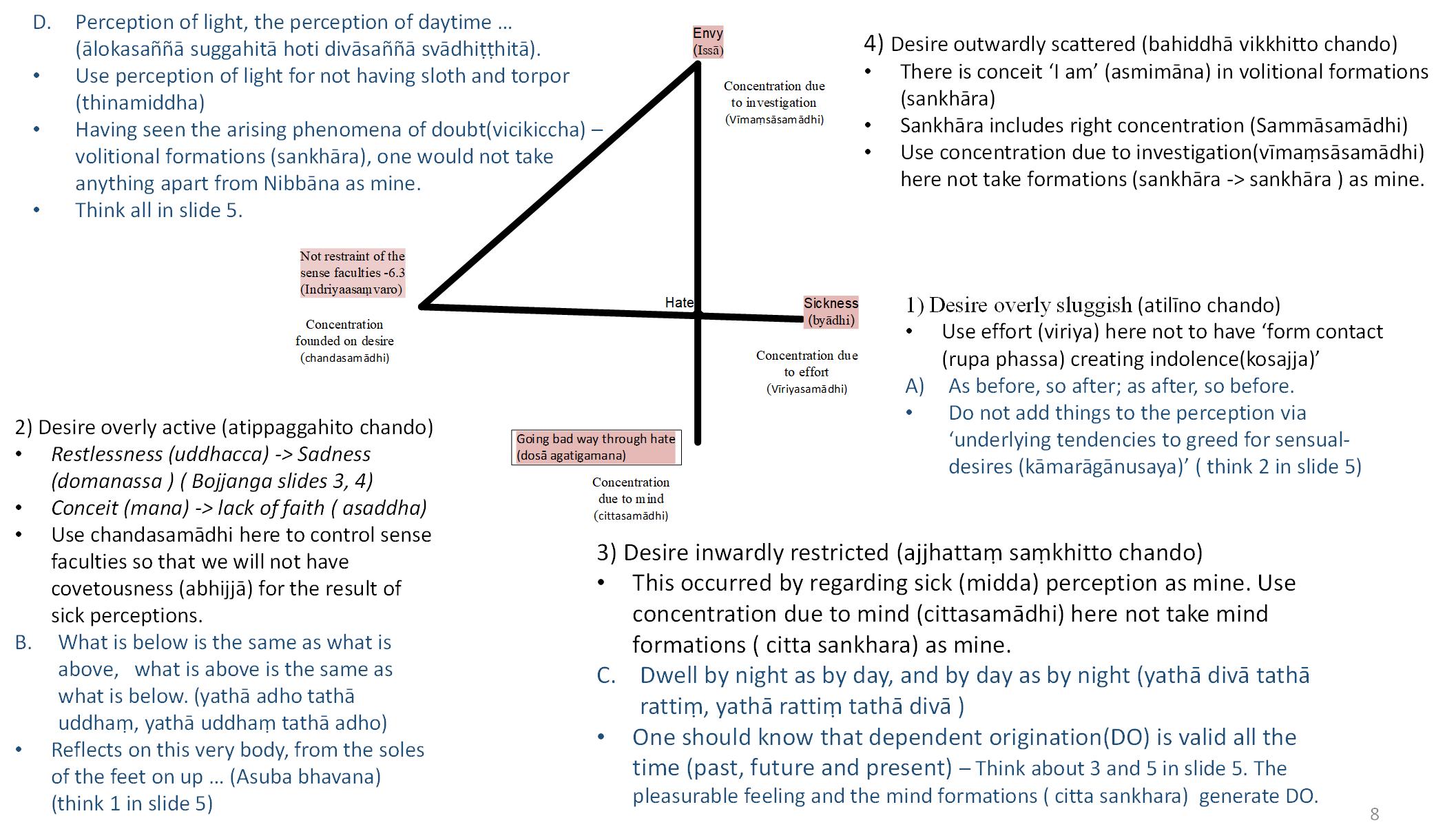
There, the doctrines of spiritual power due to investigation (Vīmaṃsiddhipāda) on page 8 have been recalled.
We have learnt the following;
Desire overly active (atippaggahito chando). We should use concentration due to desire (chanda samadhi) here to control sense faculties so that we will not have covetousness (abhijja) for the result of sick perceptions. Here we should consider both results arising due to sick perception. This twofold result of taking things as self (atta) is lust (rāga) and delusion (moha).
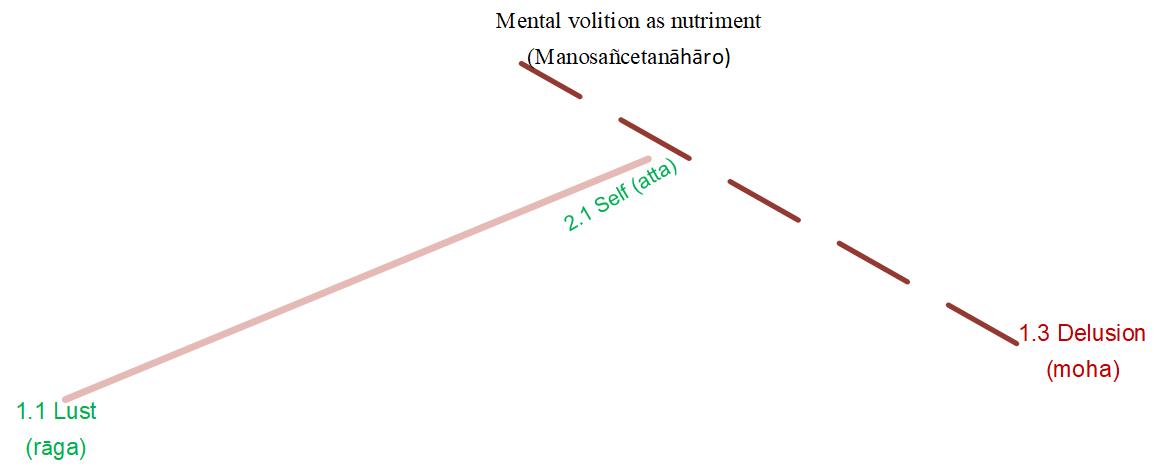
a. Here, lust considers the existence of element of heat as profitable.
b. Here the delusion is delusional by regarding the volitional formations constructed thus as permanent.
Is it not the same case as what is shown in the 17/10/2025 Tanha meditation? It is so.
By the phenomena (dhamma) that enter from the two sides by way of consciousness as condition (viññāṇa paccaya), if all three values that are said, or intended, by way of the underlying tendency to lust (rāga-anusaya), namely; beauty (subha) at the place where name-and-form (nāma-rūpa) is, the value of pleasure (sukha) at the place where the misapprehension (parāmāsa) is, the values of conceit (māna) through the underlying tendency to lust (rāga-anusaya) up to volition (cetanā) are stirred up, the mind becomes restless (uddacca). Added to this are the volition (cetanā) values that have entered the body-tie of insistence that this is truth (idaṃsaccābhiniveso kāyagantho), having reflected around the misapprehension (parāmāsa) and faculty of life (jivita-indriya) line, and within the body-tie of insistence that this is truth (idaṃsaccābhiniveso kāyagantho), without a sense of pleasure (sukha), notions have accumulated that lead to values of volitional formation (saṅkhāra); the volitional formations (sankāra) directed by volition (cetanā) are then carried out.
The doctrines added in the fourth part in the 03/03/2023 Aggi Sutta- Uddata Citta meditation should be properly applied; the element of cohesion (apo-dhātu), that is, the element that causes binding, should be removed so that one would have nibbana as object and only nibbana as goal, thereby bringing about the direct realization of nibbana.
That is the meditation.
To add a little more to this,
1. When doing this meditation, when recalling the phenomena (dhamma) associated with the underlying tendency to lust (rāga-anusaya), it is clearly felt that the part of the head connected with the faculty of mindfulness (sati-indriya) opens up. Before that, the part of the head connected with the faculty of wisdom (panna-indriya) had already opened. However, the sensation is stronger in the area connected with the left eye. When recollecting the delusion side (moha), in addition to the left side being open in that way, the right side also opens and the mind becomes taintless (anāsava). In this way, a division of the head into two occurs along a line through the faculty of wisdom to the left side of the chin.
2. By the phenomena (dhamma) that enter from the two sides by way of consciousness as condition (viññāṇa paccaya), if all three values that are said, or intended, by way of the latent tendency to lust (rāga-anusaya), namely; beauty (subha) at the place where name-and-form (nāma-rūpa) is, the value of pleasure (sukha) at the place where misapprehension (parāmāsa) is, the values of conceit (māna) through the underlying tendency to lust (rāga-anusaya) up to volition (cetanā), are stirred up, then conceit (māna) prevents going from wisdom (panna) to faith (shradda). Therefore there is lack of faith (asadda). It was learnt in Tayodhamma sutta that restlessness (uddacca) occurs due to lack of faith (asadda). Examining this, the eye of wisdom opens.
Discussion 08/11/2025