The Noble Council of Akanittha Brahma Realm was remembered with faith.
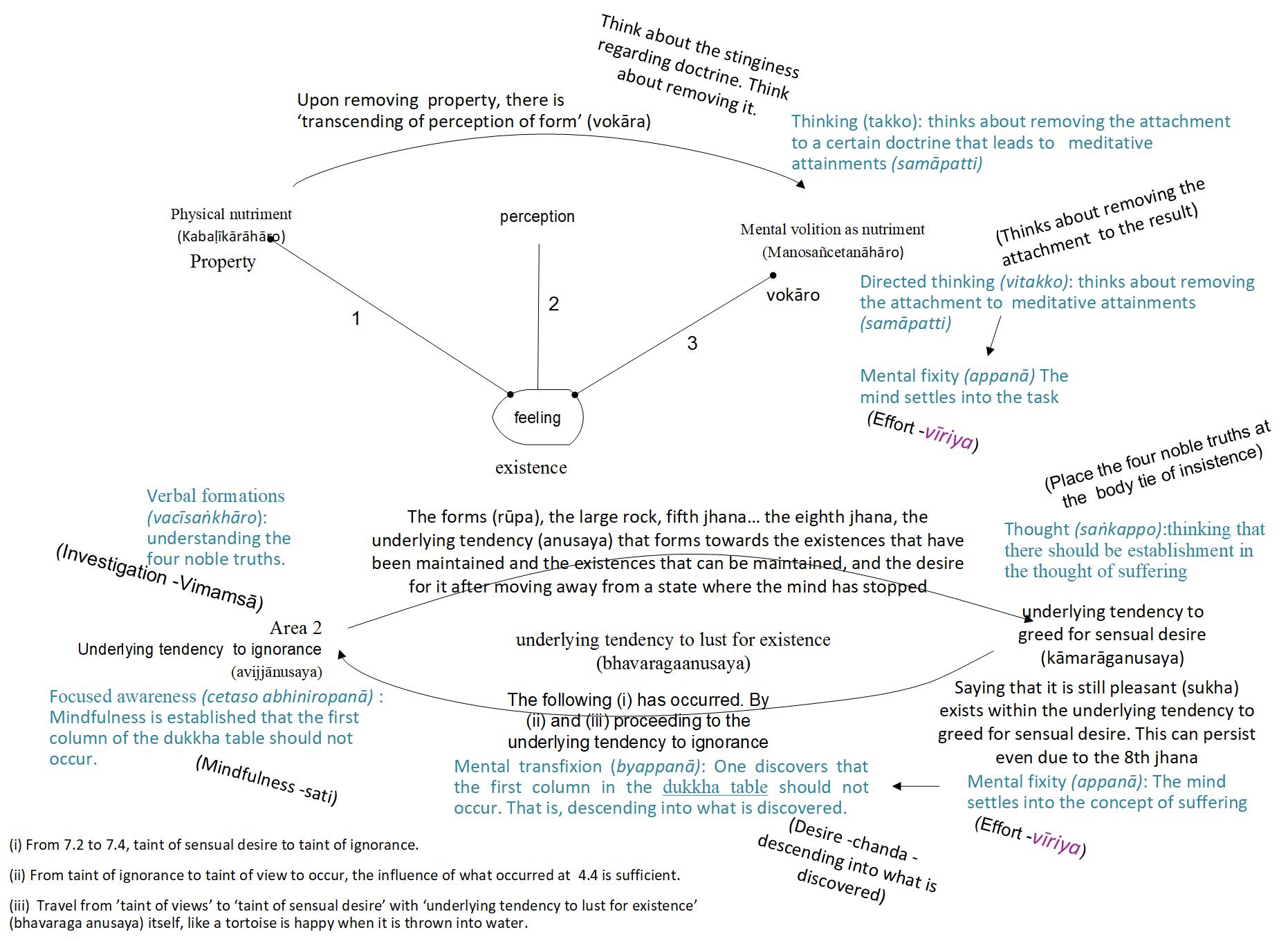
I repeated the 24/10/2025 Uddata Citta meditation. I further examined the last statement mentioned there, namely, the doctrines added in the fourth part in the 03/03/2023 Aggi Sutta- Uddata Citta meditation should be properly applied; the element of cohesion (apo-dhātu), that is, the element that causes binding, should be removed so that one would have nibbana as object and only nibbana as goal, thereby bringing about the direct realization of nibbana.
Recalling that if there is any kind of ‘craving’ (tanhā), then ‘volitions’ (cetanā) become grounded in ‘insistence that this is truth’ (idaṃsacca), through the faculty of life (jīvita-indriya), for this to occur, the pleasure (sukha) arising by adding permanence (nicca) to beauty (subha), must get established within misapprehension (parāmāsa), as pleasure. We learned earlier about the various colours that exist within misapprehension (paramasa), which arose in this way. There is a permanence that arises from this pleasure. As this spreads in various directions, it obscures the four noble truths, the sign of exertion (paggahanimitta) will be lost. To rebuild this, one must develop concentration (samādhi), as practised during the 10/02/2023 Ahaara Sutta- Samadhi meditation. I first recalled the enlightenment factor of concentration (samādhi sambojjhaṅga), arising due to concentration with thinking and exploring (savitakka–savicāra samādhi).
The volitional formations that create neither perception nor non-perception are discarded first and then perceptions of formless sphere Jhana are discarded as the second. Thirdly, the perceptions that assign permanency to the form are discarded. Then there arises rapture. If there is equanimity towards that rapture, then that will be the enlightenment factor of concentration achieved with thinking and exploring.
The definition of the sign of quiet should be recalled here. Train by higher thought (adhicittasikkha) includes the wisdom (panna) of right knowledge (sammāñāṇa) and with this wisdom, if there is anything to be abandoned, we abandon it. This is termed as sign of quiet (samathanimitta).
By not being happy due to the rapture felt by removing the perceptions that assign permanency to the form there is detachment from greed, hate and delusion.
This should be developed to an extent that one would not think the existence of element of heat as profitable. That is, all three values that are said, or intended, by way of the underlying tendency to lust (rāga-anusaya), namely; beauty (subha) at the place where name-and-form (nāma-rūpa) is, the value of pleasure (sukha) at the place where the misapprehension (parāmāsa) is, the values of conceit (māna) through the underlying tendency to lust (rāga-anusaya) up to volition (cetanā), right thought’ (samma-saṅkappa) should be developed to the extent that these three values are not stirred up.
For this, use the diagram given in the 10/01/2025 Nibbana meditation.
What is meant by mental transfixion (byappanā)? One discovers that the first column in the dukkha table should not occur. Here, by making good use of the spiritual power due to desire (chandaiddhipāda), one should immerse oneself in what has been discovered. For this, the volitional formations that create neither perception nor non-perception are discarded first, and then perceptions of formless sphere jhana are discarded as the second, thirdly, the perceptions that assign permanency to the form are discarded, helps.
How is this so? The sign of quiet (samatha nimitta) is intended, if one properly applies ‘one does not seek delight, does not welcome it and does not remain holding to it’ (nābhinandati, nābhivadati, nājjhosāya tiṭṭhati) then preventing of dependent origination takes place for a person with right livelihood (sammā-ājīva). That is why.
Next I recalled the enlightenment factor of concentration (samādhi sambojjhaṅga) arising due to concentration without thinking and exploring (avitakka-avicāra samādhi). If there is equanimity towards rapture arising due to confirmation of the sign of exertion (paggahanimitta) in concentration born without thinking and exploring, then we learned that it is the enlightenment factor of concentration born from without thinking and exploring.
This has been investigated as the sign of non-dispersal (abyagganimitta). The reason for this is because one would have Nibbana as object and only Nibbana as goal, by establishing on the Noble Eightfold Path.
Recalling the sign of non-dispersal, if one established the mind in a certain doctrine(dhamma) in the past, and a birth resulted from it, then seeing all that as suffering one will not want to establish the mind on that doctrine again. If one has established the mind in a certain doctrine(dhamma) in the present, if a birth takes place due to it, then seeing all that as suffering one will not want to establish the mind on that doctrine again. Here one should investigate using the four scenarios; a) someone with a black breed produces a black state, b) someone with a black breed produces a white state, c) someone with a white breed produces a black state and d) someone with a white breed produces a white state.
If there is a future birth by establishing the mind in a certain doctrine in the future, then seeing it will cause suffering one will not want to establish the mind on that doctrine again. The sign of non-dispersal should be understood in this manner.
Over here there must be volition (cetana) present for not to take any jhāna plane as mine. This occurs when, in the manner it is understood as above, if one established the mind in a certain doctrine (dhamma) in the past and seen the suffering resulted from it, if one has established the mind in a certain doctrine (dhamma) in the present and seen the suffering that would arise from it, if the mind were to be established in a certain doctrine in the future and seen that it will cause suffering, not establishing the mind in all three times.
Being mindful in this manner, the doctrine focussed awareness (cetasā abhinirōpanā), that is, the establishment of mindfulness (sati) that the first column of the dukka table should not occur, becomes well-established. Here the Tathāgata spoke of the reality of verbal formations (vacī saṅkhāra). The experience that suffering arises because of craving’(taṇhā), emerges like the eye of wisdom (paññā-cakkhu).
This is the meditation I did.
If I am to add a little more to this,
1. One who has right livelihood, thinks in terms of ‘nothing is produced’; when element of heat (tejo-dhātu) arises, one does not think the existence of it as profitable. To understand this, think of a person who is doing a job. It is like the thoughts that arise in that person when knowing others are getting more money. Since he, too, is seeking, he thinks of it as profitable.
2. The doctrine that “if there is equanimity towards rapture arising due to confirmation of the sign of exertion (paggahanimitta) in concentration born without thinking and exploring” is now clearly understood. That is, if rapture (pīti) arises from being on The Noble Eightfold Path, it can lead to conceit (māna). This way wholesome volitions (kusala-cetanā) are lost, and roaming through the samsara may be prolonged. Why is it so? Mindfulness becoming established on the understanding that ‘the first column of the dukka table should not occur’ is prevented. That is the reason.
That is what needs to be added.