The Noble Council of Akanittha Brahma Realm was remembered with faith.
I repeated the 31/10/2025 Nibbāna meditation. I recalled the dhamma part, enlightenment factor of concentration (samādhi-sambojjhaṅga), which arises due to concentration without thinking and exploring (avitakka-avicāra samādhi). I recalled, if one established the mind in a certain doctrine (dhamma) in the past and seen the suffering resulted from it, if one has established the mind in a certain doctrine (dhamma) in the present and seen the suffering that would arise from it, if the mind were to be established in a certain doctrine in the future and seen that it will cause suffering, not establishing the mind in all three times and thus being mindful in this way.
In the Tanha meditation of 17/10/2025, we investigated that there are three kinds of craving present; craving for sensuality (kāma tanha), craving for existence (bhava tanha), and craving for non-existence (vibhava tanha). By means of the doctrines represented through them, volitions arise, and those volitions become grounded in ‘insistence that this is truth’ (idamsacca) through the faculty of life (jivita-indriya).
Further investigation of this was done in the 24/10/2025 Uddata Citta meditation. We learned there, by the phenomena (dhamma) that enter from the two sides by way of consciousness as condition (viññāṇa paccaya), if all three values that are said, or intended, by way of the underlying tendency to lust (rāga-anusaya), namely; beauty (subha) at the place where name-and-form (nāma-rūpa) is, the value of pleasure (sukha) at the place where the misapprehension (parāmāsa) is, the values of conceit (māna) through the underlying tendency to lust (rāga-anusaya) up to volition (cetanā) are stirred up, the mind becomes restless (uddacca). Added to this are the volition (cetanā) values that have entered the body-tie of insistence that this is truth (idaṃsaccābhiniveso kāyagantho), having reflected around the misapprehension (parāmāsa) and faculty of life (jivita-indriya) line, and within the body-tie of insistence that this is truth (idaṃsaccābhiniveso kāyagantho), without a sense of pleasure (sukha), notions have accumulated that lead to values of volitional formation (saṅkhāra); the volitional formations (sankāra) directed by volition (cetanā) are then carried out.
A mind arising that does not take a jhāna plane as ‘mine’; for the arising of volition, one becomes mindful as described above by using concentration without thinking and exploring (avitakka-avicāra samādhi), and in doing so, if there is a certain effort to bring train by higher thoughts (adhicitta-sikkhā) to fulfillment, then, volitional formations that create neither perception nor non-perception are discarded first, the perceptions of formless sphere Jhana are discarded as the second, thirdly, the perceptions that assign permanency to the form are discarded, if there arises rapture arising from this, there must be equanimity towards that rapture. Thus, if an equanimity is not established, this happens solely due to the emergence of sorrow 2 doctrines.
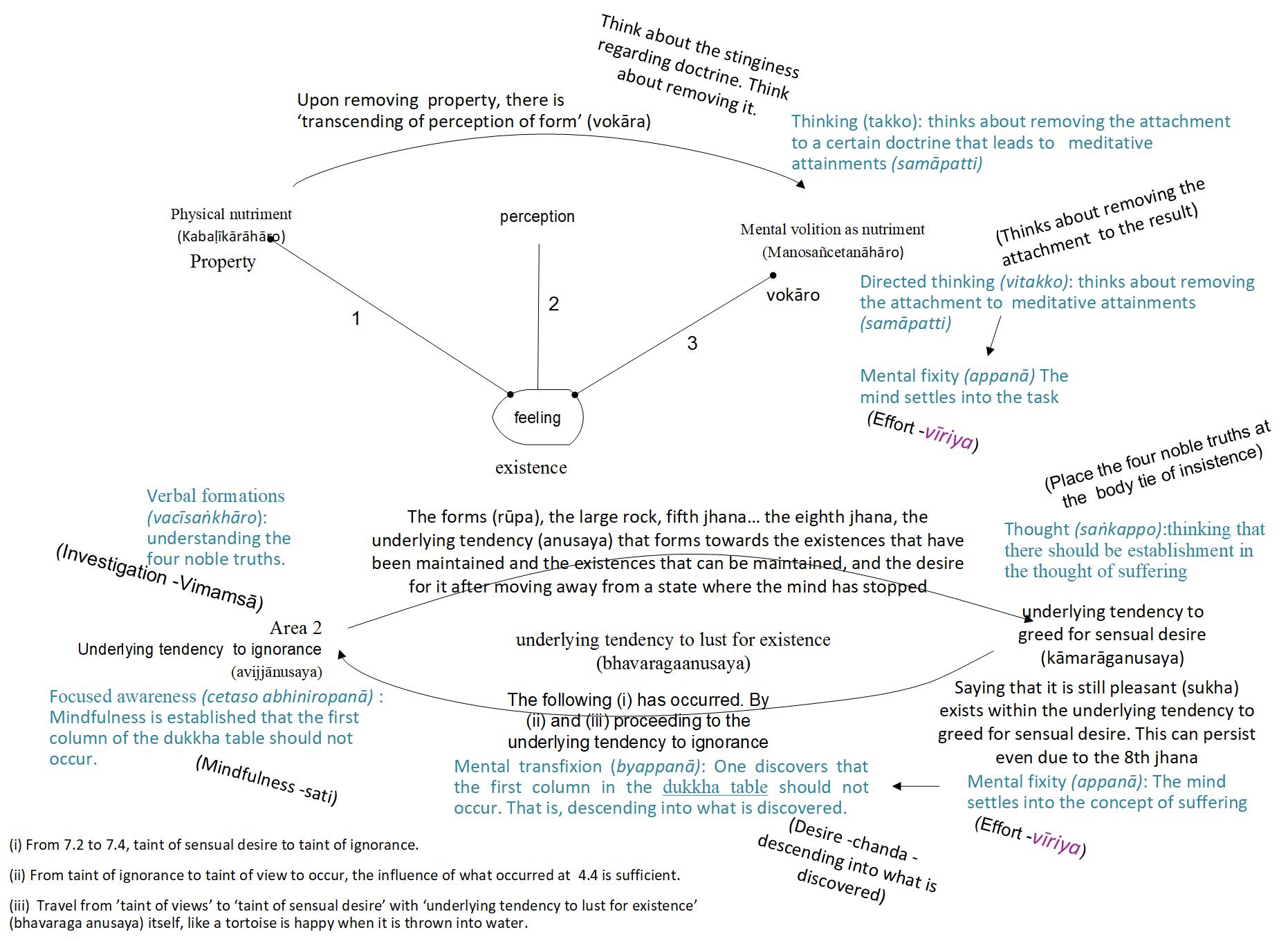
If sorrow 2 doctrines emerge, there is no establishment of effort (viriya) to maintain mental fixity (appanā) given in the diagram of 10/01/2025 Nibbāna meditation.
If the mind does not descend into thought of suffering (dukkha- saṅkappa) in this way, then not taking of a jhana plane as ‘mine’ does not occur.
If the effort made in the above manner to bring ‘train by higher thoughts’ (adhicittasikkha) to fulfillment is successful, that is, if volitional formations that create neither perception nor non-perception are discarded first, the perceptions of formless sphere jhana are discarded as the second, thirdly, the perceptions that assign permanency to the form are discarded, then if there is any rapture (pīti) arising from this and if there is ‘equanimity’ (upekkhā) towards that rapture, it is possible to achieve Nibbana as object and only Nibbana as goal.
This is the meditation I did.
If I am to add a little more to this,
1. Doing this meditation, when recalling that there are three kinds of craving present; craving for sensuality (kāma tanha), craving for existence (bhava tanha), and craving for non-existence (vibhava tanha). By means of the doctrines represented through them, volitions arise, and those volitions become grounded in ‘insistence that this is truth’ (idamsacca) through the faculty of life (jivita-indriya) and without a sense of pleasure (sukha), notions have accumulated within ‘insistence that this is truth’ (idamsacca), the volitional formations (sankāra) directed by volition (cetanā) are carried out, the mind comes to a stop. It is not possible to recall the dhamma beyond this point. For this, one should not have sorrow 2; it is sufficient to have ‘one does not sorrow over the past’ (atītaṃ nānusocati) established in the mind. Here, the stopping of the mind occurs at ‘insistence that this is truth’ (idamsacca) and it should be clearly understood the severity of the doctrine ‘volitional formations directed by volition (cetanā) are carried out’.
2. Within the jhāna planes, ‘sensual thoughts’ (kāma-vitakka) are absent. However, in the 17/10/2025 Tanha meditation, we learned that, in whatever plane one is born, the sensual element (kāma dhātu) connected with the subject of form surpasses all the elements. The mind inclines toward becoming impregnated in there itself. Here someone may proceed as far as ‘sensual perception’ (kāmasaññā) and then stop. Some others, withdraw immediately, as soon as the sensual element (kāma-dhātu) arises. As an example for this, it can be taken the one who has attained the eighth jhana. When the sensual element arises, he immediately withdraws from it. The Budu Piya said that this is so.
3. A mind arising that does not take a jhāna plane as ‘mine’; for the arising of volition, one makes use of concentration without thinking and exploring (avitakka–avicāra samādhi) and cultivate and develop it well, that is, one investigates by applying the four states; someone of the black breed produces a black state, someone of the black breed produces a white state, someone of the white breed produces a black state, someone of the white breed produces a white state, and afterwards volitions become grounded in ‘insistence that this is truth’ (idamsacca) through the faculty of life (jivita-indriya) and volitional formations, determined by volition are carried out. Recalling this, a star appeared at volition (cetanā).
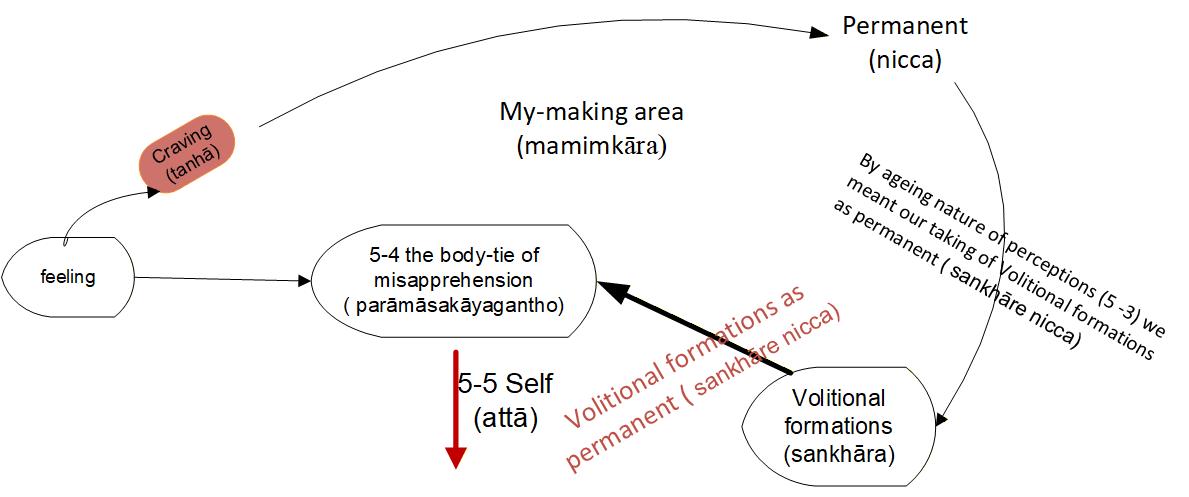
4. When reflecting on the ‘enlightenment factor of concentration’ (samādhi-sambojjhaṅga) that arises due to concentration without thinking and exploring (avitakka–avicāra samādhi), that is, recollecting if one established the mind in a certain doctrine (dhamma) in the past and seen the suffering resulted from it, if one has established the mind in a certain doctrine (dhamma) in the present and seen the suffering that would arise from it, if the mind were to be established in a certain doctrine in the future and seen that it will cause suffering, Budu Piya said to practice contemplation of the elements (dhātu-manasikāra). Here, if one established the mind in a certain doctrine (dhamma) in the past, if one has established the mind in a certain doctrine (dhamma) in the present, if the mind were to be established in a certain doctrine in the future—at this point it was connected this as—are not all of these dhammas represented by craving, that is, perceptions, feelings, and the dhammas that bind one to something? By means of the doctrines represented through them, volitions arise, and those volitions become grounded in ‘insistence that this is truth’ (idamsacca) and the volitional formations (sankāra) directed by volition (cetanā) are carried out. Remembering this, a peaceful, well-liberated mind (Shantha Suvimutta Citta) arose. Furthermore, remembering this doctrine while repairing, and soon as recollecting that lamented volitional formations say perception is pleasurable, the diagram in the fourth page of the Sabbāsava Diagram 3, came to mind. In this way, what has become ‘my-making’ (mamaṅkāra) and ‘I-making’ (ahaṅkāra) is only to the elements themselves.
This is what I have to add.