The Noble Council of Akanittha Brahma Realm was remembered with faith.
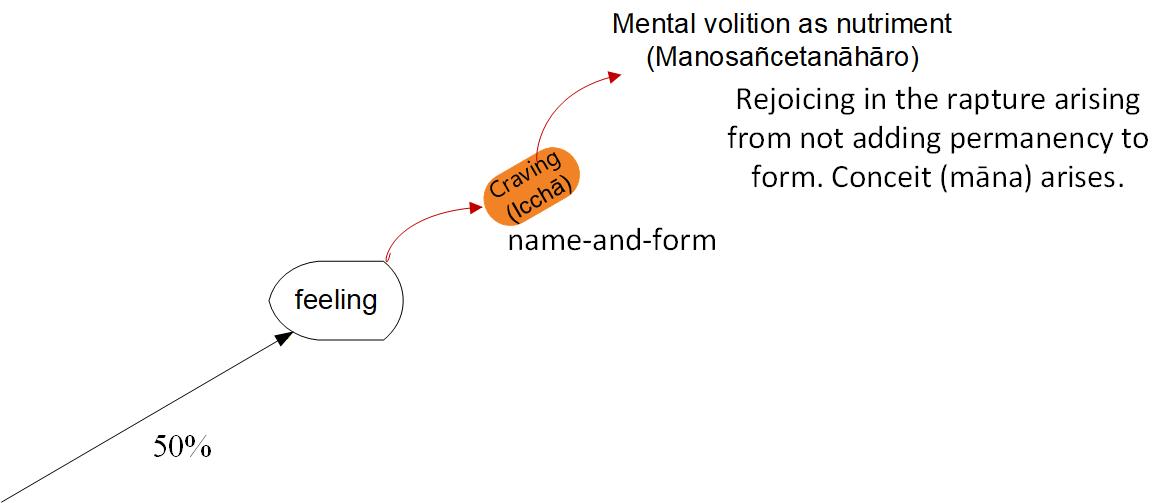
In the meditations done in past few days, it was discussed that the 50% path followed by the arising of feeling, craving and then volition (cetanā), and by the phenomena (dhamma) that enter from the two sides by way of consciousness as condition (viññāṇa paccaya), if all three values that are said, or intended, by way of the underlying tendency to lust (rāga-anusaya), namely; beauty (subha) at the place where name-and-form (nāma-rūpa) is, the value of pleasure (sukha) at the place where the misapprehension (parāmāsa) is, the values of conceit (māna) through the underlying tendency to lust (rāga-anusaya) up to volition (cetanā) are stirred up. See diagram 1 provided.
Diagram 1
Furthermore, in the 07/11/2025 Nibbāna meditation, when contemplating the ‘enlightenment factor of concentration’ (samādhi-sambojjhaṅga) arising due to ‘concentration with thinking and exploring (savitakka–savicāra samādhi), we examined what happens if one rejoices in the rapture that arises by not adding permanency to form. If one delights like that, conceit (māna) will arise. Thus, investigating being conceited this way, in the doctrine where all three values that are said, or intended, by way of the underlying tendency to lust (rāga-anusaya), namely; beauty (subha) at the place where name-and-form (nāma-rūpa) is, the value of pleasure (sukha) at the place where the misapprehension (parāmāsa) is, the values of conceit (māna) through the underlying tendency to lust (rāga-anusaya) up to volition (cetanā), Budu Piya said conceit also arises that the 50% path is reached and that path happened.
Why is this so? Because something has been acquired that can lead to ‘stinginess regarding doctrine’ (dhammamacchariya). The thought here needs to be examined. It should not be forgotten that this has arisen from the absence of ‘mental fixity’ (appanā), as shown in the diagram given in the 10/01/2025 Nibbāna meditation.
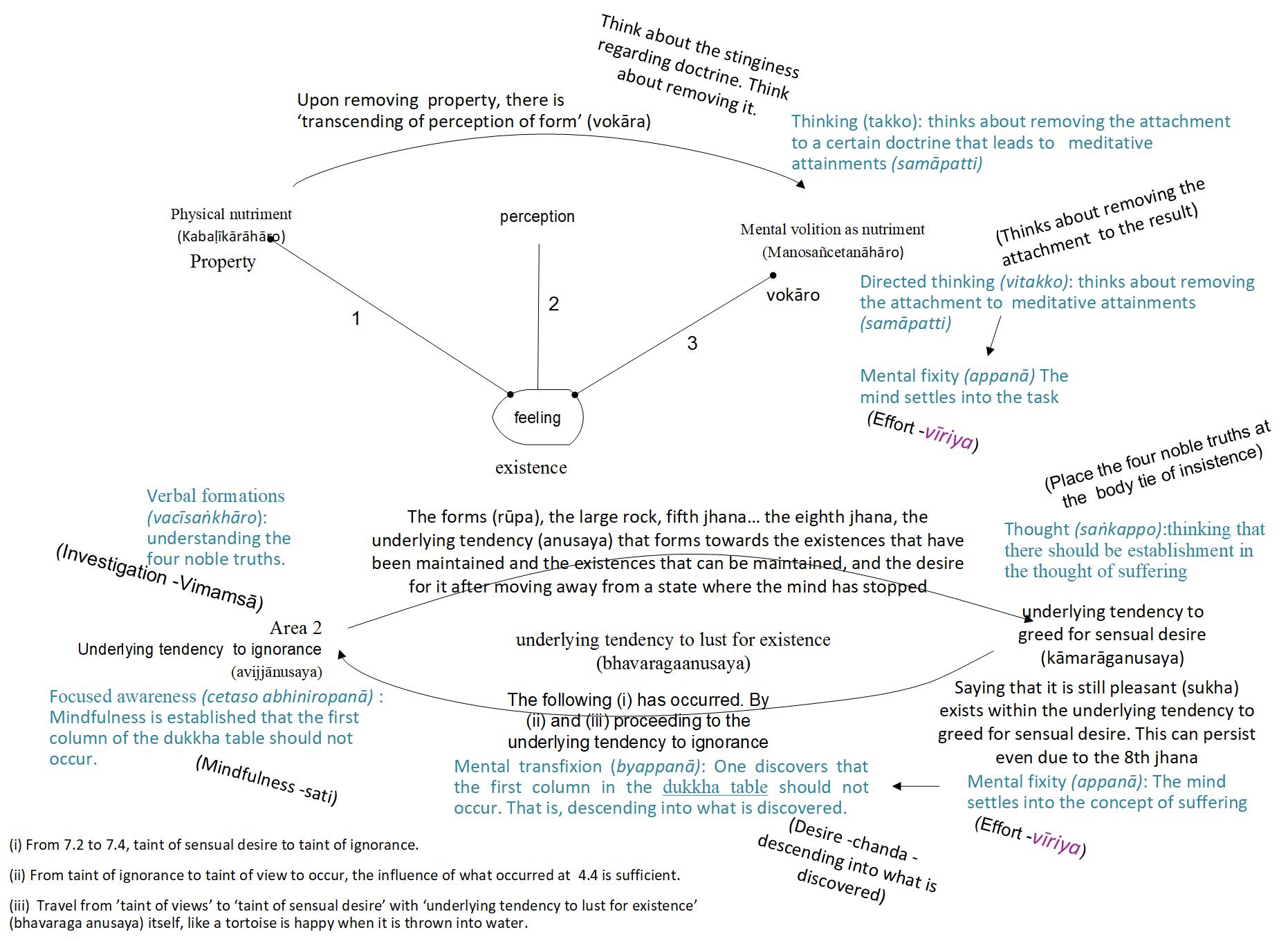
There, it has arrived from area 6 ‘underlying tendency to greed for sensual desire’ (kāmarāgānusaya) to ‘underlying tendency to ignorance’ (avijjānusaya). If conceit (māna) is occurring, with the destruction of wisdom, ‘intentions of hate’ (paduṭṭha-manasankappa) becomes active. Progressing as far as hate, ‘barb of hate’ (dosa-salla) becomes active. From that sorrow 2 becomes active. It is understood that, because of the perception of permanence, the sorrow 2 path begins, and that demanding of previously experienced feeling values occurs due to the ‘barb of hate’ (dosa-salla). See the given diagram 2.
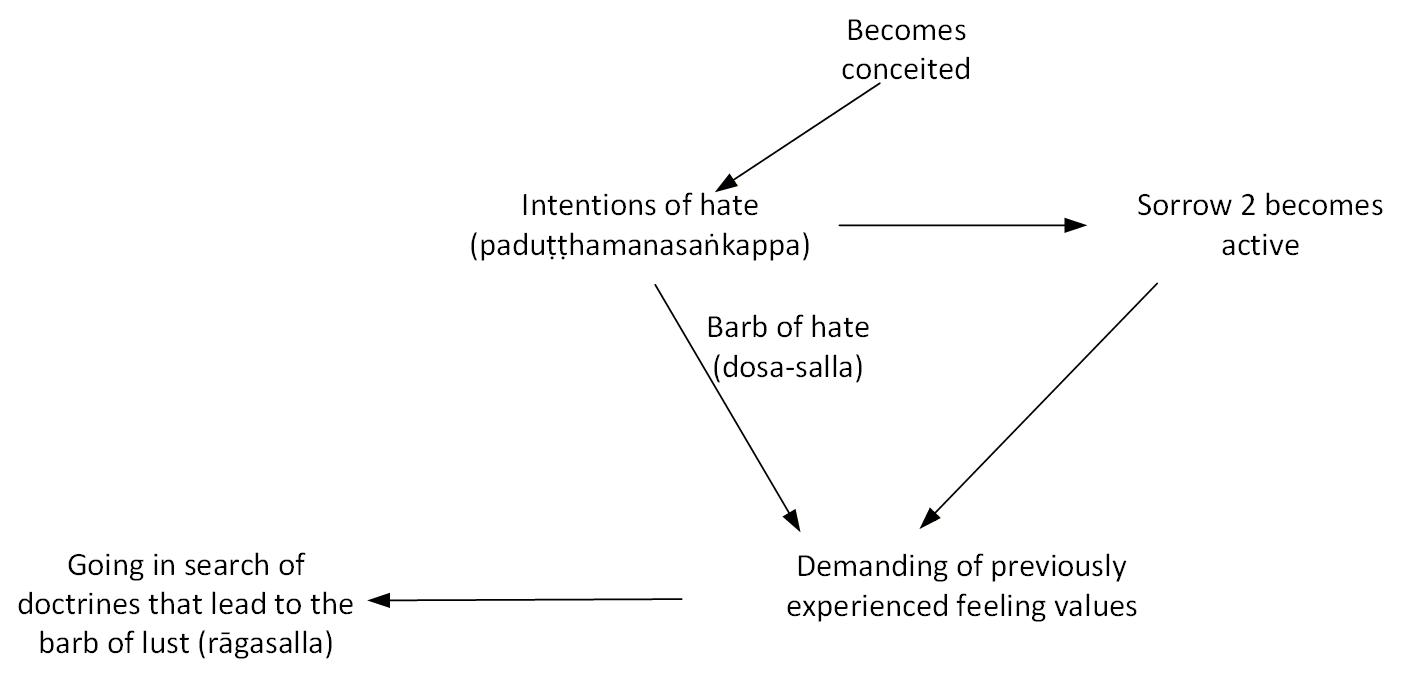
Diagram 2
Budu Piya said, that with the demanding of previously experienced feeling values, one is going in search for doctrines that lead to the ‘barb of lust’ (rāgasalla). When this happens, the 50% path becomes active. Why is this so? Because one becomes conceited in two ways.
a) Form contact (rūpa phassa) is accepted as good. This is connected with views (diṭṭhi).
b) That there is a mind moistened by previous feeling. This is related to the mind (citta). Here thought (saṅkappa) is fundamental.
Thus, with birth (jāti) as cause there is feeling (vedanā) -> craving (taṇhā)-> volition (cetanā) -> conceit (māna), also ‘barb of hate’ (dosa-salla) demanding of previously experienced feeling values occurring via ‘intentions of hate’ (paduṭṭha-manasaṅkappa), and when the 50% path becomes active, through the above-mentioned a) and b), birth cannot be prevented. This is called jati (birth).
This is the meditation I did.
If I am to add a little more to this,
1. Since one becomes taintless (anāsrava) even before reaching the second diagram, practicing this meditation is extremely difficult.
2. When investigating together with the fourth point that was added to the 14/11/2025 Nibbāna meditation, and with the addition of what has become ‘my-making’ (mamaṅkāra) and ‘I-making’ (ahaṅkāra) is only to the elements themselves, it is understood that birth (jāti) has no essence.
3. In the 26/01/2024 Nibbāna meditation, the trident diagram rotates clockwise when viewed from the perspective of perception (saññā). Here the oscillation diagram, also rotates clockwise when viewed from the perspective of perception. That is, the immorality side where ‘killing living beings’ (pāṇātipātā) is marked, slopes downwards, lamentation (parideva) moves to the heavy side that sinks towards the ground. In this way, when mental formations (citta saṅkhāra) reach completeness through bodily and verbal formations (kāya, vacī saṅkhāra), that itself is called birth (jāti). Furthermore, birth takes place continuously while we are living. We learned that mental formations (citta saṅkhāra) reach completeness, through bodily and verbal formations (kāya, vacī saṅkhāra), and that this, also occurs through the process of in-breathing and out-breathing. In this way, because of views, when one accepts contact with form as good, even when there is a breath taken, conceit is contained within it. Because thought (saṅkappa) being fundamental, even when there is a breath taken, with a mind moistened by previous feeling, within that, conceit is included.
4. When the depth of what is mentioned at the end of the meditation here,
that conceit (māna) arises in two ways and hence the 50% path becomes active, is comprehended, the left cheek becomes cool, a sensation is felt on the chin, and the arising of the seventh jhāna, also occurs. Here, recalling the form value in the conceit (māna) path, together with the line underlying tendency to views (diṭṭhānusaya), was clearly kept in mind If the 50% path is active, the danger arising from it was in the mind.
This is what I have to add.