The Noble Council of Akanittha Brahma Realm was remembered with faith.
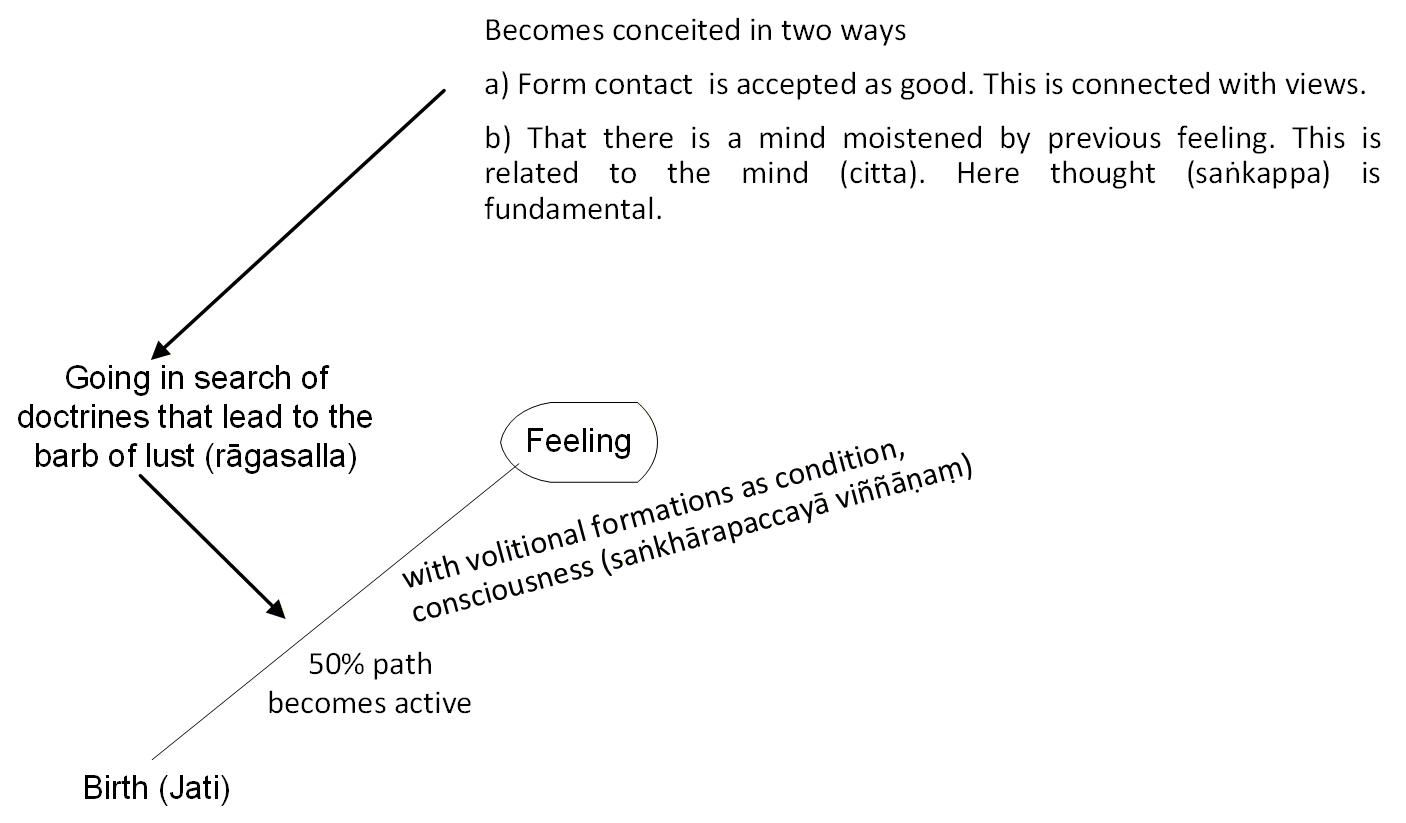
I repeated the 28/11/2025 Jati 2 meditation. Examining diagram 1, it is understood that this occurs by arriving along the path of underlying tendency to views (diṭṭhānusaya). Examining diagram 2, it is understood that it is coming from delusion (moha). Reflecting on which of these two comes first, one understands that what comes first is the coming from delusion, due to volitional formations conditioned by ignorance (avijjā-paccayā saṅkhārā). That is, it is understood that arriving at the 50% path happens first from not occurring of mental fixity (appanā). Because thoughts (saṅkappa) must have arisen before the phenomena (dhamma) that enter from the two sides by way of consciousness as condition (viññāṇa paccaya), the doctrines in diagram 1 should occur second. If that is so, it should be investigated whether this is the consciousness that arises in dependence on volitional formations (sankhara). Budu Piya said that it is so. Let us see how these doctrines are marked in diagrams 1 and 2.
First, in the diagram 1, in the section from birth (jāti) up to feeling (vedanā) we can mark ‘with volitional formations as condition, consciousness’ (saṅkhārapaccayā viññāṇaṃ). Why is it so? Because in this way feeling is identified by consciousness arising in dependent on volitional formations. Refer to given diagram 1.
Diagram 1
Secondly in diagram 2, arriving at the 50% path from not occurring of mental fixity (appanā) should be marked as ‘with ignorance as condition, volitional formations’ (avijjāpaccayā sankārā). Why is this so? Because when mental fixity (appanā) is not occurring, then the mind does not settle into the thought of suffering (dukkha-saṅkappa), there ignorance (avijjā) being fundamental. That itself leads to doing volitional formations (saṅkhārā). That is why. See the given diagram 2.
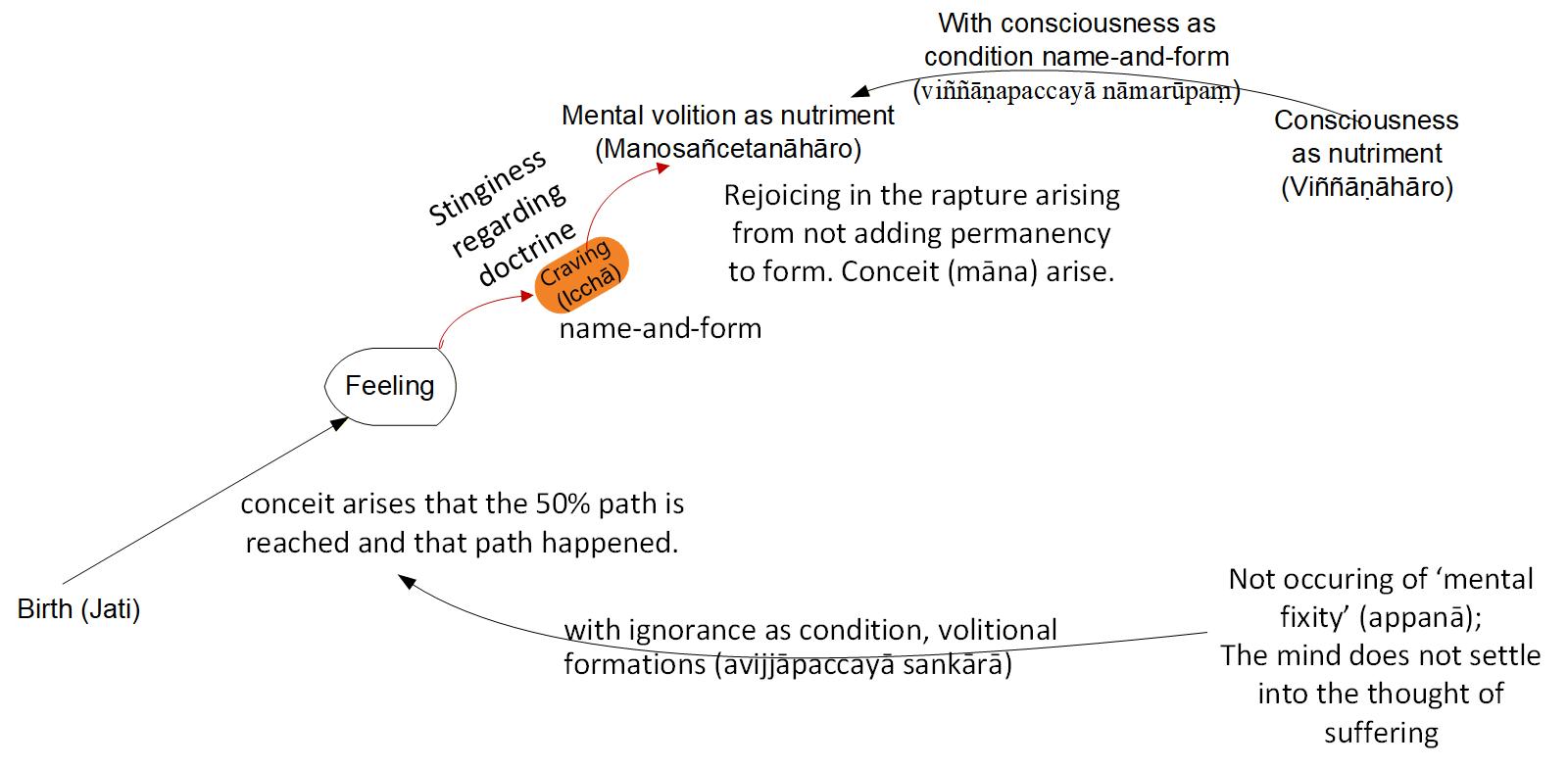
Diagram 2
For this meditation, investigate starting from diagram 3 of the 28/11/2025 Jati 2 meditation.
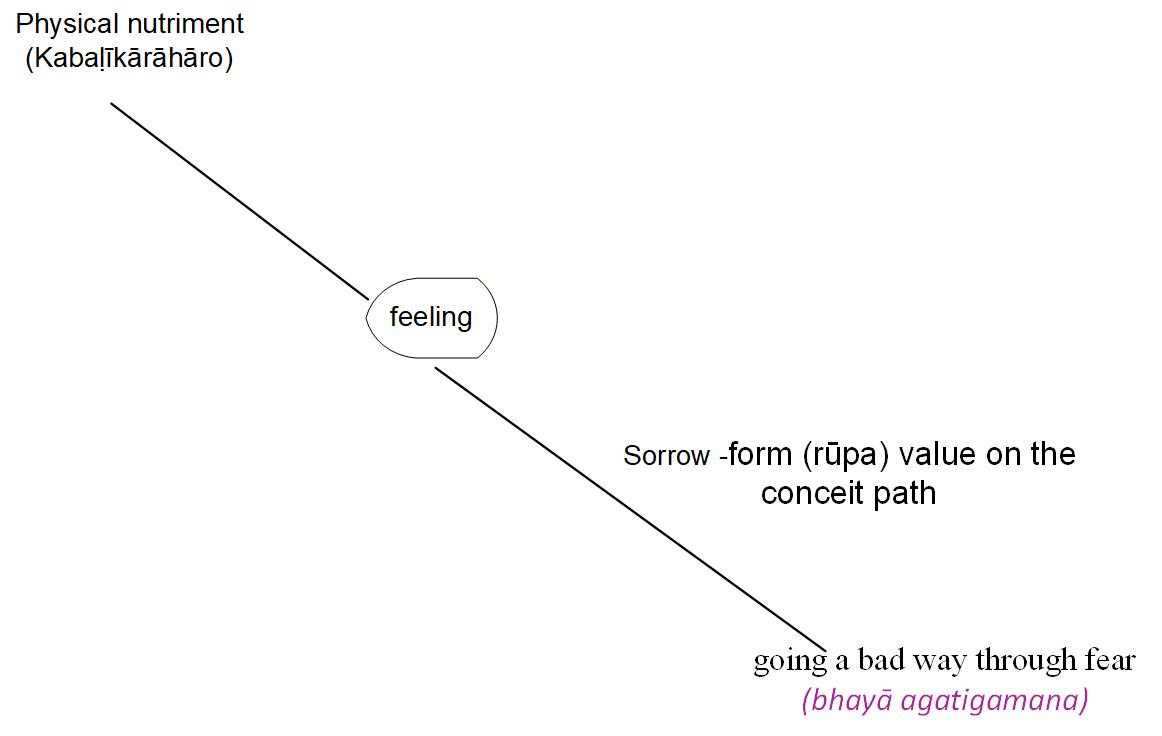
Investigate someone who is with ‘conceit I am’ (asmimāna), starting from sorrow (soka) and generating consciousness dependent on volitional formations (saṅkhārapaccayā viññāṇaṃ) and also activating the 50% path.
For this, make use of the understanding gained from 05/08/2015 Sankhara paccaya Vinnanam meditation. The ageing (jarā) value of perception (saññā), with embedded wrong view of ‘can exist’, flows through via line 5 and it reaches "union with what is displeasing" first. In the meantime, In the meantime, "exists", the wrong view flows through via line 6 and it reaches sorrow from sickness. Now the wrong view – ‘can exist’ flows on the top of the wrong view – ‘exists’. Thus, in a being whose mind has not settled into the thought of suffering (dukkha sankappa), and whose wrong view is rooted in ignorance, the flow of wrong view (micchādiṭṭhi) occurs. This itself is called ‘with ignorance as condition, volitional formations’ (avijjāpaccayā sankhārā). Thus, letting wrong view (micchādiṭṭhi) to flow in this way, the arising of birth (jāti) should be understood.
This is the meditation I did.
If I am to add a little more to this,
1. In the 05/08/2015 Sankhara paccaya Vinnanam meditation, we became aware of consciousness because of volitional formations. This is ‘with volitional formations as condition, consciousness’ (saṅkhārapaccayā viññāṇaṃ). We understood that the two views (diṭṭhi) are not identical. Two volitional formations were not equal, there was a difference in thoughts (saṅkappa). From this, we learned how that understanding came about. This awareness occurs because of the difference in the feeling (vedanā) one feels.
2. During the Vyāpāda-2 meditation of 07/03/2025 we learned that, failing to properly carry out the process that occurs through 'stinginess regarding doctrine’ (dhammamacchariya), a nature of ill will (byāpāda) arises toward the doctrines related to feelings (vedanā). When examined along with the first point added above, it is understood that a person with wrong view (micchādiṭṭhi) thinks with ill will (vyāpāda) itself. Even the right view (sammādiṭṭhi), that is affected by taints, partaking of merits, (puññabhāgiya), ripening in the acquisitions (upadhi) falls into the category of unwholesome (akusala). It should be understood that when one praises mental formations (citta saṅkhāra) in this way, then there is no right view (sammādiṭṭhi), and that this falls into the category of unwholesome (akusala). One who has wrong view (micchādiṭṭhi) together with ill will thinks in that very way; it is understood that the volitional formations (saṅkhāra), he produces are also accompanied by ill will.
3. Why The Blessed One (Tathāgata) not going to a funeral house is further understood. If one knows that the rotten mango will decay and perish, there is nothing to go and see. It is because the wrong view (micchādiṭṭhi) ‘exists’ is absent.
4. Thus, with the understanding that ‘with ignorance as condition, volitional formations’ (avijjāpaccayā saṅkhārā) is the flow of wrong view (micchādiṭṭhi), starting from sorrow (sōka) when one meditates, where there is ‘sorrow’ a taintless (anāsava) mind occurs.
This is what I have to add.
Discussion 20/12/2025
Notes added after the discussion
If I am to add a little more to this,
1. Remembering the doctrine Budu Piya said that conceit also arises that the 50% path is reached and that path happened, ‘with ignorance as condition, volitional formations’ (avijjāpaccayā saṅkhārā), that is, because of ignorance, there arises the conceit ‘I committed killing’ and there arises the conceit ‘I committed stealing ’. Thinking in this way, concentration (samādhi) becomes intense.
2. Later we will use diagram 1 doctrines as buttock 1 doctrine, diagram 2 doctrines as buttock 2 doctrine. If not, remember them as left-side buttock, right-side buttock.
This is what I have to add.