The Noble Council of Akanittha Brahma Realm was remembered with faith.
During the 12/12/2025 Jāti 4 meditation, the influence of higher absorption levels strongly influences the thought (sankappa) and the application of the craving value there was discussed. That is, there are three kinds of craving present, craving for sensuality (kāma tanha), craving for existence (bhava tanha), and craving for non-existence (vibhava tanha). By means of the doctrines represented through them, volitions arise, and those volitions become grounded in ‘insistence that this is truth’ (idamsacca) through the faculty of life (jivita-indriya), without a sense of pleasure (sukha), notions have accumulated that lead to values of volitional formation (saṅkhāra). This accumulation influences it. We learnt that the very occurrence of producing volitional formations (saṅkhāra) dependent on ignorance (avijja) is called craving (taṇhā).
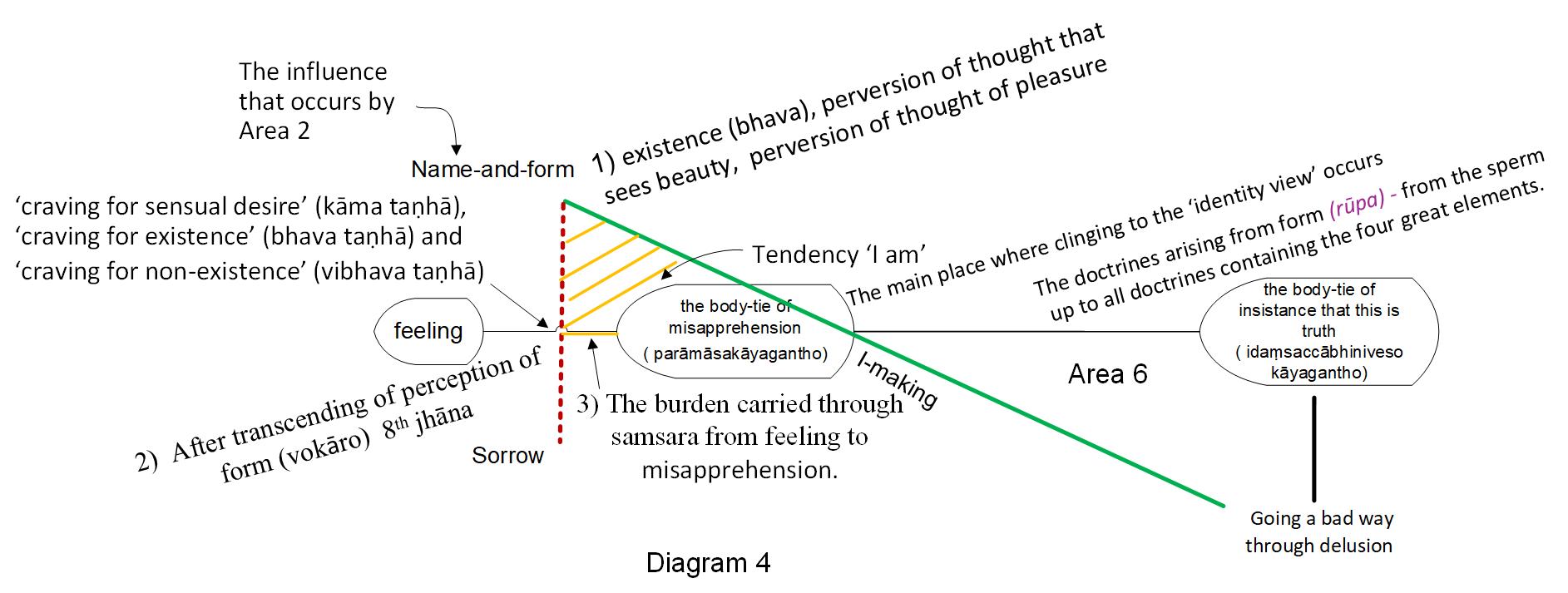
Let us examine this using the diagram 4 given in the 08/11/2024 Nibbana meditation.
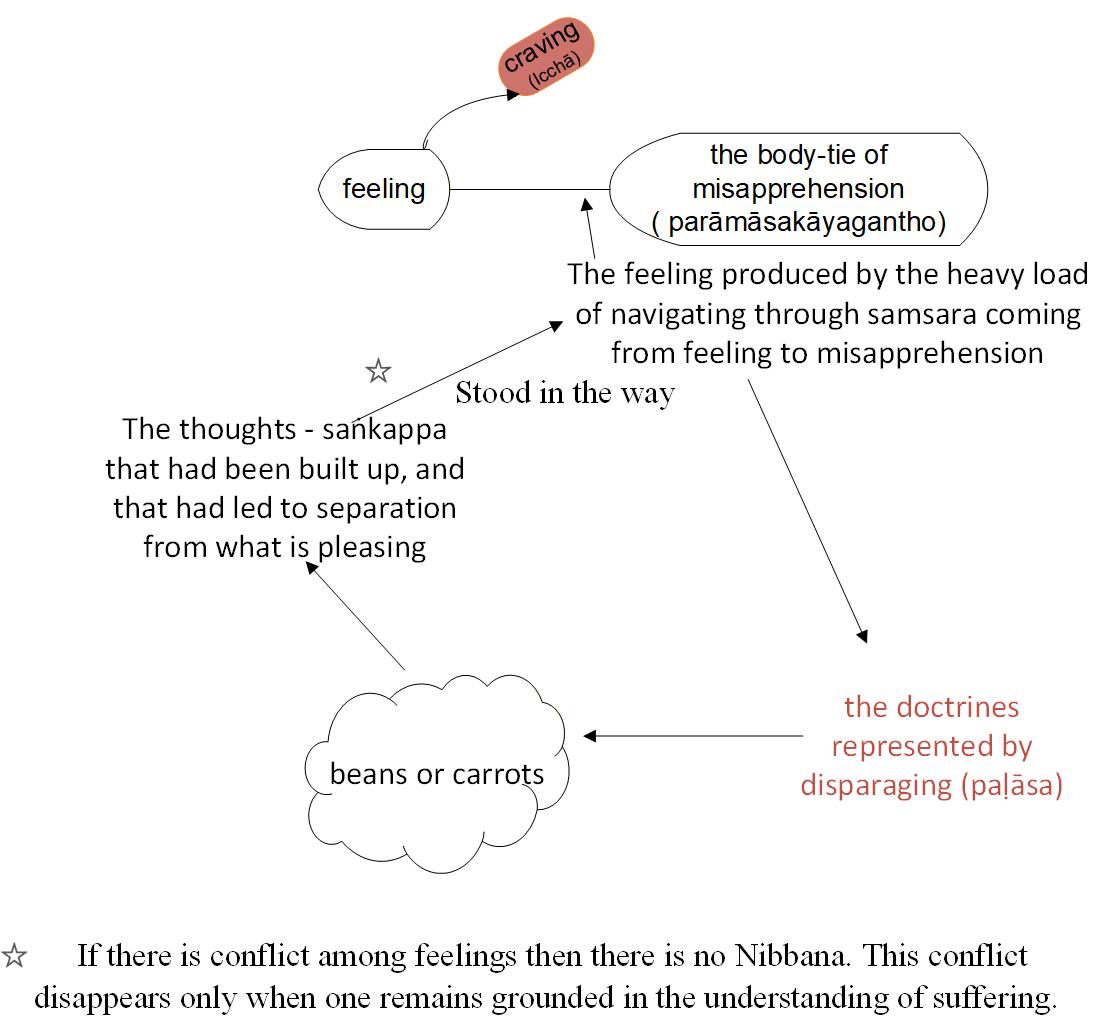
Therein, ‘transcending the perception of form’ (vokāra), the highest value of craving for non-existence (vibhava-taṇhā), is represented by the 8th jhāna, the heavy load (burden) of navigating through samsara coming from feeling (vedanā) to misapprehension (parāmāsa) is marked. Because of feeling (vedanā), craving (taṇhā) arises. If so, the three cravings are also influenced by that same feeling. What feelings? The feelings resulted from the heavy load (burden) of navigating through samsara. The thoughts - saṅkappa that had been built up, and that had led to separation from what is pleasing (piyehi vippayogo), stood in its way. That is, the mental formations (citta-saṅkhāra) that praised certain doctrine as beneficial are what exert influence. Here the doctrine of disparaging (paḷāsa) has a strong influence. The doctrine that keeps one mental formation separate from another has come to the fore. Thus, the doctrines represented by disparaging (paḷāsa) within the heavy load (burden) of navigating through samsara, has a greater influence, prevailing over other doctrines. That is so.
To stop this, the four bases of spiritual power (cattaro iddhipada) should be developed as explained in the 07/02/2025 - Nibbana and 14/02/2025 – Nibbana meditations, and if something needs to be done to eliminate disparaging (paḷāsa), it should be done continuously using right livelihood (sammā-ājīva). One should understand that, because a householder is accustomed in everyday life to distinguish between beans and carrots, it is difficult, through spiritual power due to mind (citta-iddhipāda), to maintain the association of every form with suffering (dukkha).
This is the meditation I did.
If I am to add a little more to this,
1. I recollected page 7 of the ‘Fear and Terror’ (bhaya-bherava) diagrams. Restlessness (uddhatā), unpeaceful mind (avūpasantacittā).
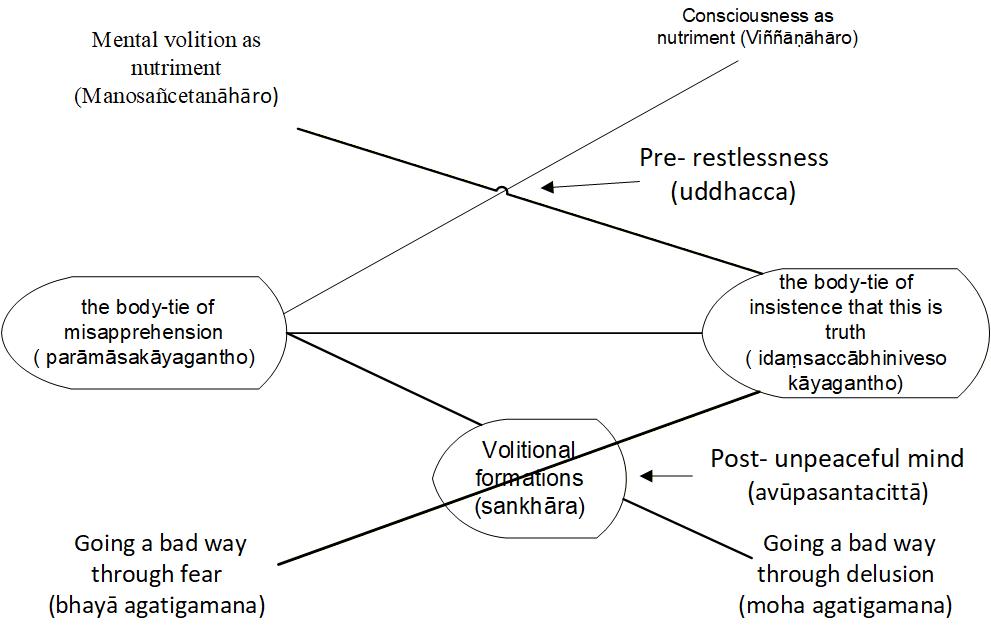
Unpeaceful mind (avūpasantacittā). In a mind that had form (rupa) contact, there is the sick (byādhi) nature due to aging (jara). If one does not accept ageing, one cannot prevent sickness (byādhi). When this happens, the objective is to seek up to the eighth jhana again. Gets established therein. Occurrence of producing volitional formations (saṅkhāra) dependent on ignorance (avijja) - craving (tanha), cannot be stopped.
2. In practising this meditation, it is understood that there is conflict among feelings (vedanā). If there is conflict among feelings, then there is no Nibbana. This conflict disappears only when one remains grounded in the understanding of suffering (dukkha). See the given diagram.
3. Repairing after doing this meditation, attainment of the eighth jhāna, appearance of past births (bhava), and seeing the rings of Saturn happened.
4. It is appropriate to do this meditation after recalling the doctrine of the two buttocks. By doing so, one recollects these doctrines with deep concentration (samādhi). In here form (rupa) contact is welcomed as good. When recalling the dhamma that this is connected with views (diṭṭhi), one must realise its danger. Just as someone who sees a pile of fire and does not go to touch it, this should be understood in the same way. Furthermore, when recalling the other buttock, one must understand the danger if mental fixity (appanā) does not happen and as a result the mind does not descend into thought of suffering (dukkha saṅkappa).
5. Together with point 4 above, thinking of the two buttocks as conceit (māna) and ignorance (avijjā), two eyes felt very calm and pleasurable, and seen conceit and ignorance as the two enemies of concentration due to investigation (vimamsā samādhi), the immeasurable state of equanimity (upekka appamana) remained unwavering.
6. Thus, seeing mental formations (citta saṅkhāra) clash with one another, and also seeing that this is due to the praised mental formations, at the moment of clashing, the mental formations are recognized, the cessation of clashing occurs with that recognition, a peaceful, well-liberated mind (shantha suvimutta citta) occurs.
This is what I have to add.
Discussion 03/01/2026