The Noble Council of Akanittha Brahma Realm was remembered with faith.
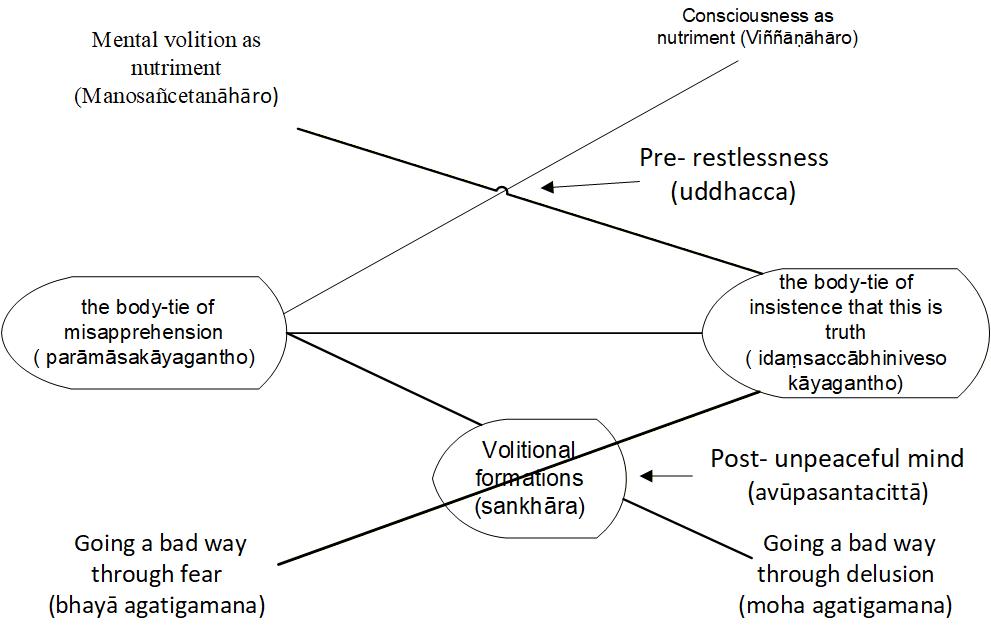
The first point added in the 19/12/2025 Nibbana meditation was investigated again. It was investigated together with page 7 of the ‘Fear and Terror’ (bhaya-bherava) diagrams.
Unpeaceful mind (avūpasantacittā). In a mind that had form (rupa) contact, there is the sick (byādhi) nature due to aging (jara). If one does not accept ageing, one cannot prevent sickness (byādhi). We discussed that, when this happens, the objective is to seek up to the eighth jhana again. Gets established therein. Occurrence of producing volitional formations (saṅkhāra) dependent on ignorance (avijja) - craving (tanha), cannot be stopped. We know hostility (upanāha) is stemming from an unpeaceful mind (avūpasantacittā) and disparaging (paḷāsa) is stemming from hostility (upanāha). Investigating with the diagram given in the 19/12/2025 Nibbana meditation, the doctrines represented by disparaging (paḷāsa) are marked therein.
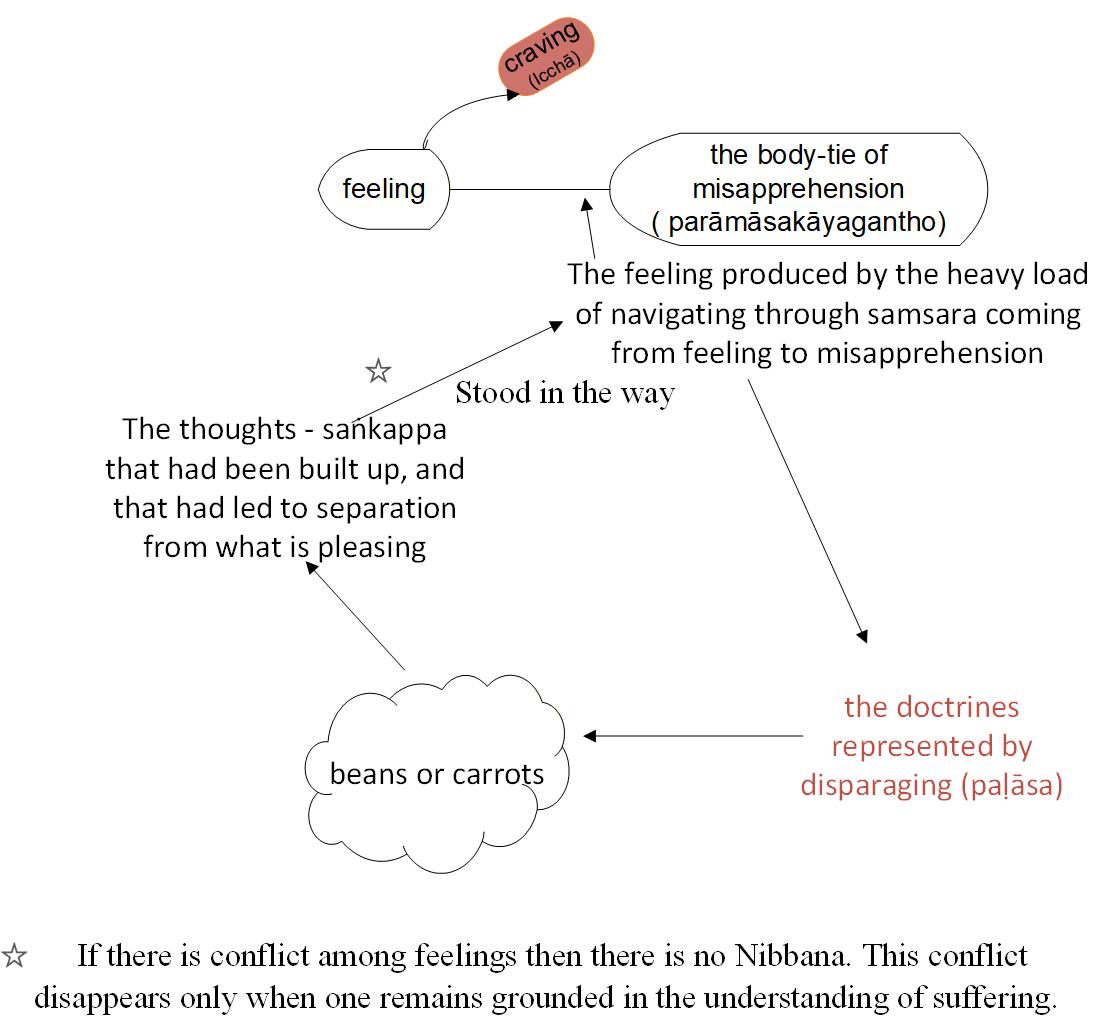
Investigating what is included in the dhamma represented by disparaging (paḷāsa), since derogation (makkha) leads to the arising of disparaging, if there is a certain deficiency in the derogation then that is included in the dhamma represented by disparaging. What deficiency? The deficiency of thinking ‘it exists’, when taking something apart from Nibbana as mine. This is the main point included in the doctrines represented by disparaging (paḷāsa).
Furthermore, the dhamma from the unpeaceful mind (avūpasantacittā) entering disparaging (paḷāsa) via hostility (upanāha) remain present there. That is, although the volitional formations (sankhāras) are fragile, the bound perceptions arising because we take things as permanent are included. From these two types of doctrines, searching for dhamma leading up to the eighth jhāna takes place. Nibbana is neglected.
The dhamma points are clearly understood when inquiring together with the diagram given in the 19/12/2025 Nibbana meditation. That is, beginning with distinguishing between beans and carrots, though we search for the thoughts (saṅkappa) that had been built up, and that had led to separation from what is pleasing (piyehi vippayogo), they will not be found. Why is it so? Because hostility (upanāha) itself stands in its way. Thereby, conflict arises among feelings. This conflict disappears only when one remains grounded in the understanding of suffering (dukkha).
This is the meditation I did.
If I am to add a little more to this,
1) It is appropriate to do this meditation after recalling the doctrine of the two buttocks. Remembering the deficiency of thinking ‘it exists’, when taking something apart from Nibbana as mine, the mind expands greatly. Furthermore, when I was asked to stop the meditation and when stopping it, it was understood that completion of the meditation occurred while in the mind made body and when expressing gratitude afterwards, the mind made body remained as such for about three minutes.
2) The doctrine of the two buttocks and the third doctrine that prepares the ground for the emergence of those doctrines are examined here. That is, craving arising from feeling, and volitions (cetanā) arising from doctrines represented by craving, those volitions become grounded in ‘insistence that this is truth’ (idamsacca) through the faculty of life (jivita-indriya), without a sense of pleasure (sukha), notions have accumulated that lead to values of volitional formation (saṅkhāra), volitional formations determined by the volition are then carried out. That is, one has been made a fool and what remains to be done are only volitional formations conditioned by ignorance.
3) Someone with an unpeaceful mind (avūpasanthacittā) searching for other doctrines in this manner, thus it is inquired how does this happen. Examples for the two given facts, namely the deficiency of the thinking that ‘it exists’ and for the bound perceptions arising by taking things as permanent, one abiding in the first jhāna while still possessing form, attain the formless jhāna because someone praises it as good, such a person has the deficiency of non-existence of the previously experienced form values. Because one can dwell in the formless jhāna planes for long periods of time, there are bound perceptions due to taking things as permanent. (*1)
4) Unpeaceful mind (avūpasantacittā). In a mind that had form (rupa) contact, there is the sickness (byādhi) nature due to ageing (jara). If one does not accept ageing, one cannot prevent sickness (byādhi). When we are sick, we take medicines to get back the strength we used to have. That means the former strength - from this birth to all the previous births. The highest strength is at 8th Jhana level.
This is what I have to add.
Discussion 03/01/2026
Foot Notes added after the discussion
(*1) Another example is, leaving the jackfruit in Sri Lanka behind and going abroad. Going abroad thinking ‘exists’. After leaving, there is no jackfruit. That means there is a deficiency.