The Noble Council of Akanittha Brahma Realm was remembered with faith.
The fourth point added in the 26/12/025 Nibbana meditation was examined again. Unpeaceful mind (avūpasantacittā). In a mind that had form (rupa) contact, there is the sick (byādhi) nature due to ageing (jara). If one does not accept ageing, one cannot prevent sickness (byādhi). When we are sick, we take medicines to get back the strength we used to have. That means the former strength, the strength from this birth to all the previous births. The highest strength is at 8th Jhana level.
In the 03/02/2023 Ahara sutta – Passaddhi meditation, we discussed how do we know all jhäna planes are sick. If one knows ageing (jara), then one knows there is sickness (byādhi). That is, the ageing (jara) we discerned in bodily seclusion, helps us in discerning all jhäna planes are sick. Why is so? Because if a mind-made body (manomaya kāya) came to arise, it happened in relation to form (rupa), by contemplating on 1 Physical nutriment, 2 From self to permanent, 3 Going from birth to ageing. For one who knows and sees that the mind-made body (manomaya kāya) which arose in relation to the discarded form, is dependent on the form (Physical nutriment) itself, one would understand all jhäna levels are sick.
Furthermore, we know from the 28/04/2023 jara sutta meditation, for a being born in Brahma realms who comes into contact with perceptions (saññā) from a lower jhāna plane, this is their sickness (vyādhi). Due to contact with such perceptions, a nature of sloth and torpor (thinamiddha) 6.4 occurs. We have learned that 6.4 is the sickness of perception (saññā byādhi), the delight (nandi) value has arrived surpassing feeling (vedanā).
Thus, the ageing of perception is the characteristic of ageing for beings born in the Brahma realms. It is thought that signs have appeared indicating for non-existence there. Thus, due to the shattering of views (diṭṭhi) and the subsequent pursuit of perceptions that are not of that nature, one wanders through samsara.
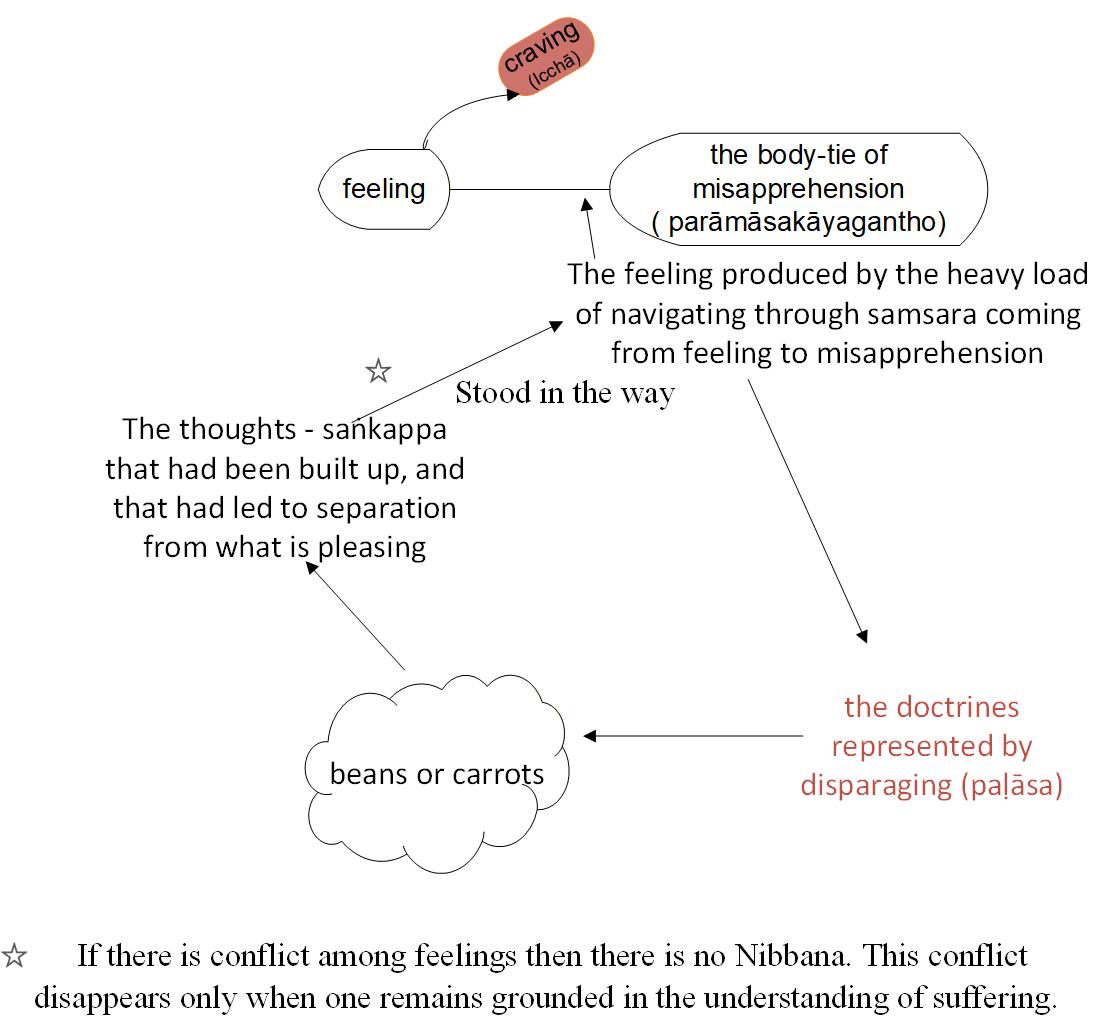
Investigating thus, even if the highest strength existed in the eighth jhāna, even there, the ageing of perception is still present. There is no other. There is only conflict among the feelings. What is investigating here are those feelings resulted from the heavy load (burden) of navigating through samsara. The thoughts - saṅkappa that had been built up, and that had led to separation from what is pleasing (piyehi vippayogo), stood in its way. That is, as we learned earlier, the mental formations (citta-saṅkhāra) that praised a certain doctrine as beneficial are those that exert influence.
These doctrines are clearly understood when investigating together with 6.4 - sickness of perception (saññā byādhi), delight (nandi) value has arrived surpassing feeling (vedanā). Investigating as in “the perception of pleasure has the characteristic of going to the contact affected by the taints”, a person with [conceit] ‘I am’ (asmiti), use delight (nandi) in order to maintain that very nature of [conceit] ‘I am’ (asmiti). This is so. Thus, with the arrival of delight (nandi) value surpassing all feelings Nibbana is not possible. Knowing this, one should, with wisdom, eliminate conflict between feelings and one should have Nibbana as object and only Nibbana as goal. (*1)
This is the meditation I did.
If I am to add a little more to this,
1. Along with the doctrines of this meditation, 60% of the Tathāgata’s Dhamma has been re-established.
2. On investigating that If one does not accept ageing, one cannot prevent sickness (byādhi), it was understood that we do not know ageing, excellent was heard. My mind was directed to the path of the straying mind (vibbhantacittā). This path is clearly understood if we use separation from what is pleasing (piyehi vippayogo) instead of ageing (jara). That is; separation from what is pleasing (piyehi vippayogo dukkho), birth (jāti), feeling (vedanā), volition (cetanā), from self (attā) to permanence (nicca), going a bad way through delusion (mohā agatigamana), through underlying tendency to lust for sensual desire (kāmarāganusaya) to perception (saññā). Thus, it is seeing that, starting from separation from what is pleasing (piyehi vippayogo dukkho) one travels to perception of pleasure (sukha saññā), due to delusion (moha).
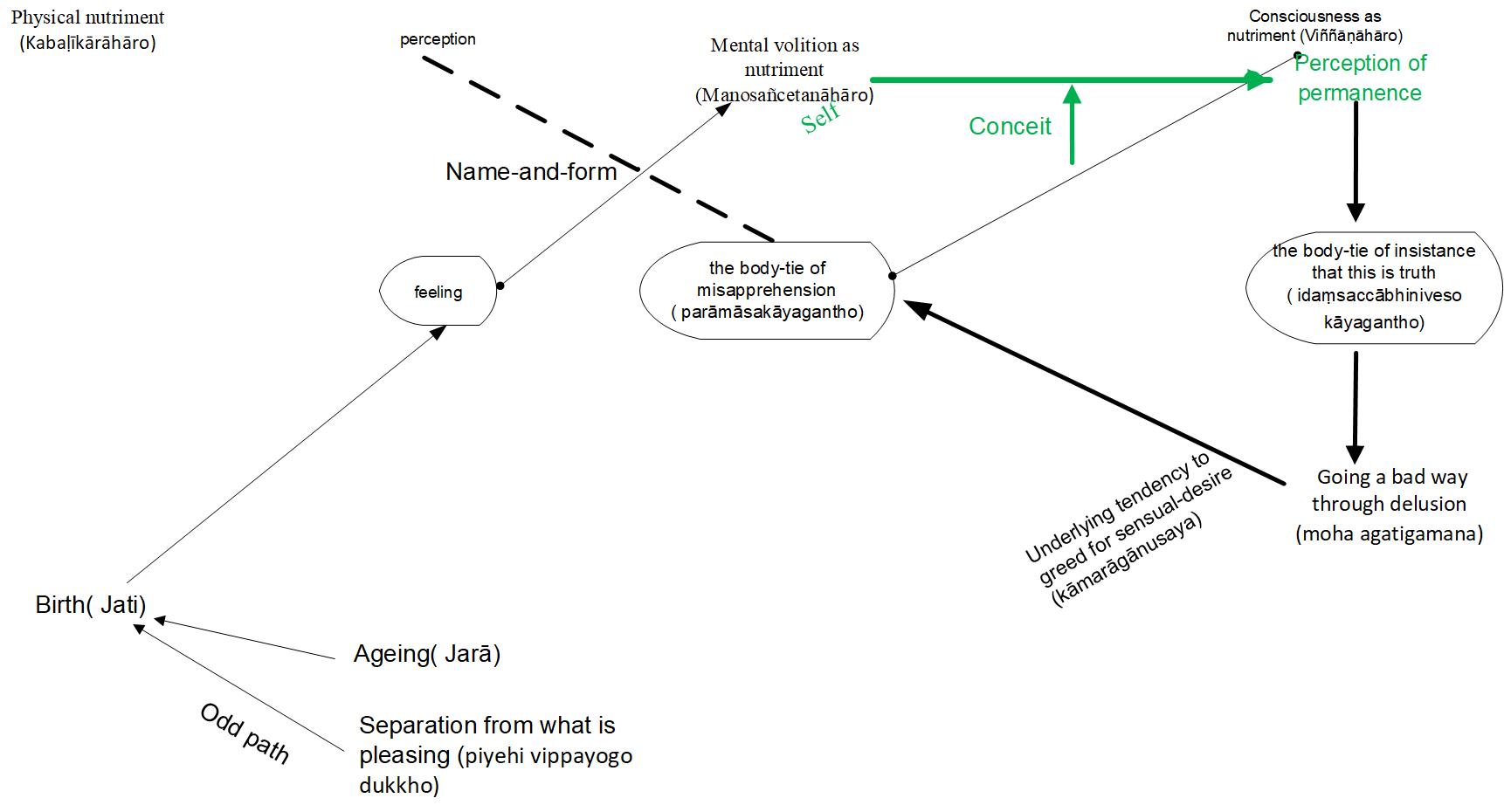
We know that for a being born in Brahma realms who comes into contact with perceptions (saññā) from a lower jhāna plane, this is their sickness (vyādhi). That is, when perception of pleasure (sukha saññā) emerges at some point in time, it is taken as a sickness (vyādhi). Thus, it is understood that one is progressing to the eighth jhāna.
3. It is also understood that “Monks, you have sought the grave”. We seek only dead pleasures. Seeking what is deceased, is seeking the grave. A star appeared near the volition (cetanā). Here, faculties of mindfulness (sati) and concentration (samādhi), together with the faculty of wisdom (paññā), felt clearly.
4. At the end of this meditation, expressing my gratitude, all fourteen Great Arahants (Budu Piyawaru) were present, there was no change in mind, the only thought in my mind was that seeking pleasure is akin to seeking the grave.
5. It is understood that the feelings arising from the heavy load (burden) of navigating through samsara are recognized through the perception afflicted by sickness. ‘Excellent’ was heard. Pondering in this way, this doctrine was comprehended furthermore. One who has ‘sick perception’, seeks for something that is without sickness. Furthermore while repairing, recalling that lamented volitional formations (saṅkhāra) say that perception is pleasurable, considering we are seeking something pleasurable from something that is dead, it is well understood that all who have not ended taints (āsavas), are mentally sick.
6. 5.3 - the ageing (jara) of perception (saññā), the perception that was taken as permanent (nicca) has changed. 4.7 - separation from what is pleasing (piyehi vippayogo). Separation from the baby type body. The desire to bring something back into existence after it has died. Investigating thus, the sickness (byādhi) of perception 6.4, the value of delight (nandi) that has arrived surpassing feeling is also clearly understood. That is, having gone beyond whatever feelings arise from the presently existing meditative absorption, having become separated from the baby type body, the desire to exist in such a form comes to the fore. Thus, one who is formless seeks form. One who is with the form seeks the formless.
This is what I have to add.
Discussion 17/01/2026
Foot note added after the discussion
(*1) In other words, one can visualise the feelings (vedanā) resulted from the heavy load (burden) of navigating through samsara forms a 'river,' and afterwards this river is [the conceit] ‘I am’ (asmiṭī). So, delight (nandi) refers to the act of maintaining the river.