The Noble Council of Akanitta Brahma Realm was remembered with faith.
The 6th point added in the 02/01/2026 Nibbana meditation was investigated again. 5.3 - the ageing (jara) of perception (saññā), the perception that was perceived as permanent (nicca) has changed. 4.7 - separation from what is pleasing (piyehi vippayogo). Separation from the baby type body. The desire to exist in such a form. Delight - the desire to bring something back into existence after it has died. Investigating thus, the sickness (byādhi) of perception 6.4, the value of delight (nandi) that has arrived surpassing feeling is clearly understood. That is, having gone beyond whatever feelings arise from the presently existing meditative absorption and having become separated from the baby type body, the desire to exist in such a form comes to the fore. Thus, one who is formless seeks form. One who is with the form seeks the formless. Investigating in this manner gives rise to a sense of shame. That is arising of sense of shame (hiri) and fear of wrongdoing (ottappa). With this, the knowledge-path came to mind. In this manner becoming wise, knowing and seeing that throughout samsara one has searched only doctrines that have perished, train by way of the knowledge- path occurs. Here, use the path of Mandaladhipathi Budu Piya given in page 3 of the Ayatana 2 diagrams.
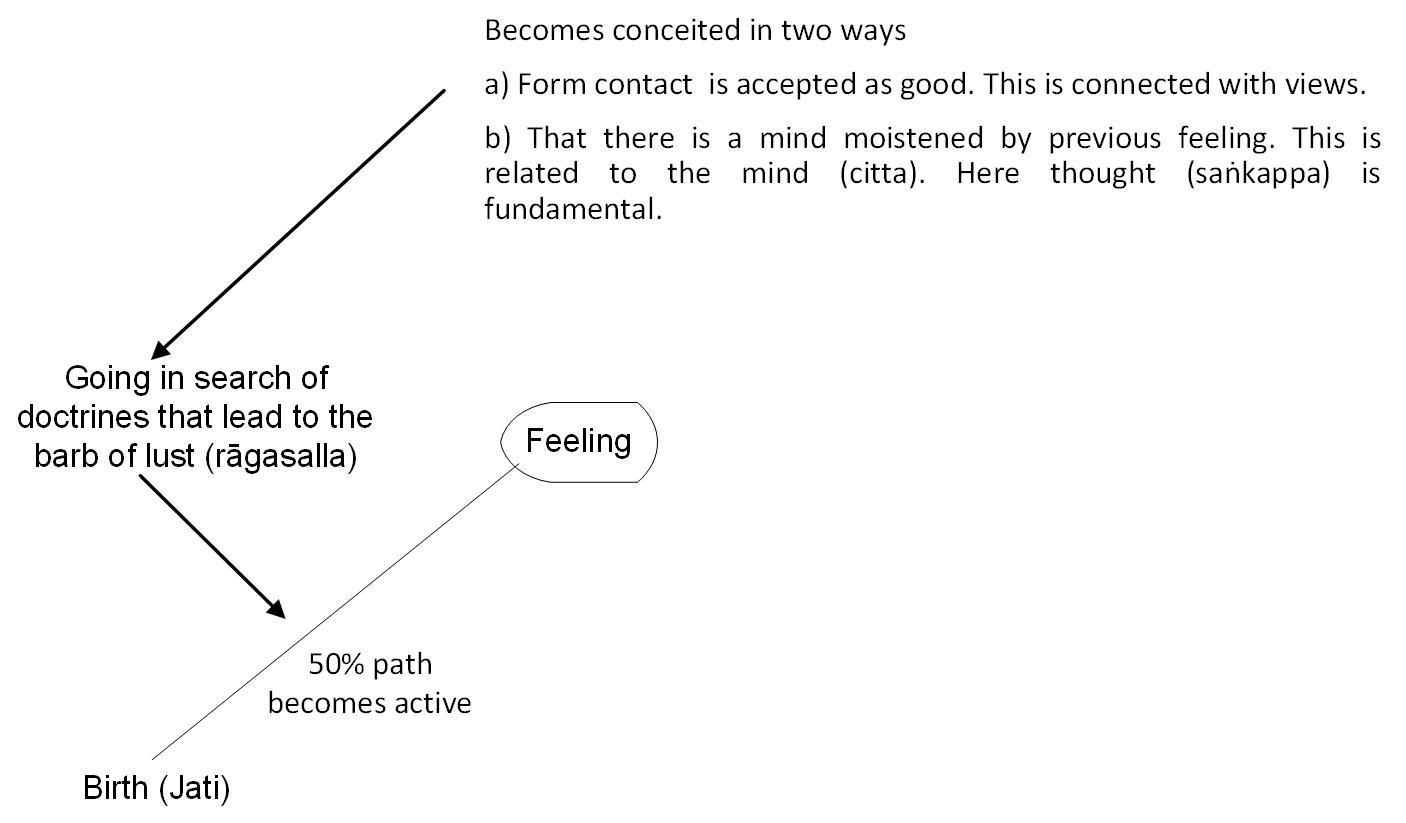
The cessation of covetousness (abhijjhā) and sadness (domanassa) was investigated there. How does sadness come to arise after covetousness? Having seen form ( rupa), we spin two rounds. The first round is due to the taint of ignorance (avijjāsava). This creates area 2 - memories and intentions (sarasaṅkappā). Investigate this with arriving at the 50% path from not occurring of mental fixity, along with volitional formations conditioned by ignorance (avijjā-paccayā saṅkhārā). Round two is due to conceit (mana). This creates area 1. Investigate this with Diagram 1 given in the 28/11/2025 Jati 2 meditation.
Due to conceit arising in two ways, going in search of doctrines that lead to the barb of lust (rāgasalla) is marked there. When going in search of doctrines that lead to the barb of lust (rāgasalla) occurs, the arising of area 1 could not be prevented.
Observe the two triangles in the path of Mandaladhipathi Budu Piya.
Path A is due to right view (sammā-diṭṭhi). The effort shown here is the first effort. What is renunciation (nekkhamma) for? To eliminate covetousness (abhijjhā). This should remain consistent throughout path A. In Diagram 1 given in the 28/11/2025 Jati 2 meditation, when recalling the doctrine that form contact is accepted as good and this is connected with views (diṭṭhi), one must realise its danger.
This should be understood in the same way that one sees a pile of fire ? and does not attempt to touch it.
Path B is due to wisdom (paññā). In page 2 of the Ayatana diagrams, we learned that sadness (domanassa) come to arise if there is covetousness (abhijjhā). Knowing this, one became discerning (nipaka). One recalls the other buttock when remembering this part of the dhamma, one should understand the danger of the mind failing to settle on the thought of suffering if mental fixity (appanā) is absent. Cessation of sadness (domanassa) is now known. Understanding thus, that is knowing passing away phenomenon, wisdom (paññā) will go inside the body tie of misapprehension (parāmāsa-kāyagantha). Subsequently knowing Nibbana is outside of this, withdrawal of wisdom (paññā) from the body tie of misapprehension (parāmāsa-kāyagantha) happens. This is the highest equanimity (uppekha). When such equanimity (upekkhā) is present, one who is formless seeks form, one who is with form seeks the formless does not apply. Thus, if there is sense of shame (hiri) and fear of wrongdoing (ottappa), one has Nibbana as object and only Nibbana as goal.
This is the meditation I did.
If I am to add a little more,
1. Practising this meditation, with the arising of liberation of mind by appreciative joy (muditācetovimutti) initially, and thereafter with the arising of liberation by wisdom (paññā-vimutti), when recalling ‘wisdom’ withdraws from the body-tie of misapprehension (parāmāsa-kāyagantha), that is the removal of stinginess regarding doctrines (dhamma-macchariya) too, the immeasurable state of equanimity (upekkhā appamāṇa) arises and remains unshaken. The mind does not settle anywhere.
This is what I have to add.
Discussion 17/01/2026
Notes added after the discussion
If I am to clarify this a bit more, knowing Nibbana is outside of this, withdrawal of wisdom (paññā) from the body tie of misapprehension (parāmāsa-kāyagantha) occurs through the relinquishment of the notion “I abide in the liberation by wisdom (paññā-vimutti)” or “I abide in the liberation of the mind (cetovimutti)”.
This is what I have to add.